Oxidation is one of the most important processes in tea production. It plays a major role in determining the flavor, aroma, color, and character of different teas.
Although all traditional teas come from the same plant, Camellia sinensis, the way tea leaves are processed after harvesting creates dramatic differences between tea types.
The key factor behind these differences is oxidation.
For example:
- Green tea undergoes very little oxidation
- Oolong tea is partially oxidized
- Black tea is fully oxidized
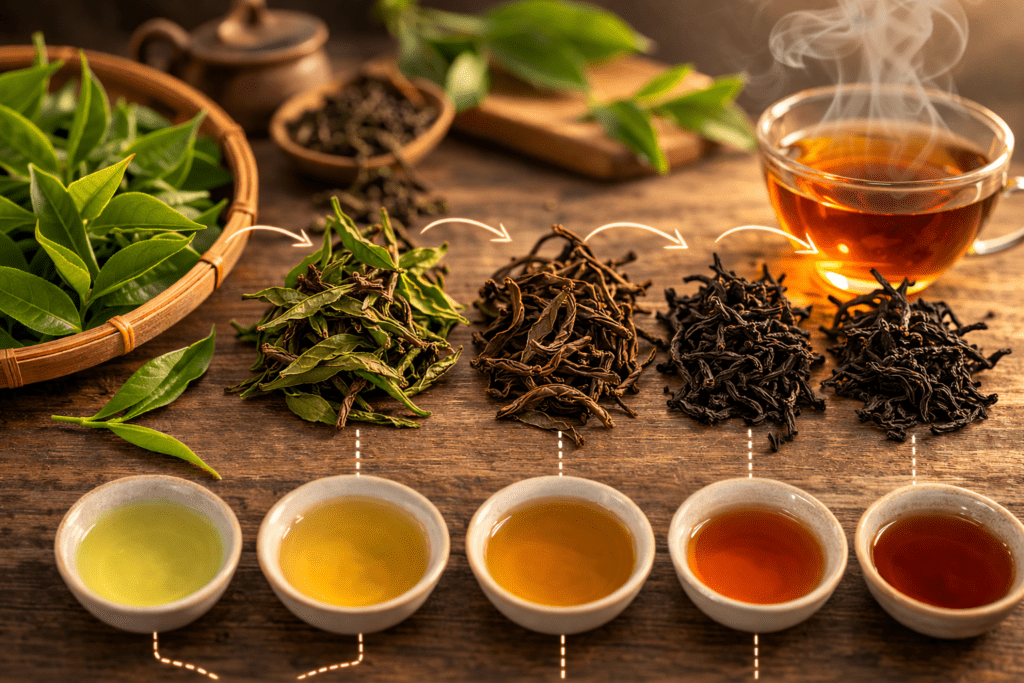
Because of oxidation, tea leaves can transform from bright green leaves into dark brown leaves with completely different flavor profiles.
Understanding tea oxidation helps explain why teas taste so different even though they come from the same plant.
What Is Oxidation in Tea?
Oxidation is a natural chemical reaction that occurs when tea leaves are exposed to oxygen.
When tea leaves are damaged through rolling or bruising, enzymes inside the leaves begin reacting with oxygen in the air.
This reaction gradually changes the leaf’s chemical structure.
During oxidation:
- the color of the leaves darkens
- new aroma compounds form
- flavor becomes richer and more complex
This process is similar to how a sliced apple turns brown when exposed to air.
Tea oxidation is carefully controlled by tea producers to achieve specific flavor profiles.
Why Oxidation Matters in Tea Production
Oxidation determines many of the characteristics we associate with tea.
These include:
Flavor
Low oxidation produces lighter flavors, while higher oxidation creates stronger and deeper tastes.
Aroma
Oxidation forms aromatic compounds that give tea fruity, floral, or malty notes.
Color
Oxidation also changes the color of both the leaves and the brewed tea.
For example:
- green tea produces pale green liquor
- black tea produces dark amber liquor
Without oxidation, many teas would taste very similar.
Oxidation Levels in Different Types of Tea
Different teas are produced by controlling how long oxidation occurs.
| Tea Type | Oxidation Level |
|---|---|
| White tea | very low |
| Green tea | minimal |
| Oolong tea | partial |
| Black tea | full |
Each level of oxidation creates a unique tea style.
Green tea
Green tea is quickly heated after harvest to stop oxidation.
This preserves:
- fresh flavor
- green color
- vegetal aroma
Oolong tea
Oolong tea is partially oxidized, usually between 10% and 80%.
This allows tea makers to create a wide range of flavor styles.
Black tea
Black tea is fully oxidized.
This produces bold flavors such as:
- malt
- caramel
- dried fruit
How Tea Oxidation Happens
Oxidation occurs through several steps in tea processing.
1. Withering
Fresh leaves lose moisture and become softer.
2. Rolling
Rolling breaks the cell walls of the leaves, releasing enzymes and juices.
3. Oxygen exposure
The damaged leaves react with oxygen in the air.
4. Oxidation control
Tea producers carefully monitor time, temperature, and humidity.
When the desired oxidation level is reached, the process is stopped by heating the leaves.
How Oxidation Changes Tea Flavor
During oxidation, chemical compounds inside tea leaves transform into new molecules.
Two important groups of compounds form:
Theaflavins
These contribute to:
- brightness
- briskness
- golden color
Thearubigins
These compounds create:
- darker color
- deeper body
- richer flavor
These chemical changes explain why black tea tastes so different from green tea.
Oxidation vs Fermentation in Tea
Many people confuse oxidation with fermentation, but they are not the same process.
Oxidation
- chemical reaction with oxygen
- controlled during tea processing
- responsible for flavor development
Fermentation
- microbial process involving bacteria and fungi
- occurs in teas such as pu-erh tea
Although the two processes are sometimes confused, they involve different biological mechanisms.
How Tea Makers Control Oxidation
Tea producers carefully manage oxidation to create specific tea styles.
Factors that influence oxidation include:
- leaf bruising
- temperature
- humidity
- air exposure time
Highly skilled tea makers can adjust these variables to produce teas with very specific flavor characteristics.
This control over oxidation is part of what makes tea production both a science and an art.
Final Thoughts
Oxidation is one of the most important processes in tea production. It transforms fresh tea leaves into a wide variety of tea styles with distinct flavors and aromas.
By controlling oxidation levels, tea makers create the diverse world of tea we enjoy today, from light green teas to rich black teas.
Understanding oxidation provides valuable insight into how tea is crafted and why different teas taste so unique.