Why This Question Matters More Than You Think
You walk into a room.
Nothing is obviously wrong.
The furniture looks fine. The lighting is okay. Everything is… normal.
But something feels off.
You can’t relax.
Your thoughts feel slightly scattered.
Your body doesn’t fully settle.
Then you enter another space.
And immediately—
you breathe differently.
Your shoulders drop.
Your mind quiets.
You feel… at ease.
What changed?
Not you.
👉 The space.
And that’s where Feng Shui begins.
Not as decoration. Not as superstition.
But as a subtle system that shapes how you feel—without you even realizing it.
So when people ask:
👉 What is Feng Shui?
They’re really asking:
👉 Why do some spaces feel right… and others don’t?
This guide will take you all the way in.
If you’re new, this is your starting point → feng shui for beginners
What Is Feng Shui? (Simple Explanation)
At its core, Feng Shui is:
👉 The art of arranging your environment to support balance, flow, and well-being
The term “Feng Shui” literally means:
- Feng (风) → wind
- Shui (水) → water
Both represent movement.
Flow.
Change.
In practice, Feng Shui is about how energy (Qi) moves through a space—and how that movement affects you.
It focuses on:
- Layout
- Direction
- Objects
- Light
- Space
But beneath all of that—
it’s about one thing:
👉 How your environment shapes your inner state
Feng Shui Is Not What Most People Think
Let’s clear something up.
Feng Shui is NOT:
- Just moving furniture randomly
- Placing lucky objects everywhere
- Following rigid superstition
- Magical thinking
That’s surface-level.
Real Feng Shui is much deeper.
It is:
- Awareness of space
- Sensitivity to energy
- Understanding of balance
And most importantly:
👉 It is practical.
It’s about creating a space where your body can relax and your mind can settle.
Just like learning to calm your mind, Feng Shui begins with awareness.
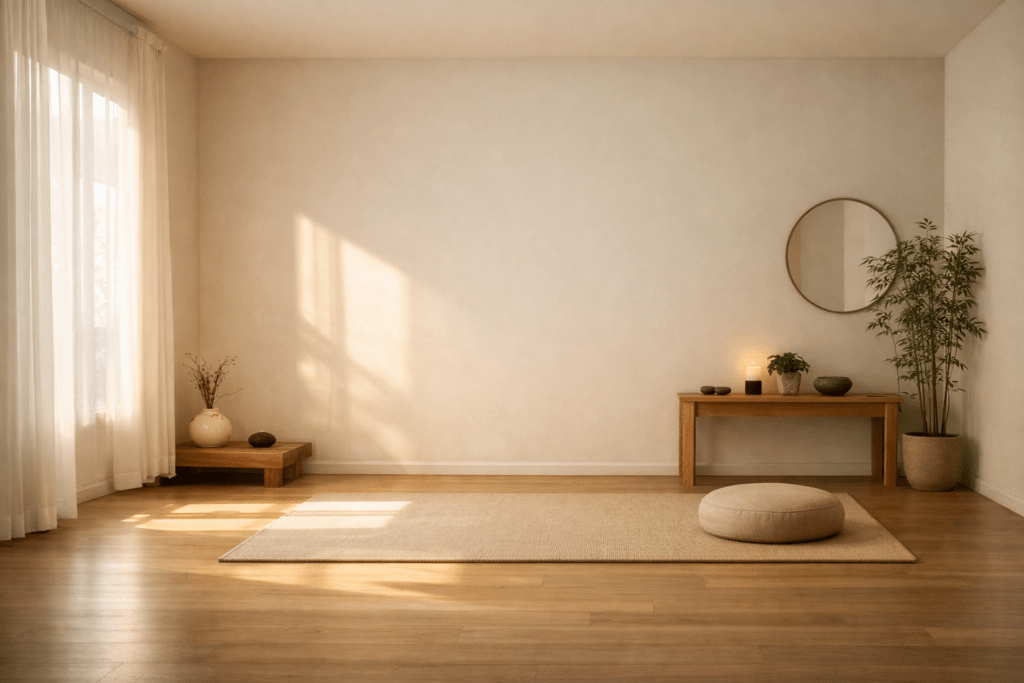
The Core Concept: Qi (Energy Flow)
At the heart of Feng Shui is one word:
👉 Qi (气)
Qi is often translated as “energy,” but it’s more accurate to think of it as:
👉 The quality of movement in a space
Good Qi feels like:
- Smooth
- Calm
- Supportive
- Natural
Bad Qi feels like:
- Stuck
- Chaotic
- Sharp
- Heavy
You’ve experienced both.
Even if you didn’t call it Qi.
Example:
- A cluttered room → heavy Qi
- A clean, open room → flowing Qi
- Harsh lighting → aggressive Qi
- Soft lighting → gentle Qi
Feng Shui simply gives language—and structure—to these experiences.
Why Feng Shui Works (Modern Explanation)
You don’t need to believe in “energy” for Feng Shui to work.
Because modern science explains it in another way:
👉 Your environment constantly affects your nervous system
Your brain is always scanning for:
- Safety
- Order
- Clarity
When your space is:
- Cluttered
- Asymmetrical
- Harsh
Your body stays slightly alert.
When your space is:
- Open
- Balanced
- Soft
Your body relaxes.
👉 Feng Shui is essentially environmental psychology—refined over thousands of years.
If you want to explore this deeper → how space affects your mind
The Three Core Principles of Feng Shui
To understand Feng Shui, you don’t need everything.
Just these three:
1. Flow (Movement of Qi)
Energy should move smoothly.
Not too fast. Not blocked.
Too fast → chaotic
Too slow → stagnant
The goal:
👉 Natural flow
2. Balance (Yin & Yang)
Every space needs balance between:
- Yin → calm, soft, quiet
- Yang → active, bright, dynamic
Too much yang → stress
Too much yin → dullness
Harmony = balance
3. Support (Stability)
Your space should support you physically and emotionally.
Examples:
- Bed against a wall
- Desk with a view of the room
- Clear pathways
Your body feels safe when supported.
And safety leads to calm.
The Five Elements in Feng Shui
Feng Shui uses five natural elements:
- Wood
- Fire
- Earth
- Metal
- Water
Each represents a type of energy.
Wood → Growth
Plants, green tones, vertical shapes
Fire → Energy
Light, warmth, red tones
Earth → Stability
Neutral colors, flat surfaces
Metal → Clarity
White, metallic objects
Water → Flow
Mirrors, glass, dark tones
The goal is not to include everything.
But to create a balanced interaction.
Too much of one element can create imbalance.
If you want a full breakdown → feng shui elements explained
How Feng Shui Applies to Your Home
Feng Shui is not abstract.
It shows up in very real ways.
Your Bedroom
Affects:
- Sleep
- Emotional state
- Relationships
→ feng shui bedroom guide
Your Living Room
Affects:
- Social energy
- Comfort
- Connection
Your Workspace
Affects:
- Focus
- Productivity
- Mental clarity
Your Entrance
Affects:
- First impression
- Energy entering your home
Every space has a role.
And each one influences you differently.

Common Feng Shui Mistakes Beginners Make
If Feng Shui hasn’t worked for you—
it’s usually one of these:
1. Focusing Only on Objects
Buying crystals or decorations without changing layout.
👉 Feng Shui is about structure, not decoration.
2. Ignoring Clutter
Clutter is the fastest way to block energy.
3. Overcomplicating Everything
You don’t need dozens of rules.
Simple adjustments work best.
4. Expecting Instant Results
Feng Shui works gradually.
Like your nervous system resetting.
If you want to avoid mistakes → common feng shui mistakes
How to Start Feng Shui (Simple Beginner Steps)
Start small.
Step 1: Clear Your Space
Remove what you don’t need.
Step 2: Fix Your Bed or Desk Position
Focus on the most important areas first.
Step 3: Adjust Lighting
Use softer, more natural light.
Step 4: Simplify
Less clutter = more clarity.
Step 5: Notice How You Feel
Feng Shui is not just visual.
It’s experiential.
Feng Shui and Zen: The Same Direction
Feng Shui and Zen come from different traditions.
But they point to the same truth:
👉 Outer space influences inner space
👉 Simplicity leads to clarity
👉 Awareness creates change
A well-designed space supports presence.
And presence supports everything else.
If you want to go deeper → stay present in everyday life
FAQ
What is Feng Shui in simple terms?
Feng Shui is the practice of arranging your environment to create balance, improve energy flow, and support well-being.
Does Feng Shui really work?
Yes. Even without believing in “energy,” the layout, lighting, and organization of a space affect your mood, focus, and stress levels.
What is Qi in Feng Shui?
Qi refers to the flow and quality of energy in a space. Good Qi feels smooth and calming, while poor Qi feels stuck or chaotic.
Is Feng Shui a religion?
No. Feng Shui is not a religion. It is a practical system of environmental design rooted in observation and experience.
What is the most important Feng Shui rule?
The most important rule is to create a space that feels balanced, uncluttered, and supportive.
Final Reflection
Feng Shui is not about perfection.
It’s not about rules.
And it’s not about making your space look “correct.”
It’s about something quieter.
More subtle.
More real.
👉 How your space makes you feel
Because your environment is always speaking to you.
Even when you’re not listening.
So take a moment.
Look around.
Not with judgment—
but with awareness.
What feels heavy?
What feels calm?
And what can you gently change?
You don’t need to transform everything.
Just begin.
One space.
One shift.
One breath.
And slowly—
your environment will start to support the life you want to live.
