Why Tools Confuse Beginners More Than They Should
When most people decide to learn Chinese calligraphy, they don’t start with practice.
They start with tools.
They search:
- “best calligraphy brush”
- “professional ink set”
- “complete calligraphy kit”
And suddenly—
they are overwhelmed.
Dozens of brushes.
Different types of ink.
Paper that all looks the same—but isn’t.
And a quiet assumption begins to form:
👉 “Maybe I need the right tools before I can begin.”
That assumption is one of the biggest mistakes beginners make.
Because the truth is:
👉 tools matter—but not in the way you think
This guide will show you exactly:
- what tools actually do
- what you really need
- what you can safely ignore
So you can start clearly, without confusion.
The Reality: Tools Support Skill — They Don’t Create It
There’s something important to understand early:
A better brush will not fix a bad stroke.
Better paper will not fix poor control.
Expensive ink will not improve your structure.
Tools amplify what you already do.
If your fundamentals are weak—
👉 tools will expose it
If your fundamentals are strong—
👉 tools will enhance it
That’s why beginners often feel frustrated.
They buy better tools—
but nothing improves.
The problem was never the tools.
It was the foundation.
The Four Traditional Tools (The “Four Treasures”)
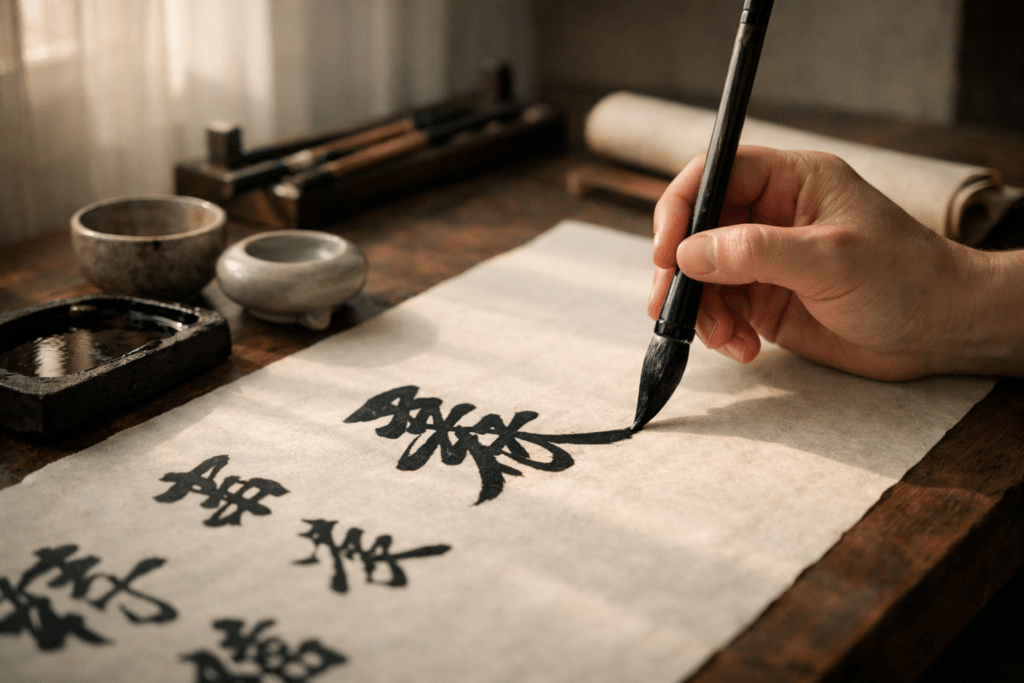
Chinese calligraphy is traditionally built on four core tools:
- Brush (笔)
- Ink (墨)
- Paper (纸)
- Ink Stone (砚)
These are known as:
👉 “The Four Treasures of the Study”
Each one plays a specific role.
But not all are equally important for beginners.
1. The Brush: The Most Important Tool You Will Use
If there is one tool that truly matters—
it is the brush.
Because the brush is not just a tool.
👉 it is the interface between your intention and the paper
What Makes a Calligraphy Brush Unique
Unlike a pen:
- it is soft
- it changes shape
- it responds to pressure
This means:
Every movement you make—
is visible.
Key Characteristics of a Brush
A brush has three essential qualities:
1. Elasticity
How well it returns to shape after pressure.
2. Point (Tip Sharpness)
A good brush forms a fine point when wet.
3. Ink Retention
How much ink it can hold.
These determine how controllable the brush feels.
Types of Brushes (Simplified for Beginners)
You will often hear:
- soft brush (羊毫)
- hard brush (狼毫)
- mixed brush
For beginners:
👉 Use a medium or mixed brush
Why?
- soft brush → too hard to control
- hard brush → too rigid
A mixed brush gives balance.
Size Matters More Than You Think
Beginners often choose very small brushes.
That’s a mistake.
👉 A medium-sized brush is best
Because:
- it forces proper movement
- it prevents over-tight control
The Real Skill: Not the Brush — But Control
Even with a perfect brush:
If you grip too tightly
If your pressure is inconsistent
If your movement is unstable
👉 the result will still be poor
The brush reveals your habits.
It does not hide them.
2. Ink: Simpler Than It Looks
Ink seems complex.
But for beginners—
it’s actually very simple.
Two Main Types of Ink
1. Liquid Ink
- ready to use
- consistent
- beginner-friendly
2. Ink Stick (Traditional)
- requires grinding
- more ritualistic
- more control over density
What Beginners Should Use
👉 Liquid ink
Because:
- it removes friction
- it saves time
- it keeps focus on practice
What Actually Matters About Ink
Not brand.
Not price.
👉 Consistency
You want ink that:
- flows smoothly
- is not too watery
- is not too thick
Common Beginner Mistake
Using very cheap synthetic ink.
This leads to:
- uneven flow
- harsh lines
- poor learning feedback
👉 Use basic but decent ink.
That’s enough.
3. Paper: The Silent Teacher
Paper is often ignored.
But it has a huge impact.
Because paper determines:
👉 how ink behaves
Two Main Categories
1. Practice Paper (Grid Paper)
- has guide lines
- less absorbent
- easier to control
2. Rice Paper (Xuan Paper)
- highly absorbent
- more sensitive
- harder to control
What Beginners Should Use
👉 Grid practice paper
Because:
- it helps structure
- it reduces randomness
- it builds discipline
Why Rice Paper Feels Difficult
On rice paper:
- ink spreads faster
- mistakes are amplified
Which means:
👉 it requires control you don’t yet have
The Transition
Start with practice paper.
Move to rice paper later.
4. Ink Stone: Optional, Not Essential
Ink stones are part of tradition.
But for beginners—
they are not necessary.
What an Ink Stone Does
- used to grind ink stick
- controls ink thickness
Why You Can Skip It
If you use liquid ink:
👉 you don’t need it
When It Becomes Useful
Later, when you:
- care about ink texture
- want ritual
- explore deeper practice
Then it becomes meaningful.
What You Actually Need (Simple Setup)
If you remove all complexity—
this is enough:
👉 1 medium brush
👉 1 bottle of liquid ink
👉 1 stack of grid paper
That’s it.
Not a full kit.
Not expensive tools.
Not multiple brushes.
👉 Just enough to practice correctly
What You Do NOT Need (But Beginners Often Buy)
❌ multiple brush sizes
❌ expensive calligraphy sets
❌ decorative tools
❌ advanced ink materials
These do not help at the beginning.
They distract.
Why Too Many Tools Slow You Down
More tools create:
- decision fatigue
- inconsistency
- distraction
Instead of practicing—
you adjust tools.
Instead of improving—
you experiment endlessly.
👉 Simplicity creates progress
The Real Relationship Between Tools and Skill
Here is the truth most people learn too late:
Tools do not make you better.
They make your current level more visible.
Good tools:
- reveal mistakes more clearly
- require better control
Bad tools:
- create noise
- hide feedback
So the goal is not:
👉 “get the best tools”
The goal is:
👉 “use the right level of tools for your stage”
A Better Way to Think About Tools
Instead of asking:
👉 “What should I buy?”
Ask:
👉 “What helps me practice better?”
At the beginner stage, the answer is always:
👉 simplicity
How Tools Change as You Improve
As your skill grows—
your needs change.
Beginner
- simple tools
- focus on control
Intermediate
- explore brush types
- adjust ink density
Advanced
- refine expression
- choose tools intentionally
But at the beginning—
you are not there yet.
And that’s okay.
FAQ
What tools do I need for Chinese calligraphy?
A brush, ink, and paper are enough to start.
What is the most important tool?
The brush, because it directly affects control and movement.
Should beginners use ink stick or liquid ink?
Liquid ink is better for beginners.
What paper is best for beginners?
Grid practice paper is best.
Do I need a full calligraphy set?
No. A simple setup is more effective.
Final Reflection
Calligraphy looks complex.
But it begins simply.
A brush.
Ink.
Paper.
That’s all.
What matters is not what you hold in your hand.
But how you use it.
And if you keep it simple—
you give yourself something rare:
👉 a clear path forward