Why This Question Matters
Many beginners assume calligraphy is just neat handwriting.
It looks similar at first glance. Both involve writing characters. Both use the hand. Both create visible marks on paper.
But this assumption leads to confusion.
Because calligraphy and handwriting are fundamentally different.
If you approach calligraphy as improved handwriting, progress becomes difficult and frustrating. If you understand the difference clearly, everything becomes easier.
What Is Handwriting
Handwriting is a functional skill.
Its purpose is simple: to communicate information quickly and clearly.
When you write by hand, your goal is efficiency. You want the words to be readable, and you want to write them as fast as possible without losing clarity.
Speed matters. Practicality matters. Consistency matters.
The tools used in handwriting, such as pens or pencils, are designed to support this goal. They produce stable, predictable lines with minimal variation. You do not need to think about pressure, angle, or movement beyond basic control.
Handwriting is about reducing effort while maintaining readability.
What Is Calligraphy
Calligraphy is an expressive practice.
Its purpose is not speed or convenience. It is to create form with intention.
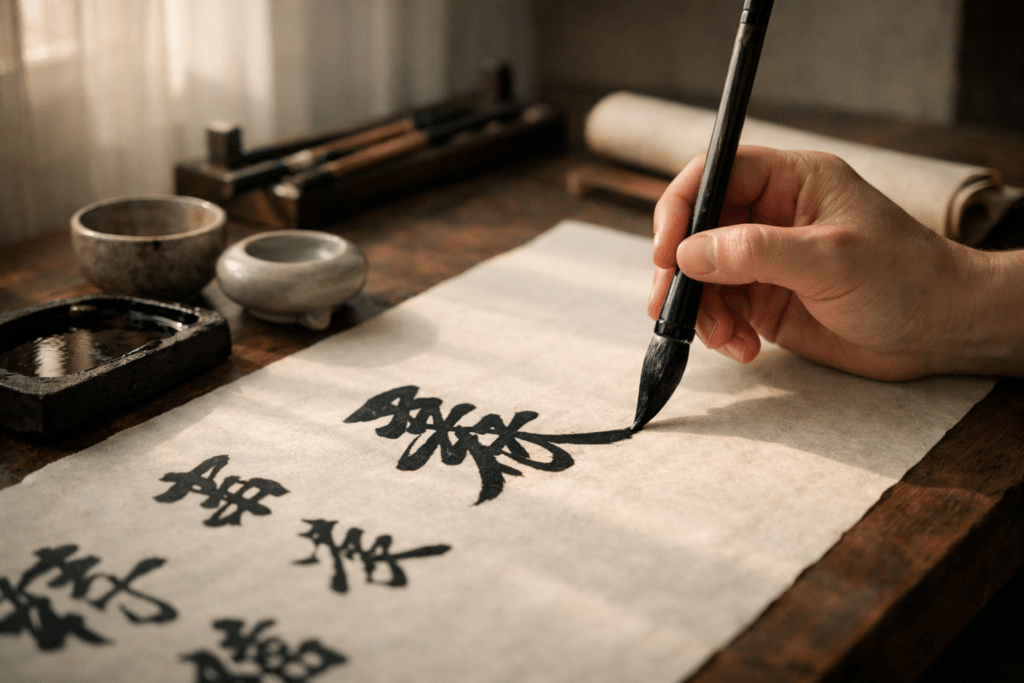
In calligraphy, every stroke matters. The way the brush touches the paper, the pressure applied, the speed of movement, and the transition between strokes all shape the final result.
Calligraphy is not just about writing characters correctly. It is about how those characters are formed.
Where handwriting aims to simplify movement, calligraphy explores it.
Where handwriting minimizes variation, calligraphy depends on it.
Calligraphy is not simply writing better. It is writing differently.
The Core Difference: Function vs Expression
The simplest way to understand the difference is this:
Handwriting is functional.
Calligraphy is expressive.
Handwriting serves communication.
Calligraphy serves form, balance, and presence.
In handwriting, the content matters most.
In calligraphy, the form matters as much as the content.
Speed: Fast vs Slow
Handwriting is designed to be fast.
You write continuously, often without thinking about each individual stroke. The movement becomes automatic over time.
Calligraphy is intentionally slow.
Each stroke is placed with awareness. The movement is deliberate. The pace allows for control and adjustment.
If you try to write calligraphy quickly, the structure collapses. The lines lose clarity. The balance disappears.
Slowness is not a limitation in calligraphy. It is a requirement.
Tools: Pen vs Brush
The difference in tools reflects the difference in purpose.
A pen produces a consistent line. No matter how you move it, the variation is limited. This makes it ideal for fast writing.
A brush is dynamic. It changes shape with pressure and movement. A single stroke can be thick, thin, light, or heavy depending on how it is used.
This sensitivity is what makes calligraphy expressive, but it also makes it harder to control.
The brush does not hide mistakes. It reveals them.
Structure vs Flow
Handwriting relies on habitual patterns. Once learned, the structure becomes automatic. You do not think about how each letter is formed.
Calligraphy requires conscious structure.
Every character has an internal balance. Each stroke relates to the others. The spacing, alignment, and proportion all need attention.
At the same time, calligraphy also involves flow. The movement between strokes must feel natural, not forced.
This combination of structure and flow is what makes calligraphy complex.
Why Beginners Struggle
Many beginners struggle because they try to apply handwriting habits to calligraphy.
They write too fast.
They grip the brush too tightly.
They focus on finishing characters instead of forming strokes.
These habits work in handwriting, but they break calligraphy.
The result is uneven lines, unstable structure, and frustration.
The solution is not more practice in the same way. It is changing how you approach the act of writing.
Movement: Habit vs Awareness
Handwriting is largely unconscious.
Once you learn it, you no longer think about each movement. Your hand follows familiar patterns.
Calligraphy is conscious.
You pay attention to how the brush moves. You observe pressure, direction, and timing. You adjust in real time.
This shift from automatic movement to intentional movement is one of the biggest transitions for beginners.
It is also where most of the learning happens.
Why This Difference Matters
Understanding the difference between calligraphy and handwriting changes how you practice.
If you treat calligraphy like handwriting, you will focus on speed and completion. You will try to make the characters look right quickly.
If you treat calligraphy as its own practice, you will focus on process. You will slow down. You will pay attention to each stroke.
This shift leads to improvement.
Without it, progress remains limited.
Can Handwriting Help Calligraphy
Handwriting can help in small ways. It builds familiarity with characters and basic hand coordination.
But it does not teach stroke control, pressure variation, or structural awareness.
In some cases, strong handwriting habits can even make calligraphy harder to learn because they encourage speed and automatic movement.
To improve in calligraphy, you need to develop new habits, not rely on old ones.
When the Two Overlap
There are situations where the line between calligraphy and handwriting becomes less clear.
For example, in casual writing styles, elements of calligraphy may appear. Some scripts are more fluid and resemble everyday writing.
However, the intention remains different.
Even when the forms look similar, the mindset behind them is not.
Calligraphy always involves awareness and control, even when it appears relaxed.
A Better Way to Think About It
Instead of thinking of calligraphy as better handwriting, think of it as a different language of movement.
Handwriting uses familiar, efficient patterns.
Calligraphy explores variation, balance, and expression.
They share tools and visual similarities, but they operate on different principles.
Once you understand this, learning becomes clearer.
FAQ
Is calligraphy the same as handwriting?
No. Handwriting is functional and focused on speed, while calligraphy is expressive and focused on form.
Why is calligraphy slower than handwriting?
Because it requires controlled, intentional movement for each stroke.
Can good handwriting improve calligraphy?
It can help with basic coordination, but it does not replace the need to learn calligraphy fundamentals.
Why does my calligraphy look stiff?
Because you may be applying handwriting habits like tight grip and fast movement.
Should I unlearn handwriting to learn calligraphy?
Not completely, but you do need to develop a different approach to movement and control.
Final Thought
Handwriting records words.
Calligraphy shapes them.
One is about efficiency.
The other is about presence.
If you understand that difference, your practice changes. You stop rushing. You stop trying to make it look right immediately.
And you begin to see what calligraphy actually is.
It is not just writing.
It is how you move, how you control, and how you pay attention.