Why This Question Matters
At some point, almost everyone who encounters calligraphy asks the same question:
Why should I learn this?
It looks slow.
It looks difficult.
It does not seem practical in a modern world dominated by keyboards and screens.
And yet, something about it feels meaningful.
That feeling is not accidental.
Calligraphy has survived for thousands of years not because it is useful in the conventional sense, but because it offers something most modern activities do not.
To understand why you might learn calligraphy, you need to look beyond utility.
You need to understand what it actually develops.
Calligraphy Is Not Just a Skill
If you approach calligraphy as a skill, you will measure it like one.
You will ask:
How fast can I improve?
How good can I get?
What level can I reach?
These questions are natural, but they are limited.
Calligraphy is not just about producing better writing.
It is about training how you move, how you focus, and how you pay attention.
The visible result is the writing.
The invisible result is what changes inside you.
Training Attention in a Distracted World
One of the most immediate effects of practicing calligraphy is improved focus.
Modern life constantly pulls your attention in different directions. Notifications, information, and interruptions make it difficult to stay present with a single task.
Calligraphy does the opposite.
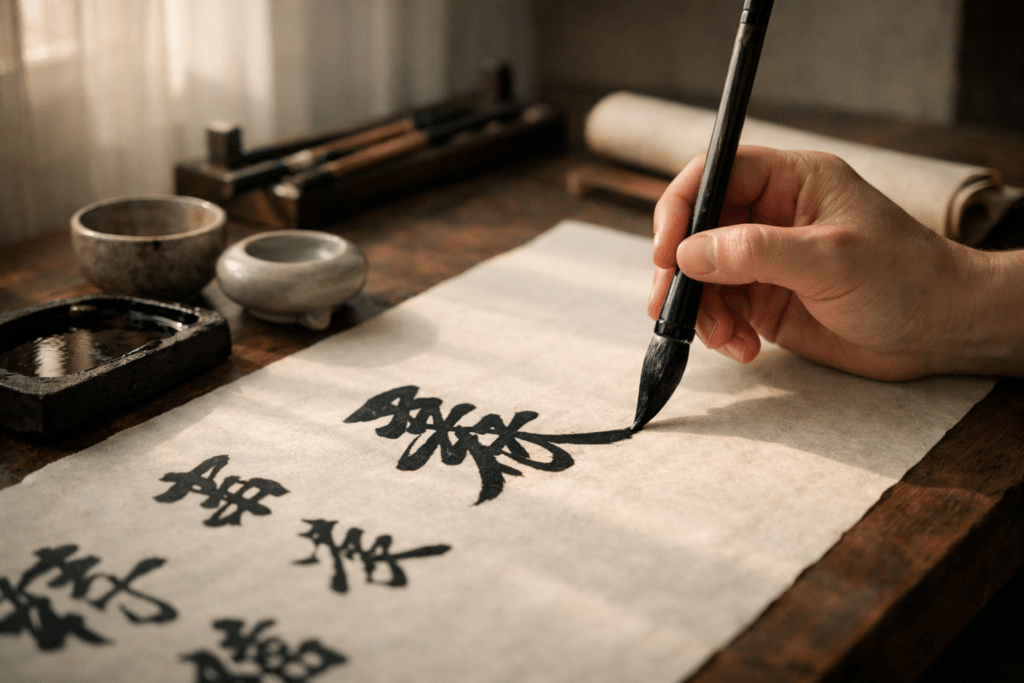
When you write with a brush, you cannot divide your attention. If your focus drifts, the stroke becomes unstable. If your mind wanders, the structure collapses.
The practice forces you to return to the present moment.
Not through effort or discipline alone, but through direct feedback.
Every stroke shows you where your attention is.
Over time, this develops a kind of focus that is calm rather than forced.
You are not concentrating harder.
You are simply not distracted.
Slowing Down Without Resistance
Most people try to slow down by telling themselves to relax.
It rarely works.
The mind continues moving quickly even when the body slows.
Calligraphy creates a different kind of slowing.
Because the brush requires control, your movement naturally becomes slower. Because the ink responds to pressure and speed, you begin to adjust your pace without thinking about it.
This creates a rhythm.
You are not forcing yourself to slow down.
The process itself slows you down.
This is one of the reasons calligraphy feels calming.
Not because it removes thoughts, but because it changes how you move through them.
Developing Control Through Repetition
Calligraphy is built on repetition.
You write the same stroke again and again. You repeat the same structure. You refine the same movement.
At first, this feels monotonous.
But repetition in calligraphy is not mindless.
Each repetition reveals something slightly different.
You begin to notice:
how pressure affects thickness
how speed affects clarity
how small changes in angle affect balance
This awareness builds control.
Not just physical control of the hand, but a deeper understanding of cause and effect.
You see directly how your actions shape the result.
This kind of learning is slow, but it is stable.
Building Patience Without Frustration
Patience is often described as waiting calmly.
In practice, most people experience waiting as frustration.
Calligraphy develops a different kind of patience.
Progress is gradual. Improvement is subtle. Results take time.
But because you are focused on the process rather than the outcome, the waiting does not feel empty.
Each session has value, even if the result is not perfect.
You begin to understand that improvement is not something you chase.
It is something that accumulates.
This changes how you relate to effort.
You are no longer rushing toward a result.
You are building something steadily.
A Different Relationship With Mistakes
In many activities, mistakes are something to avoid.
In calligraphy, mistakes are unavoidable.
The brush records everything.
If your pressure is uneven, it shows.
If your movement is unstable, it appears in the line.
If your structure is off, the entire character reflects it.
This level of transparency can feel uncomfortable at first.
But over time, it becomes useful.
Mistakes are not hidden or delayed.
They are immediate and visible.
This allows you to learn directly from them.
Instead of judging the result, you begin to observe it.
You ask:
What caused this?
What changed in my movement?
This shift from judgment to observation is one of the most valuable aspects of calligraphy.
It creates a more constructive way of improving.
Connecting With a Longer Tradition
Calligraphy is not just a personal practice.
It is part of a long cultural tradition.
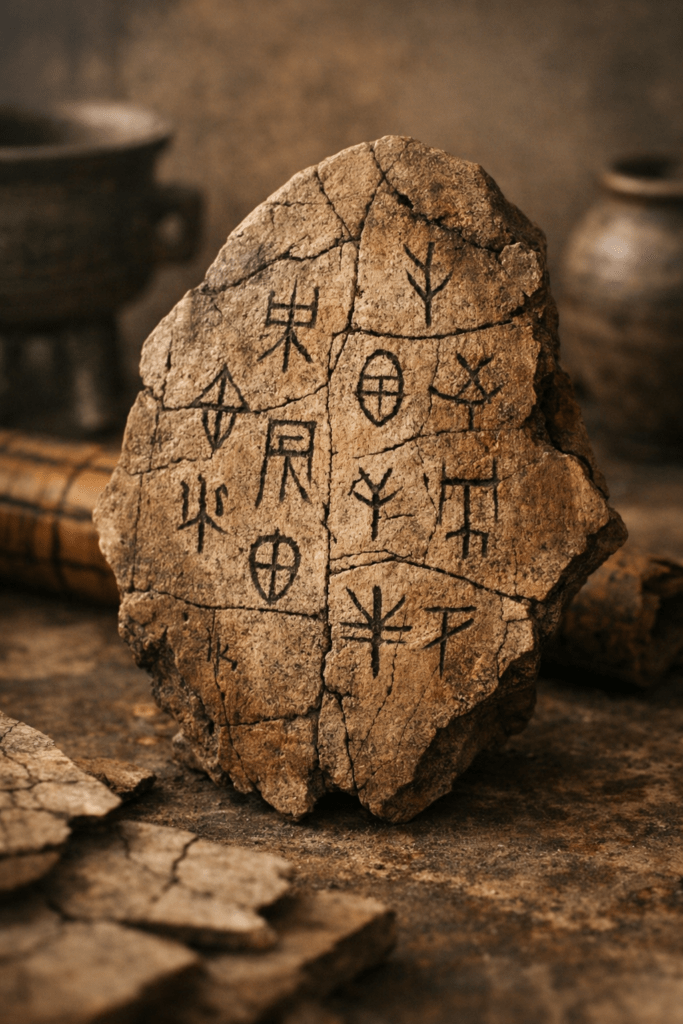
The styles you learn, the strokes you practice, and the structures you follow have been refined over centuries.
When you practice calligraphy, you are not starting from nothing.
You are entering a system that has been developed, studied, and transmitted over time.
This gives your practice context.
You are not just experimenting randomly.
You are learning something that has depth and history.
For some people, this connection adds meaning.
For others, it provides structure.
Either way, it gives the practice a sense of continuity.
Expression Beyond Words
Calligraphy is often associated with expression, but not in the usual sense.
It is not about expressing ideas or emotions directly.
It is about expressing movement.
The way you hold the brush, the way you apply pressure, and the way you transition between strokes all create variation.
Even when writing the same character, different people produce different results.
Over time, your writing begins to reflect your habits.
Not your personality in an abstract sense, but your tendencies in movement and control.
This is a subtle form of expression.
It is not something you force.
It emerges naturally as your practice develops.
Why Calligraphy Still Matters Today
In a world where most writing is digital, calligraphy might seem outdated.
But that is part of its value.
It offers something that is increasingly rare:
a direct connection between your movement and the result.
There is no automation.
No correction tools.
No shortcuts.
What you produce is exactly what you did.
This creates a kind of honesty.
You cannot separate the result from the process.
And in that, there is clarity.
Who Should Learn Calligraphy
Calligraphy is not limited to artists or professionals.
It is suitable for anyone willing to practice with patience.
You do not need talent.
You do not need prior experience.
What you need is willingness to repeat, to observe, and to improve gradually.
If you are looking for something fast or immediately rewarding, calligraphy may feel difficult.
If you are willing to engage with a slower process, it becomes meaningful.
FAQ
Why should I learn calligraphy?
Because it develops focus, control, and awareness while providing a structured and meaningful practice.
Is calligraphy useful in daily life?
Not in a practical sense like typing, but it improves mental clarity and attention.
Is calligraphy hard to learn?
It requires time and repetition, but it is accessible to beginners.
Do I need artistic talent to learn calligraphy?
No. Progress comes from practice, not talent.
How long does it take to see improvement?
Basic improvements can appear within weeks, but deeper control develops over months and years.
Final Thought
You do not learn calligraphy to achieve something quickly.
You learn it to experience a different way of working.
A way that is slower, more deliberate, and more aware.
At the beginning, it feels like you are learning how to write.
Over time, you realize you are learning how to pay attention.
And that is what makes it worth learning.