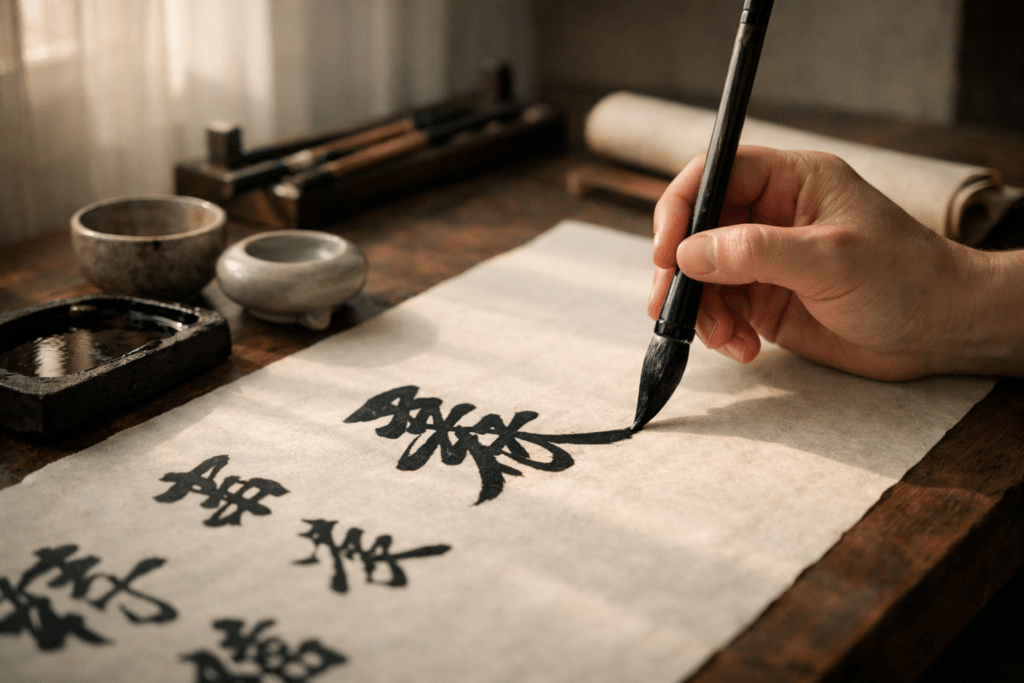
Why Holding the Brush Feels So Difficult at First
One of the first frustrations beginners face is not the stroke itself.
It is the brush.
You pick it up, try to write, and something feels off.
The lines are unstable.
The pressure is inconsistent.
Your hand feels tense or awkward.
And you start wondering:
Am I holding this wrong?
In most cases, the answer is yes—but not in a complicated way.
Holding a calligraphy brush is different from holding a pen.
If you use familiar habits, the brush will not respond correctly.
Learning how to hold the brush properly is one of the most important foundations in calligraphy.
What Makes the Brush Different From a Pen
Before learning how to hold it, you need to understand why the brush is different.
A pen is rigid.
A brush is flexible.
A pen produces a consistent line.
A brush changes with pressure, angle, and movement.
Because of this, the way you hold the brush must allow for variation.
If you hold it like a pen, you limit what it can do.
The goal is not to control the brush tightly.
The goal is to guide it while allowing it to respond naturally.
The Core Principle: Vertical Control
The most important rule in holding a calligraphy brush is this:
👉 keep the brush upright
This means the brush should be vertical, not angled like a pen.
Why this matters:
A vertical brush allows the tip to stay centered.
It creates balanced strokes.
It gives you full control over pressure.
If you tilt the brush too much, the strokes become uneven and harder to control.
Keeping the brush upright is the foundation of all other techniques.
Basic Grip Structure
The grip in calligraphy is often described as controlled but relaxed.
You use multiple fingers to guide the brush, not just one or two.
A simple way to understand the grip:
The thumb and index finger stabilize the brush.
The middle finger supports it from the opposite side.
The ring finger and little finger help balance and control.
The brush rests between your fingers rather than being squeezed tightly.
The grip should feel stable, but not rigid.
You are holding the brush, not forcing it.
Where to Hold the Brush
Another common mistake is holding the brush too close to the tip.
This reduces control and limits movement.
You should hold the brush slightly higher.
This creates more space between your fingers and the paper.
Why this helps:
It allows the brush to move more freely.
It encourages arm movement instead of finger movement.
It improves overall stability.
Holding higher may feel less secure at first, but it leads to better control over time.
The Balance Between Control and Relaxation
A correct grip is not about tight control.
It is about balance.
If you hold too tightly:
Your hand becomes stiff.
Your strokes become rigid.
Your movement becomes restricted.
If you hold too loosely:
You lose control.
The brush becomes unstable.
The ideal grip is:
firm enough to guide
loose enough to move
This balance takes time to develop.
At the beginning, you may switch between too tight and too loose.
With practice, it becomes more natural.
Common Beginner Mistakes
Many problems with brush control come from how the brush is held.
Holding the Brush Like a Pen
This is the most common mistake.
It creates angled strokes and limits pressure control.
Gripping Too Tightly
This leads to stiff lines and quick fatigue.
Holding Too Close to the Tip
This reduces range of motion and makes strokes smaller and less stable.
Ignoring the Role of the Arm
When you rely only on fingers, control becomes inconsistent.
These mistakes are normal, but they need to be corrected early.
How to Adjust Your Grip
Start by holding the brush upright.
Use your thumb, index, and middle fingers to stabilize it.
Let the other fingers support lightly.
Check your tension.
If your hand feels tight, loosen your grip slightly.
If the brush feels unstable, increase control slightly.
Then test with simple strokes.
Focus on how the brush moves, not just how it looks.
Make small adjustments.
Do not try to perfect it immediately.
The Role of the Wrist and Arm
Holding the brush correctly is only part of control.
Movement also matters.
If your grip is correct but your movement is limited, your strokes will still be unstable.
The brush should move as part of a larger system:
fingers guide
wrist adjusts
arm controls
This creates smoother and more consistent strokes.
The grip supports movement.
It does not replace it.
Why It Feels Unnatural at First
A proper brush grip feels unfamiliar because it goes against everyday habits.
You are used to holding pens at an angle.
You are used to writing with your fingers.
Calligraphy requires a different approach.
At first, this creates discomfort.
Your hand may feel awkward.
Your strokes may feel worse before they improve.
This is part of the process.
With repetition, the new grip becomes natural.
How Long It Takes to Get Comfortable
There is no fixed timeline, but most beginners begin to feel more comfortable after consistent practice.
The key is not forcing it.
Practice regularly.
Pay attention to your grip.
Make small adjustments.
Over time, your hand adapts.
Control improves gradually.
Signs You Are Holding the Brush Correctly
You do not need a perfect grip.
But there are signs that you are on the right track.
Your strokes feel more stable.
Your hand feels less tense.
Your movement feels smoother.
You can control pressure more easily.
If these improvements appear, your grip is working.
If not, adjust slightly and continue practicing.
FAQ
How should I hold a calligraphy brush?
Hold it upright with a balanced grip using multiple fingers for control and support.
Why can’t I hold it like a pen?
Because a pen is rigid, while a brush requires vertical control and pressure variation.
How tight should my grip be?
Firm enough to guide the brush, but relaxed enough to allow movement.
Where should I hold the brush?
Slightly above the middle, not too close to the tip.
Why does my hand get tired quickly?
You are likely holding the brush too tightly or using too much finger movement.
Final Thought
Holding the brush is not just a technical detail.
It is the starting point of control.
If your grip is tense, your strokes will be tense.
If your grip is balanced, your movement becomes smoother.
You do not need to get it perfect.
You need to make it workable.
And with time, what feels awkward now becomes natural.
The brush becomes easier to guide.
The movement becomes more fluid.
And everything that follows becomes clearer.