Why Ink Is More Important Than It Looks
At first, ink seems simple.
It is just black liquid on paper.
Something you dip your brush into and use to write.
But very quickly, beginners notice something unexpected.
The same stroke can look completely different depending on the ink.
Sometimes the line is smooth and clear.
Sometimes it spreads too much.
Sometimes it feels dry and broken.
This is when you realize:
👉 ink is not just a material
👉 it is part of the technique
Understanding ink is not about becoming technical.
It is about knowing how it behaves.
Because once you understand that, your control improves naturally.
What Ink Does in Calligraphy
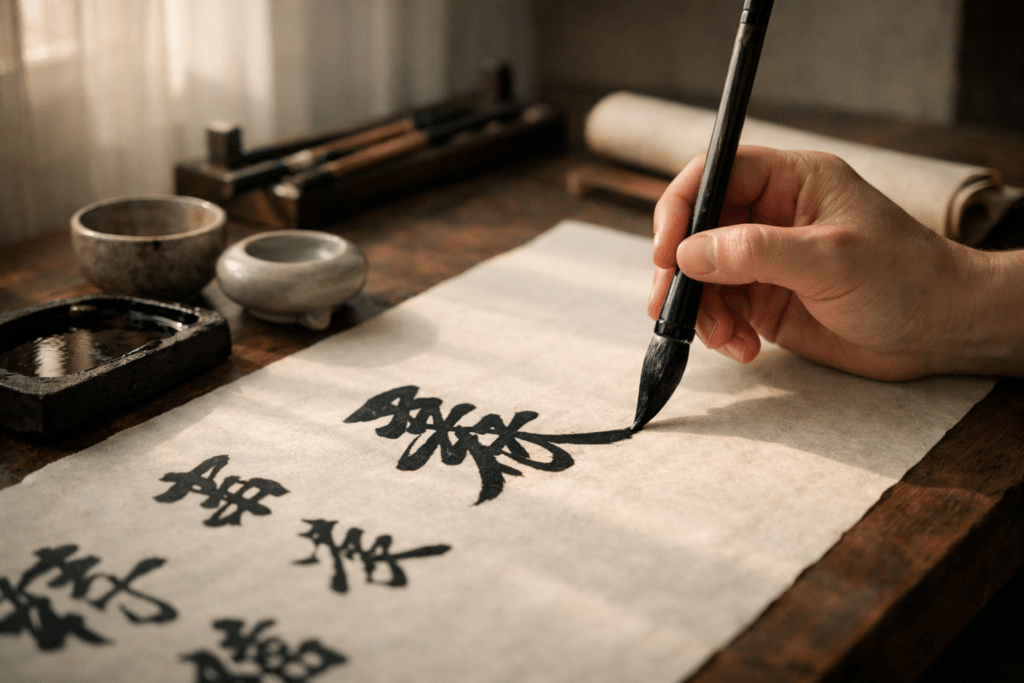
Ink is not passive.
It responds to:
the brush
the paper
your movement
When you write, three elements interact at the same time:
brush movement
ink flow
paper absorption
The result you see is a combination of all three.
If your ink is too thick, the brush feels heavy.
If it is too thin, the stroke becomes weak.
If the paper absorbs too fast, the line spreads.
Ink is the medium that connects everything.
The Two Main Types of Ink
There are two primary types of ink used in Chinese calligraphy.
Liquid ink and ink stick.
Liquid Ink
Liquid ink is ready to use.
You open the bottle and begin.
It is consistent, convenient, and stable.
For beginners, this is the best choice.
It removes unnecessary steps and allows you to focus on practice.
Ink Stick
Ink sticks are traditional.
They require grinding with water on an ink stone.
This process takes time and attention.
It allows you to control the thickness and texture of the ink.
However, it also adds complexity.
For beginners, this can be distracting.
It is better to explore this later, once your fundamentals are stronger.
What Beginners Should Use
Start with liquid ink.
Choose something basic but reliable.
You do not need expensive ink.
You need consistency.
The goal is to remove variables so you can focus on your movement.
As your control improves, you can explore other options.
Understanding Ink Thickness
One of the most important aspects of ink is thickness.
Ink can be:
thick
medium
thin
Each one behaves differently.
Thick Ink
Thick ink creates strong, dark lines.
It feels more controlled.
But it can also feel heavy and less responsive.
Thin Ink
Thin ink flows easily.
It creates lighter, more fluid strokes.
But it can spread quickly and become harder to control.
Medium Ink
Medium ink is balanced.
It provides both control and flow.
This is the best starting point for beginners.
Why Thickness Matters
Ink thickness affects:
how the brush moves
how the line appears
how the paper reacts
If your ink is too thick, your strokes may look stiff.
If it is too thin, your strokes may lose structure.
Finding the right balance helps you understand how your movement affects the result.
Ink and Paper Interaction
Ink does not behave the same on every surface.
Paper plays a major role.
On less absorbent paper, ink stays more controlled.
On absorbent paper, ink spreads quickly.
This is why beginners should use practice paper.
It reduces unpredictability.
It allows you to focus on technique.
When you move to more absorbent paper, you need better control.
The same stroke requires more precision.
Understanding this relationship helps you adjust your approach.
Common Ink Problems
Many beginner issues come from misunderstanding ink.
Ink Spreading Too Much
This usually means:
the ink is too thin
the paper is too absorbent
the brush has too much ink
Solution:
use slightly thicker ink
reduce the amount of ink on the brush
Ink Looks Dry or Broken
This usually means:
the brush does not have enough ink
the ink is too thick
the movement is too slow
Solution:
add a bit more ink
adjust your speed
Uneven Lines
This often comes from inconsistent pressure combined with uneven ink distribution.
Solution:
focus on steady movement
reload the brush more consistently
How to Load the Brush Properly
Ink control is not just about the ink itself.
It is also about how you load the brush.
Dip the brush into the ink.
Do not overload it.
Too much ink creates uncontrolled strokes.
Too little ink creates dry lines.
After dipping, you can gently adjust the amount by touching the edge of the container.
The goal is balance.
Enough ink to flow smoothly, but not so much that it spreads uncontrollably.
The Role of Consistency
Consistency is more important than perfection.
If your ink behaves the same way each time, you can learn from your results.
If it changes constantly, it becomes harder to understand what is happening.
This is why simple setups are better for beginners.
You reduce variables.
You focus on one thing at a time.
And your improvement becomes clearer.
When to Explore Traditional Ink
Ink sticks and grinding are valuable.
They add depth and control.
They connect you to tradition.
But they are not necessary at the beginning.
Once your strokes become more stable, you can explore them.
At that point, you will understand what to look for.
And the process will have meaning, not just complexity.
FAQ
What type of ink should beginners use?
Liquid ink is best because it is simple and consistent.
Why does my ink spread too much?
It may be too thin, or your paper may be too absorbent.
What is the best ink thickness?
Medium thickness is best for beginners.
Do I need an ink stick?
No, it is optional and better explored later.
How do I know if I have too much ink on the brush?
If your strokes spread uncontrollably or feel heavy, you likely have too much ink.
Final Thought
Ink seems simple.
But it teaches you something important.
Control is not just about your hand.
It is about how everything interacts.
The brush, the ink, the paper, and your movement all work together.
When you understand this, your practice becomes clearer.
You stop guessing.
You start observing.
And with that, improvement becomes steady.
Not fast.
But reliable.