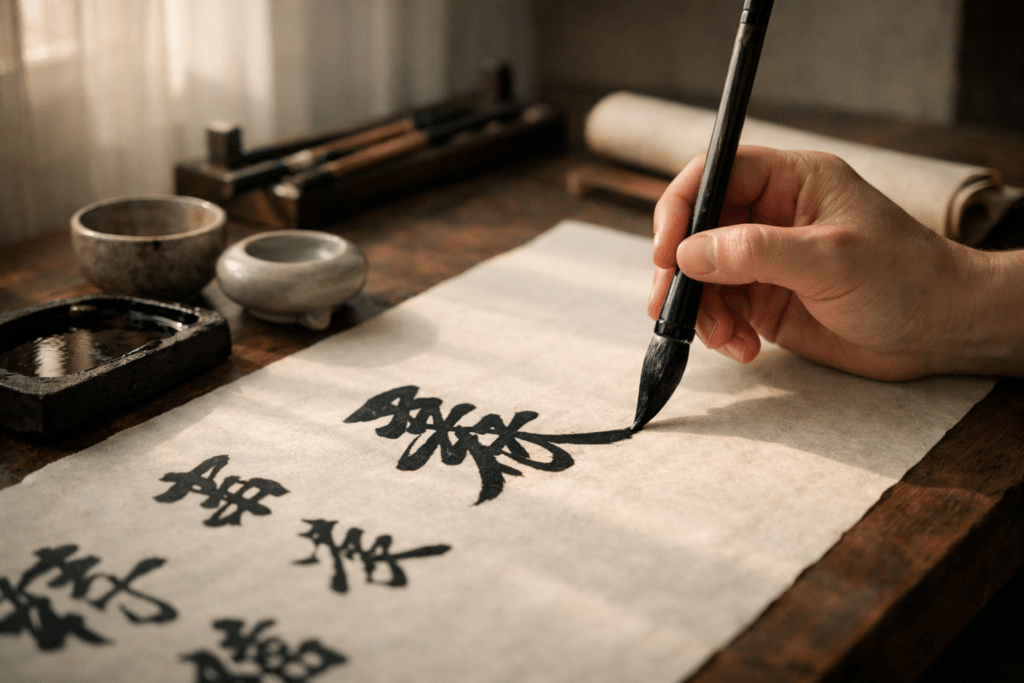
Why Paper Matters More Than Beginners Expect
Most beginners focus on the brush and ink.
Paper feels secondary.
It looks simple. It seems interchangeable.
But once you start practicing, you notice something important.
The same stroke behaves differently on different paper.
Sometimes the line is clean and controlled.
Sometimes it spreads quickly and loses shape.
Sometimes it feels smooth.
Sometimes it feels unpredictable.
This is when you realize:
👉 paper is not neutral
👉 paper changes everything
Understanding paper is not about memorizing types.
It is about understanding how it responds.
Because once you understand that, your control improves.
What Paper Does in Calligraphy
Paper determines how ink behaves.
It controls:
absorption
spread
texture
When the brush touches the paper, the ink begins to move.
How fast it spreads, how much it absorbs, and how it holds the stroke all depend on the paper.
This interaction affects:
line clarity
edge sharpness
stroke stability
If the paper absorbs too quickly, the line expands.
If it absorbs slowly, the line stays more defined.
Paper is not just a surface.
It is part of the result.
The Two Main Categories of Calligraphy Paper
For beginners, it is helpful to think of paper in two main categories:
practice paper
rice paper (Xuan paper)
Practice Paper
Practice paper is designed for learning.
It often includes grid lines.
It is less absorbent than traditional paper.
It allows more control.
This makes it ideal for beginners.
You can focus on:
structure
alignment
basic stroke control
The ink does not spread too quickly, so mistakes are easier to see and correct.
Rice Paper (Xuan Paper)
Rice paper is the traditional material used in Chinese calligraphy.
It is more absorbent.
It reacts more strongly to pressure and speed.
It produces more expressive results.
But it is also more difficult to control.
Small mistakes become visible immediately.
Ink spreads faster, and the margin for error is smaller.
This makes it better suited for intermediate and advanced practice.
Why Beginners Should Start With Practice Paper
Practice paper reduces complexity.
It allows you to focus on movement without worrying too much about ink behavior.
If you start directly with highly absorbent paper, you may feel out of control.
Your strokes may look worse than they actually are.
This can be discouraging.
Practice paper provides stability.
It helps you build confidence.
It gives you a clear foundation.
Once your control improves, you can transition to more sensitive paper.
Understanding Absorbency
Absorbency is one of the most important characteristics of paper.
It determines how quickly ink spreads.
Low Absorbency
Ink stays more on the surface.
Lines remain sharp and controlled.
This is easier for beginners.
High Absorbency
Ink spreads quickly into the paper.
Lines become softer and wider.
This requires better control.
Understanding absorbency helps you adjust your expectations.
If your lines are spreading, it may not be your technique alone.
It may be the paper.
Texture and Surface Feel
Paper also has texture.
Some papers are smooth.
Some are slightly rough.
This affects how the brush moves.
Smooth paper allows easier movement.
Rougher paper creates more resistance.
For beginners, smoother paper is usually easier to manage.
It reduces friction and helps you focus on control.
As you improve, you may explore different textures to achieve different effects.
The Role of Grid Lines
Many practice papers include grid lines.
These are not just visual guides.
They help train structure.
They show you:
how to center characters
how to balance proportions
how to maintain alignment
Without a grid, beginners often write unevenly.
Characters may lean, stretch, or compress.
The grid provides a reference.
It helps you develop consistency.
Over time, you rely on it less.
But at the beginning, it is very useful.
Common Beginner Mistakes With Paper
Choosing the wrong paper can slow progress.
Starting With Highly Absorbent Paper
This makes control difficult.
Ink spreads quickly, and strokes become unclear.
Using Very Cheap Paper
Low-quality paper can behave inconsistently.
It may absorb unevenly or resist ink in some areas.
This creates confusing feedback.
Ignoring Paper Differences
Many beginners assume all paper is the same.
They blame their technique when the issue is actually the material.
Understanding these mistakes helps you avoid unnecessary frustration.
How to Choose Paper as a Beginner
Keep it simple.
Choose:
practice paper
moderate absorbency
smooth surface
grid lines if possible
You do not need multiple types.
You do not need expensive options.
You need consistency.
Using the same type of paper allows you to understand how your strokes behave.
This makes learning clearer.
When to Transition to Rice Paper
As your control improves, you can begin exploring more absorbent paper.
You will notice:
ink responds more quickly
pressure becomes more important
timing becomes more precise
This transition can feel challenging.
But it also opens new possibilities.
Your strokes become more expressive.
Your control becomes more refined.
The key is not to rush this step.
Wait until your basic strokes feel stable.
How Paper Influences Your Learning
Paper shapes your experience.
It affects how difficult or easy practice feels.
It influences how clearly you see your mistakes.
It changes how your strokes look.
Understanding this helps you interpret your results.
If something feels off, consider the paper.
Not everything is a technique problem.
Sometimes it is a material difference.
FAQ
What paper should beginners use for calligraphy?
Practice paper with moderate absorbency and grid lines is best.
Why does my ink spread too much on paper?
The paper may be highly absorbent, or the ink may be too thin.
Is rice paper good for beginners?
It is better for intermediate learners because it requires more control.
Do I need expensive paper to improve?
No, consistent and reliable paper is more important than price.
What is the purpose of grid paper?
It helps maintain structure, alignment, and proportion.
Final Thought
Paper seems simple.
But it plays a major role in what you create.
It shapes how ink moves.
It influences how strokes appear.
It affects how you learn.
When you understand paper, you stop guessing.
You begin to see clearly what is happening.
And when things become clear, improvement becomes easier.
Not faster.
But more consistent.