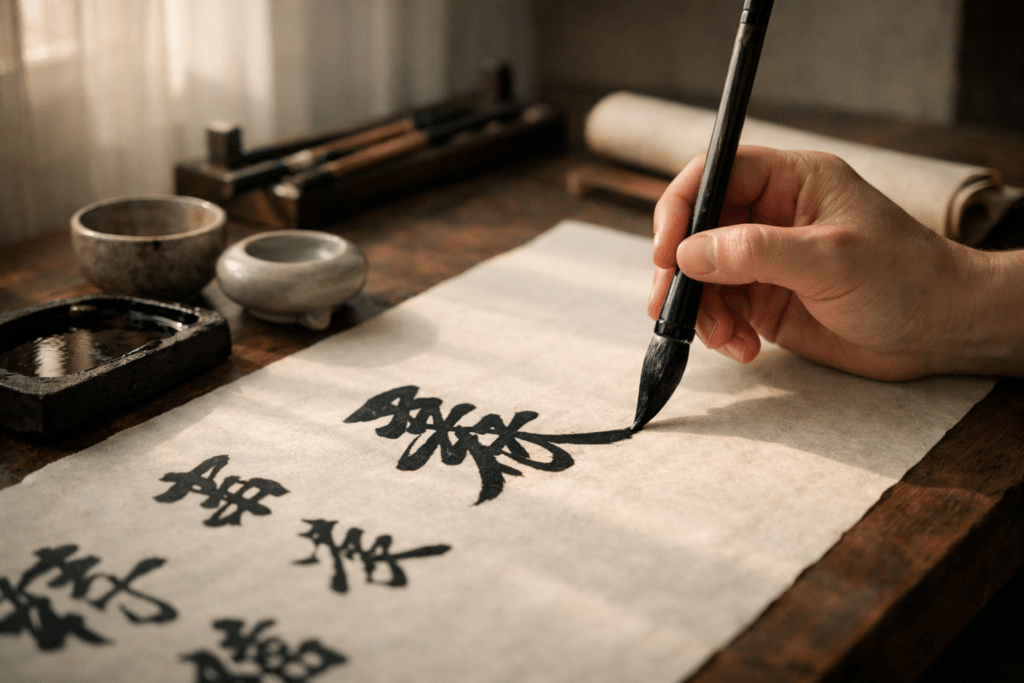
Why Discipline Matters More Than Talent
Many beginners believe that calligraphy depends on talent.
They think:
Some people are naturally good at it.
Some people just “have the feel.”
But after a short time, something becomes clear.
Improvement does not come from talent.
It comes from consistency.
The people who improve are not always the most gifted.
They are the ones who keep showing up.
This is where discipline comes in.
👉 discipline is what turns practice into progress
Without it, even the best intention fades.
With it, even small effort becomes meaningful.
What Discipline Really Means in Calligraphy
Discipline is often misunderstood.
It is not forcing yourself to practice for long hours.
It is not pushing through exhaustion.
It is not about intensity.
In calligraphy, discipline means:
showing up regularly
keeping your practice simple
maintaining focus during practice
It is quiet and steady.
Not dramatic.
But very effective.
Why Most People Struggle With Discipline
Lack of discipline is rarely about laziness.
It usually comes from:
unclear goals
overcomplicated routines
expecting fast results
When practice feels confusing, people stop.
When progress feels slow, people lose motivation.
When routines are too complex, people avoid starting.
Discipline becomes difficult when the process is unclear.
Make the process simple, and discipline becomes easier.
The Foundation of Discipline: Simplicity
If your practice is too complicated, you will not stay consistent.
You need a routine that is:
clear
repeatable
manageable
For example:
warm-up strokes
focused practice
simple application
This structure is enough.
You do not need to change it every day.
You do not need variety.
You need repetition.
Simplicity reduces resistance.
It makes it easier to begin.
And starting is the hardest part.
Consistency Over Intensity
Many beginners start strong.
They practice for a long time in the beginning.
But after a few days, the intensity drops.
Then practice becomes irregular.
This pattern slows progress.
Calligraphy improves through repetition over time.
Not through occasional effort.
It is better to practice 20 minutes every day than 2 hours once a week.
Consistency builds familiarity.
Familiarity builds control.
Discipline is about maintaining that rhythm.
How to Build a Sustainable Practice Habit
Discipline is easier when your environment supports it.
Set a fixed time for practice.
It can be morning, afternoon, or evening.
The exact time is not important.
What matters is consistency.
Prepare your tools in advance.
Keep them ready.
This removes friction.
When everything is set up, it is easier to start.
Start small.
Do not commit to long sessions.
Commit to showing up.
Once you begin, continuing becomes easier.
Remove unnecessary decisions.
Use the same tools.
Follow the same routine.
Reduce variation.
This keeps your focus on practice, not planning.
Dealing With Lack of Motivation
Motivation comes and goes.
Some days you feel like practicing.
Some days you do not.
If you rely on motivation, your practice will be inconsistent.
Discipline replaces motivation.
You practice not because you feel like it, but because it is part of your routine.
On days when motivation is low:
practice for a shorter time
focus on something simple
reduce expectations
The goal is not perfect practice.
The goal is to maintain continuity.
Even a short session keeps the habit alive.
Avoiding Burnout
Too much pressure can lead to burnout.
If you push too hard, you may lose interest.
Calligraphy should not feel forced.
If it becomes exhausting, adjust your approach.
Shorten your sessions.
Simplify your practice.
Allow space for rest.
Discipline is not about constant effort.
It is about sustainable effort.
How Discipline Changes Your Learning
With discipline, practice becomes stable.
You do not start and stop repeatedly.
You build momentum.
Small improvements accumulate.
Over time, these small changes become significant.
Your strokes become more controlled.
Your movement becomes more natural.
Your confidence increases.
This does not happen quickly.
But it happens reliably.
Common Discipline Mistakes
Some approaches to discipline actually make it harder.
Setting unrealistic goals
If your expectations are too high, you will struggle to maintain them.
Overcomplicating practice
Too many techniques or changes create confusion.
Waiting for motivation
This leads to inconsistency.
Comparing progress to others
This creates pressure and reduces enjoyment.
Avoiding these mistakes makes discipline easier to maintain.
How to Measure Discipline
Discipline is not measured by how good your work looks.
It is measured by how often you practice.
If you are showing up regularly, you are building discipline.
The results will follow.
Do not judge your discipline based on outcomes.
Judge it based on consistency.
FAQ
How often should I practice calligraphy?
Daily practice, even for a short time, is most effective.
What if I don’t feel motivated?
Practice anyway, even if only for a few minutes.
Is it better to practice longer or more often?
More often. Consistency is more important than duration.
How do I stay disciplined over time?
Keep your routine simple and reduce unnecessary decisions.
What if I miss a day?
Continue the next day. Do not let one missed session break the habit.
Final Thought
Discipline is not something you force.
It is something you build.
Through small, repeated actions.
Through simple routines.
Through consistent effort.
You do not need to be perfect.
You need to be present.
Each time you practice, you reinforce the habit.
Each session adds to your progress.
Over time, discipline becomes natural.
And when that happens, improvement is no longer uncertain.
It becomes inevitable.