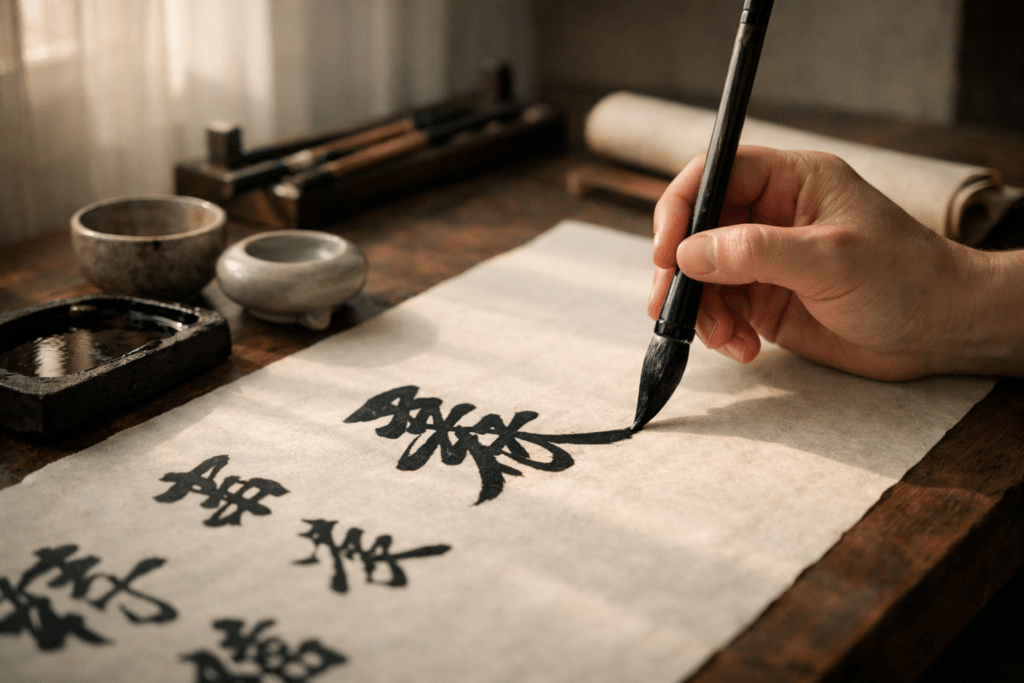
Why Your Setup Affects Your Practice More Than You Think
Most beginners focus on tools and techniques.
They think:
If I get the right brush, I’ll improve.
If I practice more, I’ll get better.
But there is something often overlooked.
The environment.
Where and how you practice directly affects:
your posture
your movement
your focus
A poor setup creates tension.
It limits your control.
It makes practice feel harder than it should be.
A good setup does the opposite.
It supports your body.
It reduces distraction.
It allows you to focus on the process.
This guide will help you create a simple, effective setup without unnecessary complexity.
What a Good Calligraphy Setup Should Do
Your setup does not need to be perfect.
It needs to be functional.
A good setup should:
support natural posture
allow free arm movement
keep tools accessible
minimize distraction
It should feel stable and calm.
Not crowded.
Not complicated.
Simplicity improves consistency.
Choosing the Right Surface
The surface you write on matters.
A stable, flat desk is ideal.
Avoid soft or uneven surfaces.
They make it harder to control pressure.
The height of the desk should allow your arm to move comfortably.
If it is too high, your shoulders may tense.
If it is too low, your posture may collapse.
Your forearm should rest naturally.
Your wrist should not be forced into awkward angles.
A stable surface gives you control.
Adjusting Your Seating
Your seating position affects your entire body.
Sit upright.
Keep your back straight but relaxed.
Your shoulders should not be raised.
Your feet should rest flat on the ground.
Avoid leaning too far forward.
Avoid collapsing your posture.
Good posture allows your arm to move freely.
It reduces tension.
It improves control.
Positioning the Paper
Paper placement is often ignored.
But it plays an important role.
Place the paper directly in front of you.
Keep it aligned with your body.
If it is too far away, you will reach.
If it is too close, your movement becomes restricted.
You can slightly rotate the paper if needed.
Find a position that allows smooth movement.
Your arm should guide the brush naturally.
Arranging Your Tools
Your tools should be easy to access.
You do not want to interrupt your practice to search for them.
Place your brush, ink, and paper within comfortable reach.
Avoid clutter.
Too many objects create distraction.
Keep only what you need.
A clean workspace supports focus.
It also makes it easier to maintain your routine.
Lighting and Visibility
Good lighting is essential.
You need to see your strokes clearly.
Natural light is ideal.
If that is not available, use a soft, steady light source.
Avoid harsh shadows.
Avoid very dim environments.
Clear visibility helps you observe details.
It improves awareness.
And awareness leads to better control.
Creating a Calm Environment
Calligraphy is not just physical.
It requires attention.
A noisy or distracting environment makes this difficult.
Choose a quiet space if possible.
Reduce unnecessary interruptions.
Keep your phone or other distractions away during practice.
This does not mean creating a perfect environment.
It means reducing what pulls your attention away.
A calm space supports consistent practice.
Preparing Before You Start
Preparation is part of the setup.
Before each session:
arrange your tools
prepare your ink
place your paper
This creates a transition into practice.
It signals that you are ready.
It reduces hesitation.
When everything is ready, starting becomes easier.
Small preparation improves consistency.
Common Setup Mistakes
Many beginners unknowingly create setups that slow their progress.
Practicing in uncomfortable positions
This leads to tension and poor control.
Using unstable surfaces
This reduces precision.
Cluttered workspace
This distracts attention.
Poor lighting
This makes it harder to observe details.
Ignoring these factors makes practice more difficult.
Adjusting them improves your experience immediately.
How to Keep Your Setup Consistent
Consistency in your setup supports consistency in your practice.
Try to use the same space each time.
Keep your tools in the same place.
Follow the same preparation steps.
This reduces decision-making.
It makes your routine automatic.
Over time, your setup becomes familiar.
And familiarity supports focus.
Adapting Your Setup Over Time
As you improve, your needs may change.
You may experiment with different tools.
You may adjust your posture slightly.
You may refine your environment.
But the core principles remain the same:
stability
simplicity
comfort
focus
Do not overcomplicate your setup.
Keep it functional.
Keep it clear.
FAQ
What is the best setup for beginners?
A stable desk, simple tools, good lighting, and a clean workspace.
Do I need a special calligraphy table?
No, a regular desk works well if it is stable.
How important is posture?
Very important. It affects control, comfort, and consistency.
Should I practice in silence?
A quiet environment helps, but complete silence is not required.
Can I change my setup often?
It is better to keep it consistent to support habit and focus.
Final Thought
Your setup is not just a place to practice.
It is part of your practice.
It shapes how you move.
It influences how you focus.
It affects how you learn.
A simple, well-arranged environment removes obstacles.
It allows your attention to stay where it matters.
On the brush.
On the stroke.
On the process.
And when your environment supports you, practice becomes easier to sustain.
Not because it is easier.
But because nothing is working against you.