Why Calligraphy Is More Than Just Writing
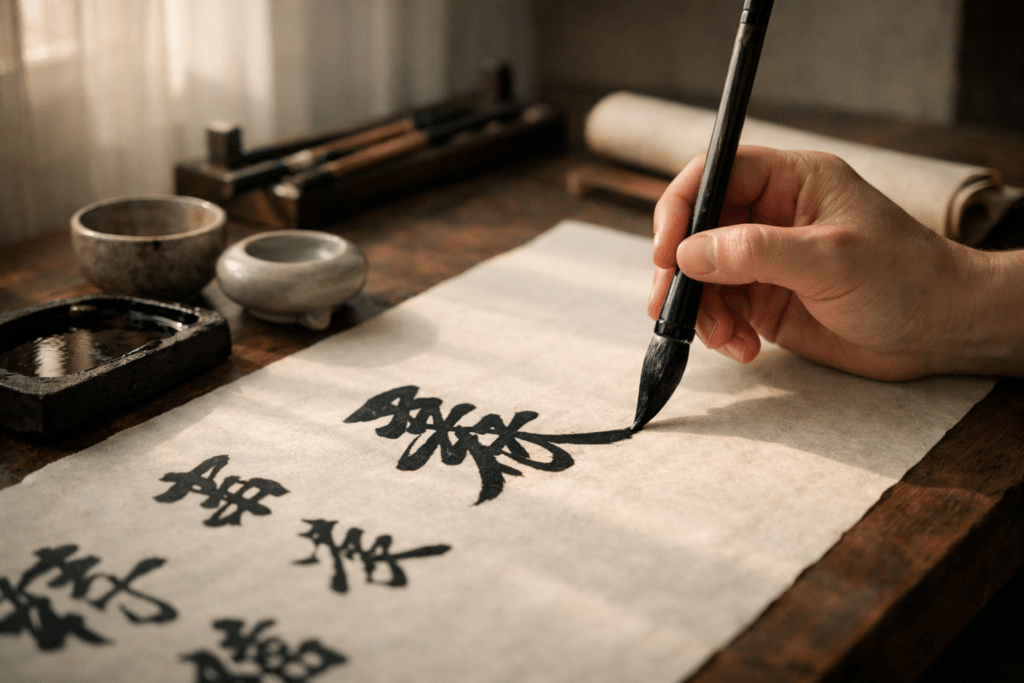
At first glance, calligraphy looks like writing.
Characters formed with ink.
Brush strokes arranged on paper.
But very quickly, something feels different.
It is not just about what is written.
It is about how it is written.
The same character can feel calm, powerful, balanced, or expressive depending on the way it is written.
This is because Chinese calligraphy is not only a method of communication.
👉 it is a cultural practice
It carries history, philosophy, and a way of seeing the world.
Understanding this helps you see calligraphy differently.
Not just as a skill.
But as a form of expression.
The Role of Calligraphy in Chinese Culture
For thousands of years, calligraphy has held a central place in Chinese culture.
It was not considered a minor skill.
It was regarded as a fundamental form of learning.
Scholars, officials, and artists all practiced calligraphy.
It was part of education.
Part of daily life.
Part of personal cultivation.
Writing was not only functional.
It reflected the person.
Their discipline.
Their character.
Their state of mind.
Calligraphy was seen as a direct expression of the individual.
This idea still influences how it is practiced today.
Calligraphy as an Art Form
In many cultures, writing is separate from art.
In Chinese tradition, they are connected.
Calligraphy is considered one of the highest visual arts.
Not because it is decorative.
But because it combines:
structure
movement
expression
A single stroke can show control.
A single character can show balance.
An entire piece can show rhythm and flow.
There is no separation between technique and expression.
They exist together.
This is what makes calligraphy unique.
The Connection Between Calligraphy and Philosophy
Calligraphy is closely connected to traditional Chinese philosophy.
It reflects ideas such as:
balance
harmony
natural flow
These ideas are not added intentionally.
They emerge through practice.
When your movement is balanced, the character looks balanced.
When your attention is steady, the strokes become stable.
Calligraphy becomes a reflection of internal state.
This is why it is often associated with:
calmness
focus
awareness
The practice itself becomes meaningful.
Not just the result.
The Importance of Practice in Culture
In traditional culture, calligraphy was not something you learned once.
It was something you practiced continuously.
Even skilled practitioners continued to refine their writing.
Practice was not only about improvement.
It was about discipline.
It was a way to cultivate patience and attention.
This idea remains important.
Calligraphy is not about reaching a final level.
It is about ongoing development.
Cultural Symbols and Meaning
Chinese characters carry meaning beyond their visual form.
Each character represents an idea.
When written in calligraphy, that idea gains an additional layer.
The way a character is written can influence how it is perceived.
A strong stroke can feel powerful.
A soft stroke can feel calm.
This connection between form and meaning is part of the cultural depth of calligraphy.
It is not only what you write.
It is how you write it.
Calligraphy in Daily Life
Calligraphy is not limited to formal practice.
It appears in many parts of daily life.
You may see it in:
artworks
decorative scrolls
architecture
traditional celebrations
It is used to express:
wishes
values
ideas
For example, characters representing harmony or prosperity are often displayed in homes.
Calligraphy connects language with visual expression.
It brings meaning into physical form.
Respect for Tradition
Traditional calligraphy values continuity.
Techniques and styles have been passed down over generations.
Many learners study the work of past masters.
They copy and observe.
Not to imitate blindly.
But to understand structure and movement.
This respect for tradition creates a strong foundation.
At the same time, it allows for personal expression.
Tradition is not a limitation.
It is a guide.
Calligraphy as Personal Expression
Although calligraphy follows structure, it is not rigid.
Each person develops a slightly different way of writing.
Small variations in movement create unique results.
Over time, these variations become a personal style.
This is not forced.
It emerges naturally.
Through consistent practice.
Through attention to detail.
Calligraphy becomes both structured and personal.
This balance is part of its cultural significance.
Why Culture Matters for Beginners
You do not need to understand all cultural aspects to begin practicing.
But having some awareness helps.
It changes how you approach learning.
Instead of rushing to produce results, you focus on process.
Instead of chasing perfection, you develop control.
Instead of treating it as a task, you treat it as a practice.
This shift makes learning more meaningful.
It also makes it more sustainable.
Common Misunderstandings
Some beginners think culture is separate from technique.
They focus only on writing.
Others think culture is too abstract to matter.
Both views miss the connection.
Technique and culture are linked.
The way you practice reflects the cultural approach.
Slow, attentive practice is not just a method.
It is part of the tradition.
Understanding this helps you practice with more clarity.
FAQ
What is the cultural significance of Chinese calligraphy?
It reflects history, philosophy, and personal expression.
Is calligraphy considered art in Chinese culture?
Yes, it is one of the highest forms of visual art.
Do I need to understand culture to learn calligraphy?
Not fully, but basic awareness improves your learning approach.
Why is calligraphy linked to philosophy?
Because it reflects balance, flow, and internal state.
Can calligraphy express personality?
Yes, writing style often reflects individual characteristics.
Final Thought
Calligraphy is more than writing.
It is a practice shaped by culture.
It carries history.
It reflects ideas.
It connects movement with meaning.
You do not need to understand everything at once.
You only need to be aware that there is more beneath the surface.
As you continue practicing, that depth becomes clearer.
Not through explanation.
But through experience.
And over time, calligraphy becomes more than something you learn.
It becomes something you understand.