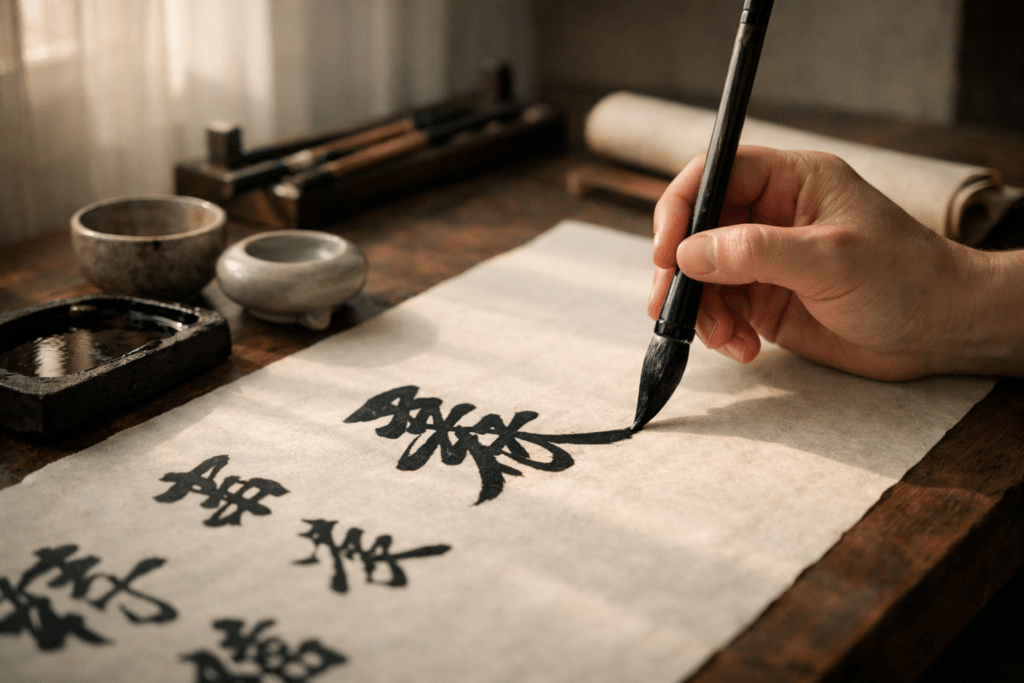
Why Calligraphy Is Not Just a Skill
At the beginning, calligraphy feels like a technical activity.
You learn how to hold the brush.
You practice strokes.
You try to improve control.
Everything seems focused on technique.
But after some time, something changes.
You begin to notice that calligraphy is not only about how well you write.
It is also about how you approach the process.
Your mindset affects your movement.
Your attention affects your strokes.
Your state of mind affects the result.
This is where philosophy enters.
👉 calligraphy is not only a skill
👉 it is a way of practicing awareness
You do not need to study philosophy formally.
But understanding its principles can change how you practice.
The Idea of Presence
One of the most important aspects of calligraphy is presence.
When you write, your attention needs to be with the brush.
Not on the result.
Not on what comes next.
Only on the current stroke.
If your attention is scattered:
your strokes become unstable
your movement becomes inconsistent
If your attention is focused:
your strokes become clearer
your control improves
Calligraphy teaches you to stay with the moment.
Not because it is a rule.
But because it is necessary.
The brush responds to your attention.
The Principle of Simplicity
Calligraphy values simplicity.
Not in appearance, but in approach.
You use a small number of tools.
You repeat basic strokes.
You follow simple structures.
This simplicity is intentional.
It removes distraction.
It allows you to focus deeply.
When there are fewer variables, you see more clearly.
Simplicity makes practice more direct.
It also makes improvement more stable.
The Balance Between Control and Letting Go
Calligraphy requires control.
You guide the brush.
You manage pressure.
You maintain structure.
But too much control creates tension.
Strokes become stiff.
Movement becomes forced.
At the same time, too little control leads to instability.
Strokes become loose and inconsistent.
The practice is about balance.
You guide the movement.
But you do not force it.
You remain aware.
But not rigid.
This balance develops gradually.
It cannot be rushed.
The Role of Repetition
Repetition is central to calligraphy.
You write the same stroke many times.
You repeat the same character.
At first, this may feel repetitive.
But repetition is not just duplication.
It is refinement.
Each repetition reveals something new.
A small adjustment.
A slight improvement.
A clearer understanding.
Repetition builds familiarity.
Familiarity builds control.
Over time, repetition becomes a form of exploration.
Not just practice.
Patience as a Core Principle
Calligraphy does not reward impatience.
If you rush, your strokes become unstable.
If you expect quick results, you become frustrated.
Progress happens slowly.
But consistently.
Patience allows you to stay with the process.
It removes pressure.
It makes practice sustainable.
You do not need to reach a goal quickly.
You need to continue.
This shift changes your experience.
Practice becomes less stressful.
More focused.
More stable.
Awareness of Movement
Calligraphy brings attention to movement.
How you move the brush matters.
Small changes in direction, speed, and pressure affect the result.
This encourages observation.
You begin to notice:
how your hand moves
how your arm supports the motion
how your body influences the stroke
This awareness improves control.
But it also changes how you relate to the process.
You become more attentive.
Less automatic.
Calligraphy becomes a way of observing action.
Not just producing results.
The Connection Between Inner State and Outer Form
In calligraphy, what you feel influences what you create.
If you are tense, your strokes may look stiff.
If you are distracted, your structure may become uneven.
If you are calm, your movement may become smoother.
This connection is not abstract.
It is visible.
The writing reflects the state of the writer.
This does not mean you need to control your emotions.
It means you become aware of them.
And through practice, your movement becomes more stable.
The Relationship Between Discipline and Freedom
At first, calligraphy feels restrictive.
There are rules.
Stroke order.
Structure.
Technique.
You follow them carefully.
This builds discipline.
Over time, something changes.
As your control improves, you gain flexibility.
You are no longer limited by the rules.
You understand them.
You can adapt them.
Discipline creates the foundation.
Freedom emerges from that foundation.
Without discipline, freedom becomes chaos.
With discipline, it becomes expression.
Why Philosophy Matters for Beginners
You do not need to think about philosophy constantly.
But understanding these ideas can help you:
reduce frustration
focus on process
build consistency
It changes your expectations.
You stop looking for quick results.
You start observing gradual improvement.
This makes your practice more stable.
More meaningful.
Common Misunderstandings
Some beginners think philosophy is separate from practice.
They focus only on technique.
Others think philosophy is too abstract to matter.
Both views miss the connection.
Philosophy is not something you add.
It is something you experience through practice.
The way you approach calligraphy reflects these principles.
Whether you are aware of them or not.
FAQ
What is the philosophy of calligraphy?
It involves presence, balance, patience, and awareness.
Do I need to understand philosophy to learn calligraphy?
No, but it can improve your approach and mindset.
Why does mindset affect calligraphy?
Because attention and movement are directly connected.
Is calligraphy a form of meditation?
It can be, because it requires focus and awareness.
How can I apply philosophy in practice?
By staying present, practicing consistently, and observing your movement.
Final Thought
Calligraphy is not only about writing.
It is about how you practice.
It is about how you pay attention.
It is about how you move.
Through simple actions, you develop awareness.
Through repetition, you develop control.
Through patience, you develop stability.
You do not need to force these ideas.
They emerge naturally.
As long as you continue.
One stroke at a time.