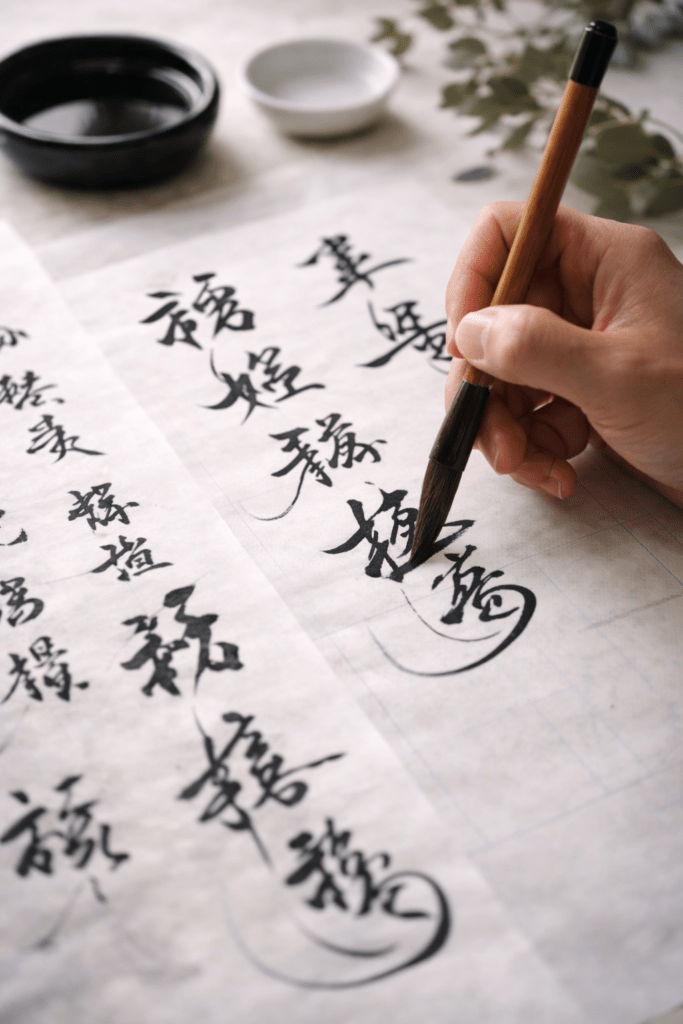
What Is Xingshu and Why It Matters
Xingshu, often translated as Running Script, sits between Kaishu (Regular Script) and Caoshu (Cursive Script).
It is:
more fluid than Kaishu
more readable than Caoshu
👉 it is the bridge between structure and expression
Xingshu is widely used because it balances:
clarity
speed
natural movement
It is not just a style.
It is a way of writing that reflects how the hand naturally moves when control and freedom meet.
For many learners, Xingshu becomes the most practical and expressive form of calligraphy.
What Defines Xingshu
Xingshu is defined by:
connected strokes
simplified forms
continuous movement
Unlike Kaishu, where strokes are fully separated, Xingshu allows:
partial connections
stroke merging
movement flow across the character
But it is not chaotic.
👉 it still respects structure
The character remains readable.
The structure remains intact.
This balance is what makes Xingshu unique.
The Core Characteristics of Xingshu
To understand Xingshu deeply, focus on its key characteristics.
Flow
Strokes are connected through movement.
The brush rarely stops completely.
There is a sense of continuity.
Simplification
Some strokes are reduced or merged.
Unnecessary details are removed.
But the character remains recognizable.
Rhythm
Movement has a natural tempo.
Some strokes are faster.
Some are slower.
This creates variation.
Flexibility
The brush adapts constantly.
Direction, speed, and pressure change naturally.
Why Xingshu Is Important
Xingshu is important because it reflects real writing.
In daily use, people do not write in strict Kaishu.
They naturally simplify and connect strokes.
👉 Xingshu is that natural evolution
It develops:
flow
adaptability
expression
It also improves efficiency.
You can write faster without losing clarity.
The Structure of Xingshu Characters
Even though Xingshu is more flexible, structure is still essential.
A good Xingshu character maintains:
balance
proportion
center alignment
Balance
The character should not lean.
Even with movement, it must feel stable.
Proportion
The relative size of components must remain correct.
Simplification should not distort structure.
Center Alignment
The character should feel centered.
Movement should not pull it off balance.
👉 freedom exists within structure
Without structure, Xingshu becomes unreadable.
The Stroke Behavior in Xingshu
Strokes in Xingshu behave differently from Kaishu.
They are:
connected
compressed
varied
Connections
Strokes may link together.
The brush does not always lift.
Compression
Certain strokes are shortened or merged.
This increases efficiency.
Variation
Pressure and speed vary more.
This creates dynamic lines.
👉 strokes are no longer isolated
They become part of a continuous motion.
How Xingshu Differs from Kaishu
Understanding the difference helps learning.
Kaishu:
separate strokes
strict structure
slow and controlled
Xingshu:
connected strokes
flexible structure
moderate speed
Kaishu teaches discipline.
Xingshu teaches flow.
👉 Xingshu grows out of Kaishu
You should not learn Xingshu without a Kaishu foundation.
How Xingshu Differs from Caoshu
Xingshu is not fully cursive.
Caoshu:
highly simplified
often abstract
difficult to read
Xingshu:
moderately simplified
still readable
balanced
👉 Xingshu maintains readability
This makes it practical and widely used.
How to Practice Xingshu Effectively
Start from Kaishu Foundation
Do not skip Kaishu.
Understand structure first.
Then transition gradually.
Practice Stroke Connections
Take simple characters.
Practice linking strokes.
Focus on smooth transitions.
Maintain Readability
Do not over-simplify.
Ensure characters remain clear.
Balance Speed and Control
Do not rush.
Speed should come naturally.
Focus on flow, not speed.
Observe Master Works
Study how experienced calligraphers:
connect strokes
simplify forms
This improves understanding.
Common Mistakes in Xingshu
Overconnecting Strokes
Too many connections reduce clarity.
Not all strokes should connect.
Losing Structure
Excessive freedom creates imbalance.
Maintain proportion.
Writing Too Fast
Speed without control creates messy strokes.
Build control first.
Imitating Without Understanding
Copying shapes without understanding movement leads to poor results.
Focus on process.
What Good Xingshu Feels Like
When Xingshu improves:
movement feels continuous
strokes connect naturally
writing feels fluid
There is no rigidity.
No forced control.
The brush moves with intention.
This feeling is important.
Because Xingshu is about movement.
Not just form.
How Xingshu Connects to Technique
Xingshu depends heavily on:
flow
speed control
pressure variation
brush angle
All techniques become more dynamic.
It is where fundamentals are applied in motion.
The Role of Rhythm in Xingshu
Rhythm is essential.
Each stroke has timing.
Fast and slow movements alternate.
This creates:
balance
variation
natural flow
Without rhythm, Xingshu becomes mechanical.
With rhythm, it becomes expressive.
How Long It Takes to Learn Xingshu
Xingshu develops after foundation.
At first:
connections feel unnatural
movement feels unstable
With practice:
flow improves
structure stabilizes
Over time:
writing becomes natural
FAQ
What is Xingshu in calligraphy?
It is a running script that connects strokes and balances structure with flow.
Is Xingshu good for beginners?
Only after learning Kaishu basics.
Why is Xingshu easier to write?
It allows natural movement and simplification.
How do I practice Xingshu?
Start with Kaishu, then practice connecting strokes.
Is Xingshu readable?
Yes, it maintains clarity while allowing flexibility.
Final Thought
Xingshu is where calligraphy begins to move.
It is where structure becomes fluid.
Where control becomes expression.
You do not force Xingshu.
You grow into it.
Through practice.
Through understanding.
Through movement.
And over time, your writing becomes natural.
Not rigid.
Not chaotic.
But flowing.
One stroke into the next.