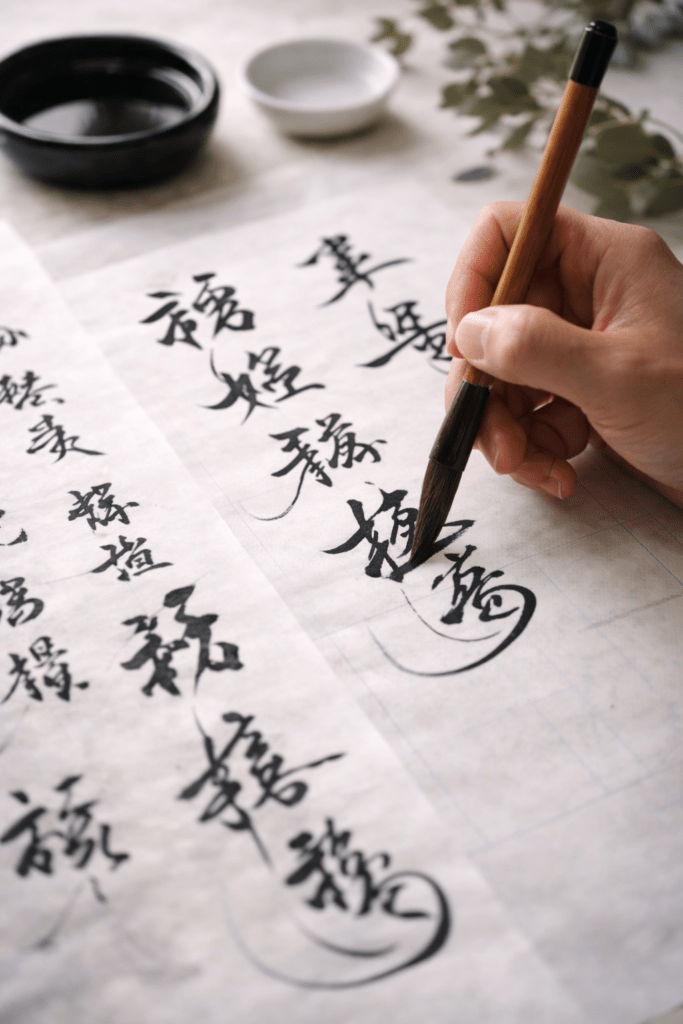
What Is Running Script and Why It Matters
Running Script, known as Xingshu, is a semi-cursive style of Chinese calligraphy that sits between Regular Script (Kaishu) and Cursive Script (Caoshu).
It combines:
structure
fluidity
natural movement
👉 it is the bridge between precision and expression
Unlike Regular Script, which emphasizes clarity and separation, Running Script allows strokes to connect and flow.
Unlike Cursive Script, it still maintains readability.
This balance makes Running Script one of the most practical and widely used calligraphy styles.
What Defines Running Script
Running Script is defined by:
connected strokes
reduced lifting of the brush
natural rhythm
Strokes are often linked together.
Movements are continuous.
The writing feels fluid rather than segmented.
👉 writing becomes movement, not just construction
This gives Running Script its unique character.
The Core Characteristics of Running Script
To understand Running Script deeply, focus on its key features.
Connection
Strokes are often linked.
Transitions between strokes are smooth.
This reduces pauses.
Flow
The brush moves continuously.
There is a sense of direction and rhythm.
The writing feels alive.
Simplification
Some strokes are simplified.
Not every detail from Regular Script is preserved.
But structure remains.
Balance Between Structure and Freedom
Running Script allows flexibility.
But it does not abandon form.
👉 it is controlled freedom
Why Running Script Is Important
Running Script develops:
fluid movement
stroke connection
natural writing rhythm
It teaches you how to:
transition between strokes
maintain structure while moving
write with continuity
👉 it transforms writing into a flowing process
For many learners, this is where calligraphy begins to feel natural.
The Structure of Running Script Characters
Although more flexible than Regular Script, structure is still essential.
Characters must maintain:
proportion
balance
readability
Proportion
Even with simplification, the character must retain its shape.
Balance
The character should feel stable.
Even with movement, weight must be controlled.
Readability
Forms must remain recognizable.
Over-simplification leads to confusion.
👉 structure is flexible, but not optional
The Stroke System in Running Script
Strokes in Running Script are:
connected
shortened
sometimes merged
Brush lifting is reduced.
Movements are continuous.
Transitions are key.
👉 the space between strokes becomes part of the writing
This creates rhythm.
How Running Script Differs from Other Styles
Compared to Regular Script:
Regular Script:
separate strokes
strict structure
Running Script:
connected strokes
flexible structure
Compared to Cursive Script:
Cursive Script:
highly simplified
often difficult to read
Running Script:
moderately simplified
still readable
👉 Running Script balances clarity and speed
It is practical and expressive.
How to Practice Running Script Effectively
Master Regular Script First
Running Script is built on structure.
Without a strong foundation, writing becomes unstable.
Practice Stroke Connections
Focus on linking strokes smoothly.
Avoid abrupt breaks.
Control Speed
Do not rush.
Speed should come naturally.
Maintain Structure
Even when simplifying, keep the character balanced.
Study Classical Examples
Observe how masters connect strokes.
This improves understanding.
Common Mistakes in Running Script
Over-connecting
Connecting too many strokes reduces clarity.
Keep readability.
Losing Structure
Too much freedom leads to imbalance.
Maintain proportion.
Writing Too Fast
Speed without control creates messy writing.
Slow down.
Ignoring Stroke Order
Incorrect order disrupts flow.
Follow proper sequence.
What Good Running Script Feels Like
When Running Script improves:
movement feels continuous
transitions feel smooth
writing feels natural
There is flow.
There is rhythm.
The writing feels alive but controlled.
This feeling is essential.
Because Running Script is about movement with structure.
How Running Script Connects to Technique
Running Script develops:
flow control
stroke connection
rhythm
It integrates:
pressure control
speed control
structure
It is where techniques come together.
The Role of Rhythm in Running Script
Rhythm is central.
Writing should not feel mechanical.
It should have:
variation
timing
continuity
👉 rhythm turns writing into expression
This is what makes Running Script engaging.
How Long It Takes to Learn Running Script
Running Script becomes easier after mastering Regular Script.
At first:
connections feel awkward
structure may weaken
With practice:
movement becomes natural
flow improves
Over time:
writing becomes smooth and expressive
FAQ
What is Running Script in calligraphy?
It is a semi-cursive style combining structure and flow.
Is Running Script easy to learn?
It is easier after learning Regular Script.
Why are strokes connected?
To create flow and improve writing speed.
Is Running Script readable?
Yes, it remains more readable than Cursive Script.
How do I practice it?
Focus on connections, structure, and controlled movement.
Final Thought
Running Script is where writing begins to move.
Not rigid.
Not chaotic.
But flowing.
It teaches you:
how to connect
how to transition
how to express
You do not force it.
You allow it.
And over time, your writing becomes natural.
Smooth.
Continuous.
Alive.
One movement at a time.