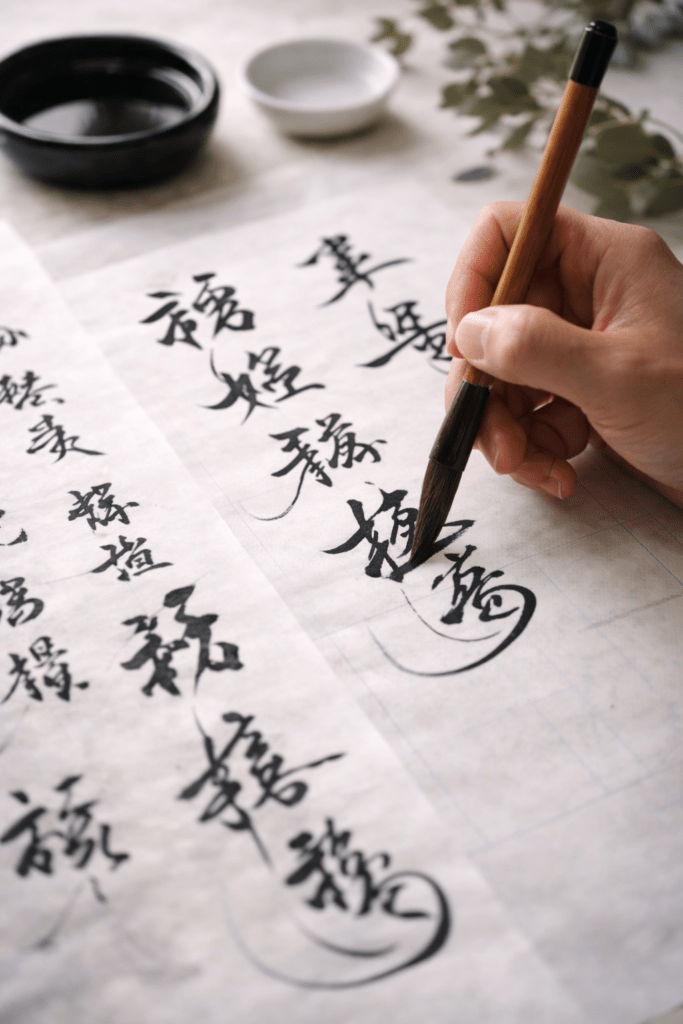
Why Comparing Styles Changes How You Learn
Many learners study calligraphy styles one by one.
Kaishu.
Xingshu.
Caoshu.
Lishu.
Zhuanshu.
But without comparison, these styles feel disconnected.
👉 comparison reveals relationships
It shows:
how styles differ
how they connect
how they evolve
Understanding comparison helps you:
choose the right style
practice more effectively
build a complete system
👉 you stop memorizing styles and start understanding them
The Five Core Styles Overview
The five major styles in Chinese calligraphy are:
Zhuanshu (Seal Script)
Lishu (Clerical Script)
Kaishu (Regular Script)
Xingshu (Running Script)
Caoshu (Cursive Script)
Each style represents a different balance of:
structure
speed
expression
👉 comparing them reveals the full spectrum of calligraphy
Comparison by Structure
Zhuanshu:
highly structured
symmetrical
geometric
Lishu:
structured
wide and flat
stylized
Kaishu:
strict structure
clear proportions
precise
Xingshu:
flexible structure
adaptable
partially simplified
Caoshu:
minimal visible structure
highly abstract
👉 structure decreases as you move from Zhuanshu to Caoshu
This is a key pattern.
Comparison by Stroke Behavior
Zhuanshu:
uniform lines
no pressure variation
Lishu:
flat strokes
distinct endings
Kaishu:
clear beginnings and endings
controlled pressure
Xingshu:
connected strokes
smooth transitions
Caoshu:
merged strokes
continuous motion
👉 stroke complexity increases with expression
Each style treats strokes differently.
Comparison by Speed
Zhuanshu:
very slow
deliberate
Lishu:
slow
controlled
Kaishu:
moderate
precise
Xingshu:
faster
flowing
Caoshu:
fastest
continuous
👉 speed increases as structure loosens
But speed always depends on control.
Comparison by Readability
Zhuanshu:
readable with training
less common today
Lishu:
readable
stylized
Kaishu:
highly readable
standard
Xingshu:
generally readable
partially simplified
Caoshu:
often difficult to read
👉 readability decreases as abstraction increases
This is the trade-off between clarity and expression.
Comparison by Difficulty
Zhuanshu:
difficult in precision
requires symmetry
Lishu:
moderate difficulty
requires stroke control
Kaishu:
easy to learn
hard to master
Xingshu:
moderate difficulty
requires flow control
Caoshu:
most difficult
requires advanced skill
👉 difficulty is not about complexity—it is about control
Caoshu is hardest because it removes visible structure.
Comparison by Learning Value
Zhuanshu teaches:
form
symmetry
precision
Lishu teaches:
horizontal balance
stroke shaping
Kaishu teaches:
structure
discipline
control
Xingshu teaches:
flow
connection
rhythm
Caoshu teaches:
expression
energy
freedom
👉 each style builds a different skill
Together, they form a complete training system.
The Spectrum of Calligraphy Styles
If we place styles on a spectrum:
Zhuanshu → Lishu → Kaishu → Xingshu → Caoshu
We see a transition from:
form → structure → flow → expression
👉 this is the core logic of calligraphy
Every style fits somewhere on this spectrum.
How to Use This Comparison in Practice
Start With Kaishu
Build structure and control.
Add Lishu or Zhuanshu
Develop understanding of form and variation.
Move to Xingshu
Introduce flow and connection.
Explore Caoshu
Develop expression.
👉 follow progression, not preference
This ensures stable growth.
Common Misunderstandings
“All styles are equal for beginners”
They are not.
Some require foundation.
“More expressive styles are better”
Expression without control leads to instability.
“Speed means skill”
Speed without structure is chaos.
👉 understanding comparison prevents mistakes
What This Comparison Teaches You
Calligraphy is not about choosing one style.
It is about understanding all of them.
Each style answers a different question:
How should structure work?
How should strokes behave?
How should movement flow?
How should expression appear?
👉 comparison turns confusion into clarity
FAQ
What are the main calligraphy styles?
Zhuanshu, Lishu, Kaishu, Xingshu, and Caoshu.
Which style is easiest to learn?
Kaishu is the most beginner-friendly.
Which style is hardest?
Caoshu is the most difficult.
How are the styles related?
They evolved from one another.
Should I learn all styles?
Eventually, yes, but in the correct order.
Final Thought
Each style is not separate.
It is part of a whole.
Zhuanshu gives form.
Lishu gives structure.
Kaishu gives clarity.
Xingshu gives flow.
Caoshu gives freedom.
You do not need to choose one.
You learn them as a system.
Step by step.
Layer by layer.
And over time, your understanding deepens.
Not just of writing—
but of movement, structure, and expression.
One style at a time.