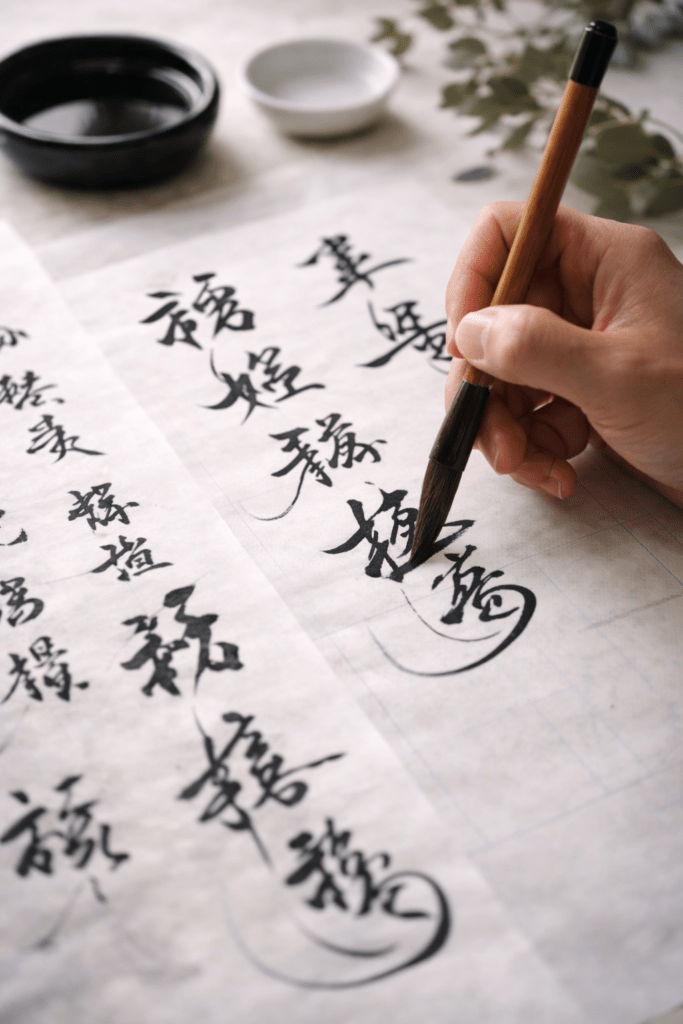
Why Practicing Styles Requires a System
Many learners make a common mistake.
They switch between styles randomly.
One day Kaishu.
Next day Xingshu.
Then Caoshu.
It feels productive.
But progress remains slow.
Because practicing styles is not about exposure.
👉 it is about structured training
Each style requires:
different movement
different control
different awareness
Without a system, practice becomes inconsistent.
👉 with a system, progress becomes measurable
What “Style Practice” Really Means
Practicing a style is not just copying characters.
It means training specific aspects:
structure
stroke behavior
movement
rhythm
Each style emphasizes different elements.
👉 practice must match the style’s characteristics
Otherwise, you are not actually learning the style.
The Foundation Rule: One Style at a Time
Before anything else, follow this rule:
👉 do not practice multiple styles simultaneously
Each style builds different habits.
Mixing them creates confusion.
Focus on one style.
Develop consistency.
Then move forward.
👉 depth before variety
This is essential for real progress.
The Core Practice System for Any Style
A complete practice system includes five stages.
Understanding
Learn the characteristics of the style.
Know:
structure
stroke behavior
movement
Without understanding, practice lacks direction.
Isolation
Practice individual strokes.
Focus on:
shape
pressure
control
Build precision.
Repetition
Repeat strokes and simple characters.
Develop consistency.
Avoid rushing.
Variation
Adjust:
speed
pressure
connection
Explore how the style behaves.
Integration
Combine strokes into full characters.
Focus on:
balance
structure
flow
👉 this system applies to all styles
It ensures structured progress.
How to Practice Each Style Correctly
Kaishu (Regular Script)
Focus on:
structure
precision
stroke separation
Practice slowly.
Use grids.
Build strong fundamentals.
👉 Kaishu is about control
Xingshu (Running Script)
Focus on:
connection
flow
transition
Reduce brush lifting.
Maintain structure.
👉 Xingshu is about movement
Caoshu (Cursive Script)
Focus on:
continuous motion
simplification
rhythm
Do not force speed.
Control movement.
👉 Caoshu is about expression
Lishu (Clerical Script)
Focus on:
horizontal balance
stroke endings
flat structure
Control pressure at the ends.
👉 Lishu is about shape
Zhuanshu (Seal Script)
Focus on:
line consistency
symmetry
smooth movement
Maintain even pressure.
👉 Zhuanshu is about form
👉 each style requires a different mindset
Adapting your practice is essential.
How to Structure a Daily Practice Session
A simple session can include:
Warm-Up (5–10 minutes)
Practice basic strokes.
Loosen your hand.
Focused Practice (15–30 minutes)
Work on one style.
Practice selected characters.
Stay consistent.
Review (5–10 minutes)
Compare your work.
Identify errors.
Adjust next session.
👉 short, focused sessions are more effective
Consistency matters more than duration.
How to Track Progress
Improvement in calligraphy is gradual.
To track progress:
compare old and new work
observe stroke control
check structure consistency
Look for:
stability
clarity
balance
👉 awareness accelerates improvement
Without reflection, progress slows.
Common Practice Mistakes
Switching Styles Too Often
Creates conflicting habits.
Stay focused.
Practicing Without Understanding
Copying shapes without knowing why.
Learn characteristics first.
Rushing Speed
Speed without control leads to errors.
Slow down.
Ignoring Structure
Focusing only on strokes.
Structure is equally important.
Inconsistent Practice
Irregular sessions slow progress.
👉 consistency builds skill
How Long to Practice Each Style
There is no fixed time.
But you should stay with a style until:
your strokes are stable
your structure is consistent
your movement is controlled
Only then move to another style.
👉 progression should feel natural
Do not rush.
How Styles Connect in Practice
Calligraphy styles are not separate.
They build on each other.
Kaishu builds structure.
Xingshu builds flow.
Caoshu builds expression.
Lishu and Zhuanshu deepen understanding of form.
👉 practice becomes layered
Each style adds a skill.
What Effective Practice Feels Like
When your practice is effective:
you know what you are improving
your strokes become consistent
your writing becomes stable
There is clarity.
There is direction.
Practice feels purposeful.
This is important.
Because focused practice leads to real progress.
FAQ
How should I practice calligraphy styles?
Focus on one style, follow a structured system, and practice consistently.
Can I practice multiple styles at once?
Not recommended for beginners.
How long should each session be?
Short, focused sessions are effective.
Which style should I start with?
Kaishu is the best starting point.
How do I know I am improving?
By observing consistency, control, and structure.
Final Thought
Practice is not about doing more.
It is about doing correctly.
Each style teaches something different.
But only if you approach it with clarity.
With structure.
With intention.
You do not rush through styles.
You move through them.
Step by step.
Skill by skill.
And over time, your writing becomes stable.
Controlled.
Expressive.
Built on a system that works.
One session at a time.