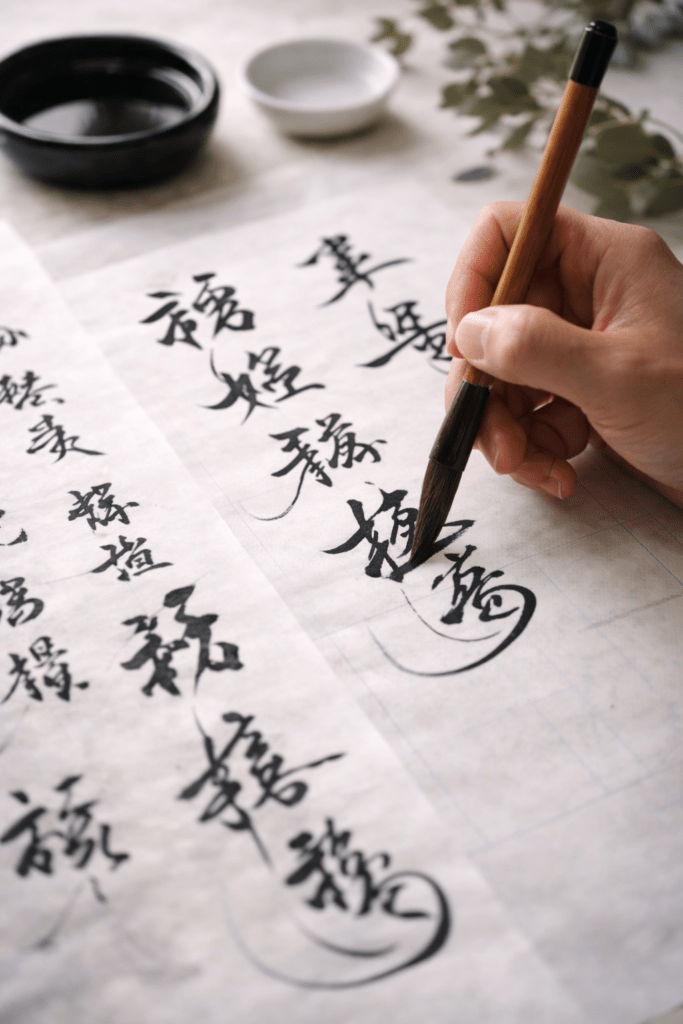
Why Stroke Differences Define Style
When people compare calligraphy styles, they often focus on how characters look.
But the real difference is not just visual.
👉 it is how strokes are made
Every style has its own way of handling:
pressure
direction
connection
speed
These differences change:
how the brush moves
how the character feels
how the writing expresses itself
👉 stroke behavior is the foundation of style
If you understand stroke differences, you understand calligraphy at a deeper level.
What “Stroke Differences” Really Means
A stroke is not just a line.
It is a movement.
It includes:
how the brush touches the paper
how pressure is applied
how the stroke begins and ends
Each style modifies these elements.
👉 styles are defined by how strokes behave, not just how they look
This is why copying shape alone is not enough.
You must understand movement.
The Core Stroke Elements That Change Across Styles
There are four main elements that vary.
Pressure
How much force is applied.
Light or heavy.
Direction
How the stroke moves across the paper.
Straight or curved.
Connection
Whether strokes are separate or linked.
Speed
How fast the stroke is executed.
👉 these four elements create style variation
Changing them changes everything.
Stroke Differences Across the Five Core Styles
Zhuanshu (Seal Script)
Pressure:
even and consistent
Direction:
smooth, rounded
Connection:
continuous
Speed:
slow
👉 strokes are uniform and controlled
There is no visible variation.
The brush behaves like a steady line.
Lishu (Clerical Script)
Pressure:
varies at the beginning and end
Direction:
mostly horizontal
Connection:
separate
Speed:
slow to moderate
👉 stroke endings are emphasized
The brush creates distinctive flared shapes.
Kaishu (Regular Script)
Pressure:
controlled variation
Direction:
precise and defined
Connection:
separate
Speed:
moderate
👉 each stroke is clearly formed
Beginnings and endings are visible.
Structure is explicit.
Xingshu (Running Script)
Pressure:
smooth transitions
Direction:
fluid
Connection:
partial
Speed:
faster
👉 strokes begin to connect
Movement becomes continuous.
Transitions replace pauses.
Caoshu (Cursive Script)
Pressure:
dynamic and expressive
Direction:
free and flowing
Connection:
continuous
Speed:
fast
👉 strokes merge into movement
The brush rarely stops.
The entire character can become one gesture.
The Key Pattern in Stroke Differences
Across all styles, a clear pattern appears:
uniform → structured → connected → expressive
Zhuanshu is most uniform.
Kaishu is most structured.
Xingshu introduces connection.
Caoshu maximizes expression.
👉 stroke behavior evolves with style
Understanding this progression helps you learn more effectively.
Why Stroke Differences Matter in Practice
If you ignore stroke differences:
your writing becomes inconsistent
styles get mixed
progress slows
👉 correct stroke behavior ensures accuracy
For example:
writing Kaishu with Xingshu connections creates confusion
writing Caoshu with Kaishu separation removes flow
Each style must be practiced with its correct stroke behavior.
How to Practice Stroke Differences
Isolate Each Style
Practice one style at a time.
Do not mix behaviors.
Focus on Movement
Pay attention to how the brush moves.
Not just the final shape.
Adjust Pressure
Learn how each style uses pressure.
Practice transitions.
Control Speed
Different styles require different speeds.
Do not rush.
Observe Examples
Study how strokes behave in real works.
👉 observation improves understanding
Common Mistakes
Mixing Stroke Behaviors
Using the wrong pressure or connection for a style.
Ignoring Pressure Control
Flat strokes in Kaishu reduce quality.
Over-connecting
Too many connections in Xingshu reduce clarity.
Writing Too Fast
Speed without control reduces precision.
👉 awareness prevents errors
What Correct Stroke Behavior Feels Like
When stroke behavior is correct:
movement feels natural
strokes look consistent
the style becomes clear
Each style has a distinct feeling.
Zhuanshu feels steady.
Kaishu feels controlled.
Xingshu feels flowing.
Caoshu feels dynamic.
👉 feeling helps recognition
How Stroke Differences Connect to Skill Development
Learning stroke differences improves:
control
adaptability
precision
It teaches you:
how to adjust movement
how to switch styles correctly
👉 it builds technical flexibility
This is essential for advanced practice.
How Long It Takes to Master Stroke Differences
At first:
strokes feel inconsistent
styles feel similar
With practice:
differences become clear
control improves
Over time:
you instinctively adjust your strokes
This is gradual.
FAQ
What are stroke differences in calligraphy?
They are variations in pressure, direction, connection, and speed across styles.
Why are stroke differences important?
They define each style and ensure accurate writing.
Which style has the most complex stroke behavior?
Caoshu has the most dynamic and complex strokes.
How do I practice stroke differences?
Focus on one style, observe movement, and practice consistently.
Can stroke behavior be mixed?
Not at the beginner level. Learn styles separately first.
Final Thought
A stroke is not just a line.
It is a decision.
A movement.
A form of control.
Each style changes how that movement happens.
Some are steady.
Some are structured.
Some are flowing.
Some are free.
You do not just learn strokes.
You learn how to move.
How to adjust.
How to express.
And over time, your strokes become intentional.
Not accidental.
Not mixed.
But true to the style.
One stroke at a time.