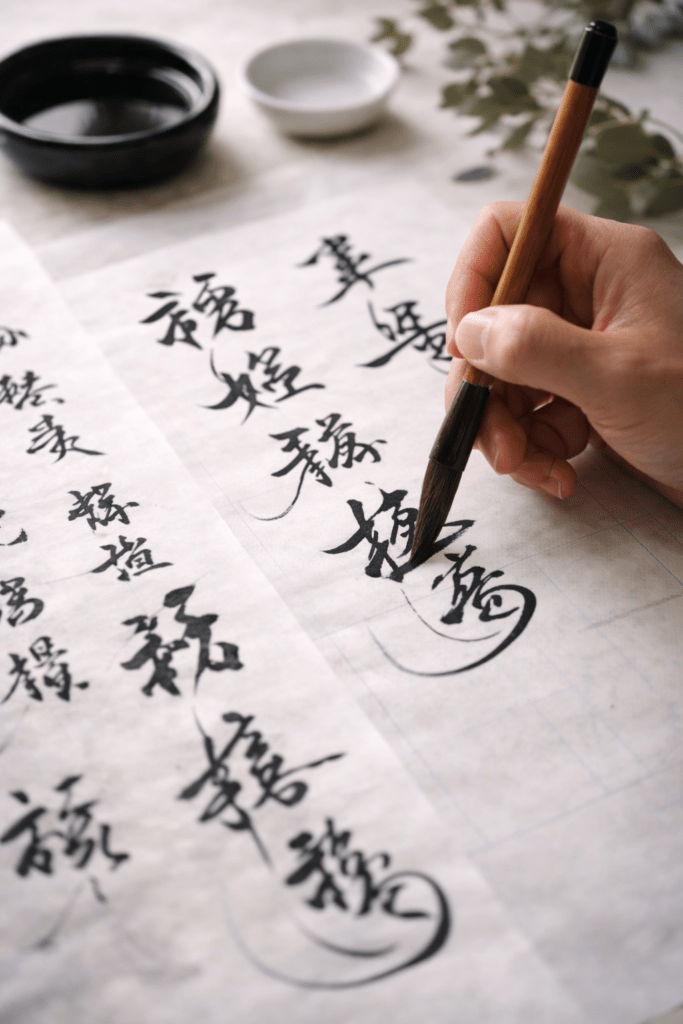
Why Style History Matters
Calligraphy styles did not appear randomly.
Each style developed to solve a problem.
Each change reflects:
how people wrote
what they needed
how tools evolved
👉 style history is the story of writing adapting over time
When you understand this, styles stop feeling separate.
You begin to see:
how one style leads to another
why certain features exist
how writing becomes more efficient or expressive
👉 history gives meaning to technique
What “Style History” Really Means
Style history is not just a timeline.
It is a progression of:
form
movement
function
Each stage changes:
stroke behavior
structure
speed
👉 styles evolve from necessity to refinement
Understanding this progression helps you:
learn in the correct order
recognize stylistic relationships
practice with purpose
The Earliest Stage: Oracle Bone Script
The earliest form of Chinese writing appears in inscriptions on bones and shells.
These characters were:
simple
angular
symbolic
They were carved, not written.
👉 strokes were rigid and direct
There was no brush technique yet.
This stage established:
basic character forms
symbolic meaning
It is the foundation of all later styles.
Bronze Script: More Structure and Ornamentation
As writing moved onto bronze vessels, forms became:
more complex
more decorative
Characters developed:
curved elements
balanced shapes
👉 structure became more refined
This stage introduced:
visual harmony
early aesthetic awareness
It was still formal and ceremonial.
Zhuanshu (Seal Script): Standardization and Harmony
Zhuanshu marked a major transformation.
It introduced:
consistent line thickness
smooth curves
symmetrical structure
Writing became:
uniform
controlled
visually balanced
👉 this was the first standardized writing system
Zhuanshu reflects:
order
authority
formal beauty
It laid the foundation for later developments.
Lishu (Clerical Script): Practical Transformation
Lishu emerged as writing became more common in administration.
Speed and efficiency became important.
Changes included:
flattened character shapes
strong horizontal strokes
simplified structure
👉 writing became more practical
Stroke endings became more expressive.
Lishu represents a transition:
from formality to usability
It introduced rhythm and variation.
Kaishu (Regular Script): Stability and Clarity
Kaishu refined the structure introduced by Lishu.
It became:
clear
balanced
standardized
Each stroke gained:
defined beginnings
controlled endings
👉 this is the most structured and stable style
Kaishu became the foundation for learning.
It represents:
clarity
discipline
precision
Even today, it is widely used.
Xingshu (Running Script): Flow and Efficiency
As writing continued to evolve, speed became more important.
Xingshu introduced:
stroke connections
reduced brush lifting
fluid movement
👉 writing became more natural
Structure remained, but became more flexible.
Xingshu represents:
balance between clarity and speed
It feels:
smooth
continuous
lively
It is widely used in personal writing.
Caoshu (Cursive Script): Expression and Freedom
Caoshu represents the most expressive stage.
It introduced:
extreme simplification
continuous strokes
fast execution
👉 structure becomes abstract
The focus shifts to:
movement
energy
expression
Caoshu reflects:
freedom
emotion
individual style
It is the most artistic form.
The Overall Evolution Pattern
The development of styles follows a clear pattern:
rigid → structured → efficient → expressive
Oracle Bone: rigid carving
Zhuanshu: uniform structure
Lishu: practical adaptation
Kaishu: refined clarity
Xingshu: flowing efficiency
Caoshu: expressive freedom
👉 each stage solves a different problem
Understanding this pattern helps you:
see connections between styles
learn more efficiently
Why Styles Continue to Evolve
Even today, calligraphy is not fixed.
Modern influences introduce:
new tools
new interpretations
new aesthetics
But the core system remains.
👉 modern styles still follow historical principles
This continuity is important.
It connects past and present.
How Style History Improves Your Practice
Understanding history helps you:
choose the right learning order
avoid confusion between styles
appreciate stylistic differences
👉 it gives context to your practice
Instead of copying blindly, you understand why things are done.
Common Misunderstandings
Thinking Styles Are Separate
They are connected stages.
Ignoring Historical Order
Learning out of sequence slows progress.
Focusing Only on Appearance
Ignoring development and purpose.
👉 awareness leads to better learning
How Long It Takes to Understand Style History
At first:
styles seem disconnected
With study:
patterns become clear
Eventually:
you see evolution naturally
👉 understanding deepens over time
It is a gradual process.
FAQ
What is the origin of Chinese calligraphy styles?
They began with Oracle Bone Script and evolved over time.
Which style came first?
Oracle Bone Script, followed by Bronze Script and Zhuanshu.
Why did styles change?
To improve efficiency, clarity, and expression.
Which style is most modern?
Caoshu is the most expressive, but all styles are still used.
Do I need to learn history to practice calligraphy?
It is not required, but it greatly improves understanding.
Final Thought
Calligraphy is not static.
It is a living system.
Each style carries the past within it.
Each stroke reflects a history of change.
When you write—
you are not just practicing technique.
You are continuing a tradition.
A progression that began thousands of years ago.
From carving on bone—
to flowing ink on paper.
From rigid form—
to expressive movement.
And in that progression—
you find not just styles—
but meaning.
One stroke at a time.