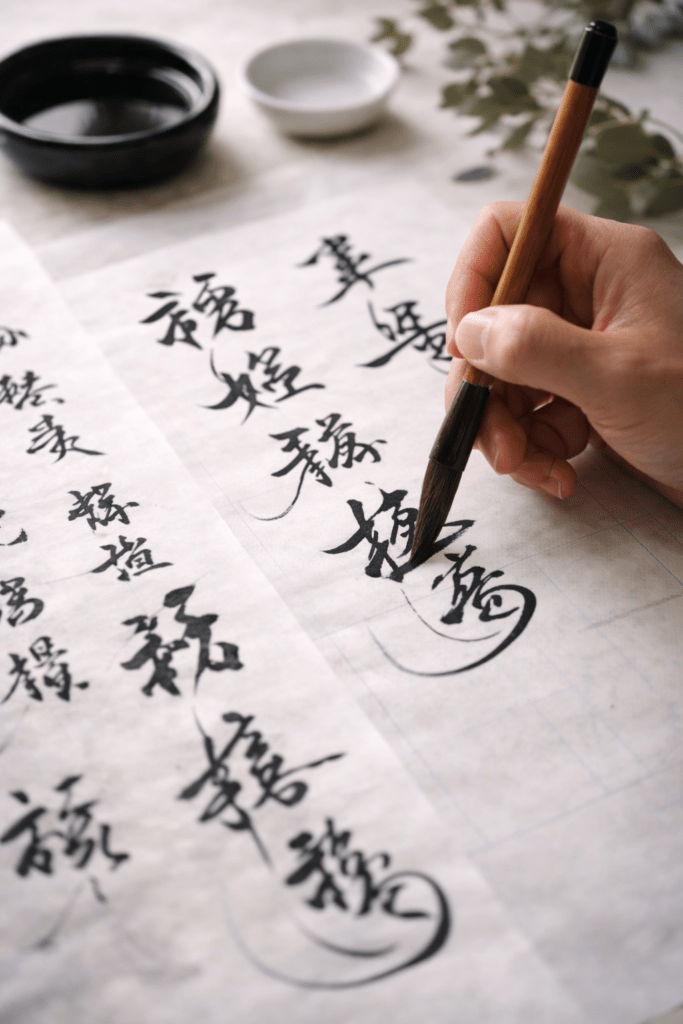
Why Style Philosophy Matters
Most people learn calligraphy as a technique.
They focus on:
strokes
structure
accuracy
But beyond technique, every style carries something deeper.
👉 a way of thinking
👉 a way of seeing
👉 a way of moving
Each style is not just a method of writing.
It reflects:
a mindset
a rhythm of attention
a relationship between control and freedom
👉 understanding philosophy changes how you practice
Instead of copying shapes, you begin to understand intention.
What “Style Philosophy” Really Means
Style philosophy is not abstract theory.
It is embedded in:
how the brush moves
how strokes are formed
how structure is maintained or released
Each style answers a question:
How much control is needed?
How much freedom is allowed?
👉 philosophy lives inside technique
You do not think about it separately.
You feel it through practice.
The Core Philosophical Spectrum of Styles
All major calligraphy styles exist along a spectrum:
Zhuanshu → Lishu → Kaishu → Xingshu → Caoshu
This spectrum reflects a progression:
form → structure → balance → flow → expression
👉 philosophy evolves with movement
Each step represents a shift in:
discipline
efficiency
freedom
Zhuanshu: Philosophy of Harmony and Order
Zhuanshu reflects a worldview of:
balance
symmetry
stability
Its philosophy emphasizes:
consistency
uniformity
clarity of form
Every stroke is:
even
controlled
deliberate
👉 nothing is excessive
There is no sudden movement.
No variation.
This style represents:
order without disruption
Practicing Zhuanshu teaches:
patience
precision
calm attention
Lishu: Philosophy of Structure and Adaptation
Lishu introduces:
practicality
efficiency
rhythmic variation
Its philosophy balances:
formality and function
Strokes begin to show:
contrast
weight variation
distinct endings
👉 structure adapts to use
This style represents:
controlled change
Practicing Lishu teaches:
flexibility within structure
awareness of rhythm
control of variation
Kaishu: Philosophy of Discipline and Clarity
Kaishu is the clearest expression of:
structure
control
correctness
Its philosophy is based on:
precision
balance
order
Every stroke has:
a defined beginning
a controlled path
a clear ending
👉 nothing is accidental
This style represents:
discipline as foundation
Practicing Kaishu teaches:
focus
consistency
attention to detail
It builds the core of all calligraphy.
Xingshu: Philosophy of Flow and Continuity
Xingshu shifts from strict control to:
natural movement
Its philosophy emphasizes:
flow
connection
continuity
Strokes begin to:
merge
transition smoothly
follow rhythm
👉 movement becomes continuous
This style represents:
balance between control and freedom
Practicing Xingshu teaches:
adaptability
fluid thinking
rhythmic awareness
It reflects how writing happens in real life.
Caoshu: Philosophy of Expression and Freedom
Caoshu represents the furthest point of freedom.
Its philosophy emphasizes:
expression
energy
spontaneity
Structure becomes:
simplified
flexible
sometimes abstract
👉 movement leads, not structure
This style represents:
freedom supported by mastery
Practicing Caoshu teaches:
release of control
confidence in movement
direct expression
But this freedom is not chaotic.
It is built on deep understanding.
The Hidden Principle: Control and Release
Across all styles, one principle remains constant:
control → release
Zhuanshu: full control
Kaishu: structured control
Xingshu: controlled release
Caoshu: expressive release
👉 freedom is built on discipline
Without control, release becomes disorder.
Without release, control becomes rigid.
Calligraphy balances both.
How Philosophy Changes Your Practice
When you understand style philosophy:
you stop forcing strokes
you begin to feel movement
you adjust naturally
Instead of asking:
“Is this correct?”
You begin to ask:
“Does this match the spirit of the style?”
👉 this shift improves quality
Practice becomes more intentional.
Common Mistakes
Ignoring Philosophy
Focusing only on shape.
Forcing Expression Too Early
Without structure, expression becomes unstable.
Over-controlling Advanced Styles
Caoshu becomes stiff.
Mixing Philosophies
Confuses style identity.
👉 awareness prevents imbalance
How to Apply Style Philosophy
Practice Slowly
Feel each stroke.
Do not rush.
Observe Movement
Notice how the brush behaves.
Adjust Mindset
Match your approach to the style.
Kaishu → focus and control
Xingshu → relax and flow
Caoshu → express and release
👉 mindset affects movement
Calligraphy is physical and mental.
What Understanding Philosophy Feels Like
At first:
you follow rules
With practice:
you understand patterns
Eventually:
you feel the style
👉 writing becomes intuitive
You no longer think step by step.
You respond naturally.
How Philosophy Connects to Personal Style
Over time, philosophy helps you:
develop your own writing
balance control and freedom
express intention clearly
👉 technique becomes expression
This is where calligraphy becomes personal.
FAQ
What is calligraphy style philosophy?
It is the mindset and principles behind how each style is written.
Why is philosophy important?
It helps you understand intention, not just technique.
Which style is most disciplined?
Kaishu emphasizes discipline and structure.
Which style is most expressive?
Caoshu emphasizes freedom and expression.
Can beginners learn philosophy?
Yes, through practice and observation.
Final Thought
Calligraphy is more than writing.
It is movement guided by awareness.
Each style offers a different way to move.
A different way to control.
A different way to release.
You do not just learn strokes.
You learn how to approach them.
With patience.
With balance.
With flow.
With expression.
And over time—
your writing reflects not just skill—
but understanding.
Not just form—
but intention.
One stroke at a time.