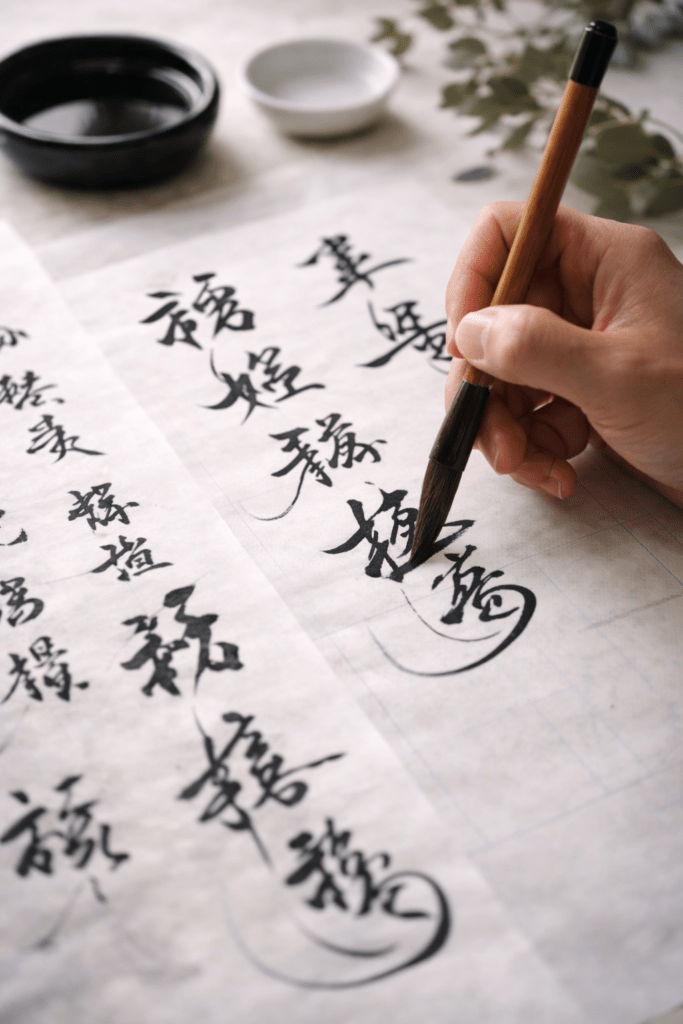
Why Practice Exercises Matter More Than Theory
Understanding calligraphy styles is important.
But understanding alone does not improve your writing.
👉 improvement comes from structured practice
Many beginners practice randomly:
writing characters repeatedly
switching styles too often
focusing only on copying
This leads to:
slow progress
inconsistent results
frustration
👉 exercises give your practice direction
They isolate specific skills.
They make improvement measurable.
What “Style Practice Exercises” Really Mean
A practice exercise is not just repetition.
It is focused training.
Each exercise targets:
a specific movement
a specific control
a specific skill
👉 exercises break complexity into manageable parts
Instead of writing full characters immediately—
you train the components.
The Three Levels of Practice
All effective calligraphy training follows three levels:
stroke level
structure level
flow level
👉 each level builds on the previous one
Skipping levels leads to instability.
Stroke-Level Exercises
This is the foundation.
Focus on:
individual strokes
Practice:
horizontal lines
vertical lines
dots
hooks
Goals:
consistent thickness
clean beginnings and endings
controlled pressure
👉 repetition builds control
How to Practice
Write one stroke repeatedly.
Focus on:
entry
movement
exit
Do not rush.
Quality matters more than quantity.
Structure-Level Exercises
After stroke control, focus on:
character structure
Practice:
simple characters
balanced compositions
Goals:
correct proportion
proper spacing
alignment
👉 structure creates stability
How to Practice
Use grid paper.
Break characters into parts.
Practice each part separately.
Then combine.
Flow-Level Exercises
After structure, focus on:
movement between strokes
Practice:
stroke connections
transition speed
Goals:
smooth movement
consistent rhythm
natural flow
👉 flow creates continuity
How to Practice
Write slowly.
Focus on transitions.
Gradually increase speed.
Style-Specific Practice Exercises
Each style requires different training.
Kaishu Exercises
Focus on:
precision
structure
control
Exercises:
slow stroke repetition
grid-based character writing
stroke order drills
👉 aim for consistency
Xingshu Exercises
Focus on:
connection
flow
transition
Exercises:
connecting strokes
reducing pauses
writing at moderate speed
👉 aim for smooth movement
Caoshu Exercises
Focus on:
expression
speed
continuity
Exercises:
continuous writing
simplifying characters
rhythm training
👉 aim for controlled freedom
Lishu Exercises
Focus on:
horizontal expansion
stroke endings
Exercises:
horizontal stroke practice
ending variation drills
👉 aim for rhythm and balance
Zhuanshu Exercises
Focus on:
line consistency
symmetry
Exercises:
uniform stroke repetition
symmetrical character practice
👉 aim for evenness
The Most Effective Practice Methods
Repetition with Awareness
Do not repeat mindlessly.
Focus on improvement.
Slow Practice
Speed hides mistakes.
Slow practice reveals them.
Segment Practice
Break characters into parts.
Train each part separately.
Comparison Practice
Compare your work with examples.
Identify differences.
👉 awareness accelerates progress
Daily Practice Structure
A simple daily routine:
10 minutes stroke practice
10 minutes structure practice
10 minutes flow practice
👉 consistency is more important than duration
Even short sessions are effective if focused.
Common Practice Mistakes
Practicing Without Focus
Repeating without awareness.
Skipping Basics
Moving to complex styles too early.
Practicing Too Fast
Losing control.
Switching Styles Frequently
Reducing consistency.
👉 discipline improves results
How to Track Progress
Look for:
consistent strokes
balanced characters
smooth transitions
Progress is gradual.
👉 small improvements matter
Do not expect immediate results.
What Effective Practice Feels Like
At first:
practice feels difficult
strokes feel unstable
With time:
control improves
structure becomes clearer
Eventually:
movement becomes natural
👉 practice becomes enjoyable
This is a key shift.
How Long It Takes to See Improvement
With consistent practice:
visible improvement in weeks
solid control in months
Mastery takes longer.
👉 progress depends on consistency
There is no shortcut.
FAQ
What are the best calligraphy exercises for beginners?
Stroke repetition, grid-based writing, and slow practice.
How often should I practice?
Daily practice is ideal.
Should I practice full characters or strokes?
Start with strokes, then move to characters.
How do I improve faster?
Practice with focus and correct mistakes.
Can I practice multiple styles at once?
It is better to focus on one style at a time.
Final Thought
Calligraphy is not learned through theory.
It is learned through practice.
Each stroke you repeat—
builds control.
Each character you write—
builds structure.
Each movement you refine—
builds flow.
Exercises give your practice direction.
They turn effort into progress.
They turn repetition into skill.
And over time—
what once felt difficult—
becomes natural.
Not forced.
Not mechanical.
But controlled.
Balanced.
Alive.
One exercise at a time.