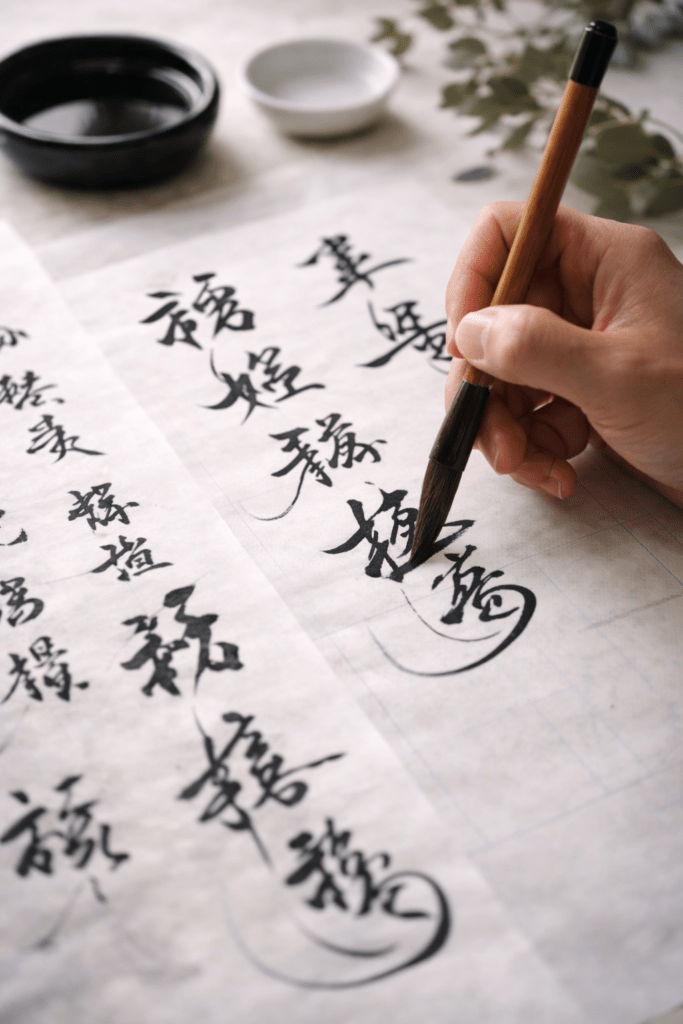
Why Beginners Get Confused About Styles
When you first discover Chinese calligraphy, you quickly realize something:
There is not just one style.
There are many.
Kaishu
Xingshu
Caoshu
Lishu
Zhuanshu
Each looks different.
Each feels different.
And naturally, you ask:
👉 which one should I start with?
This is where most beginners get stuck.
They try multiple styles at once.
They switch too quickly.
They follow what looks interesting—not what builds skill.
👉 without guidance, learning becomes inefficient
This guide gives you a clear starting point.
What “Calligraphy Style” Means for Beginners
A calligraphy style is not just a visual form.
It is a system of:
stroke behavior
structure
movement
Each style trains a different skill.
👉 styles are learning tools
Not just artistic choices.
If you choose the wrong starting point—
you make learning harder.
The Five Main Styles (Simple Overview)
Kaishu (Regular Script)
clear
structured
balanced
👉 best for beginners
Xingshu (Running Script)
flowing
connected
natural
👉 intermediate level
Caoshu (Cursive Script)
fast
expressive
abstract
👉 advanced level
Lishu (Clerical Script)
wide
rhythmic
structured
👉 optional for beginners
Zhuanshu (Seal Script)
symmetrical
uniform
calm
👉 useful for control training
👉 understanding these roles is important
The Best Style for Beginners
The answer is simple:
👉 start with Kaishu
Why Kaishu?
It teaches:
stroke clarity
structure
balance
Everything is:
visible
defined
consistent
👉 Kaishu builds your foundation
Without it:
other styles become unstable.
What You Learn From Each Style
Kaishu teaches:
control
precision
discipline
Xingshu teaches:
flow
connection
movement
Caoshu teaches:
expression
speed
energy
Lishu teaches:
rhythm
horizontal balance
Zhuanshu teaches:
consistency
symmetry
👉 each style develops a different skill
This is why order matters.
The Correct Learning Path for Beginners
Follow this sequence:
Kaishu → Xingshu → Caoshu
Optional:
Lishu and Zhuanshu as support styles
👉 this path moves from structure to expression
Step 1: Focus on Kaishu
Practice:
basic strokes
simple characters
Goal:
stable structure
consistent strokes
Step 2: Introduce Xingshu
Practice:
connections
flow
Goal:
smooth movement
Step 3: Explore Caoshu
Practice:
continuous writing
simplification
Goal:
controlled expression
👉 do not skip steps
How to Choose Your First Practice Style
Choose Kaishu.
But also choose:
simple characters
clear examples
Avoid:
complex works
advanced styles
👉 simplicity improves learning
How Beginners Should Practice Styles
Focus on One Style
Do not mix styles.
Stay consistent.
Practice Slowly
Speed creates mistakes.
Build control first.
Repeat Core Patterns
Practice the same characters multiple times.
👉 repetition builds skill
Observe Before Writing
Study examples carefully.
Understand structure.
Common Beginner Mistakes
Trying Multiple Styles at Once
Leads to confusion.
Skipping Kaishu
Weakens foundation.
Writing Too Fast
Reduces control.
Copying Without Understanding
Slows improvement.
👉 awareness prevents mistakes
How Long to Stay in Each Style
There is no fixed time.
Move forward when:
your strokes are consistent
your structure is stable
👉 skill determines progression
Do not rush.
What Progress Looks Like for Beginners
At first:
writing feels difficult
Then:
strokes become clearer
Later:
structure becomes stable
Eventually:
movement feels natural
👉 progress is gradual
Stay consistent.
How Styles Shape Your Learning Experience
Each style changes how you think about writing.
Kaishu:
teaches discipline
Xingshu:
teaches flow
Caoshu:
teaches expression
👉 styles shape your approach
They are not just techniques.
They influence how you move.
FAQ
What is the best calligraphy style for beginners?
Kaishu is the best starting point.
Can beginners learn Xingshu first?
It is not recommended. Start with Kaishu.
Is Caoshu suitable for beginners?
No, it requires a strong foundation.
Should I learn multiple styles at once?
Focus on one style first.
How do I know when to move to the next style?
When your current style becomes stable and consistent.
Final Thought
Starting calligraphy is not about choosing what looks exciting.
It is about choosing what builds skill.
Each style has its place.
Each step has its purpose.
If you begin with structure—
flow will come naturally.
If you build control—
expression will follow.
Do not rush ahead.
Do not skip steps.
Start simply.
Practice consistently.
And over time—
your writing will grow.
From careful strokes—
to natural movement—
to expressive form.
One style at a time.