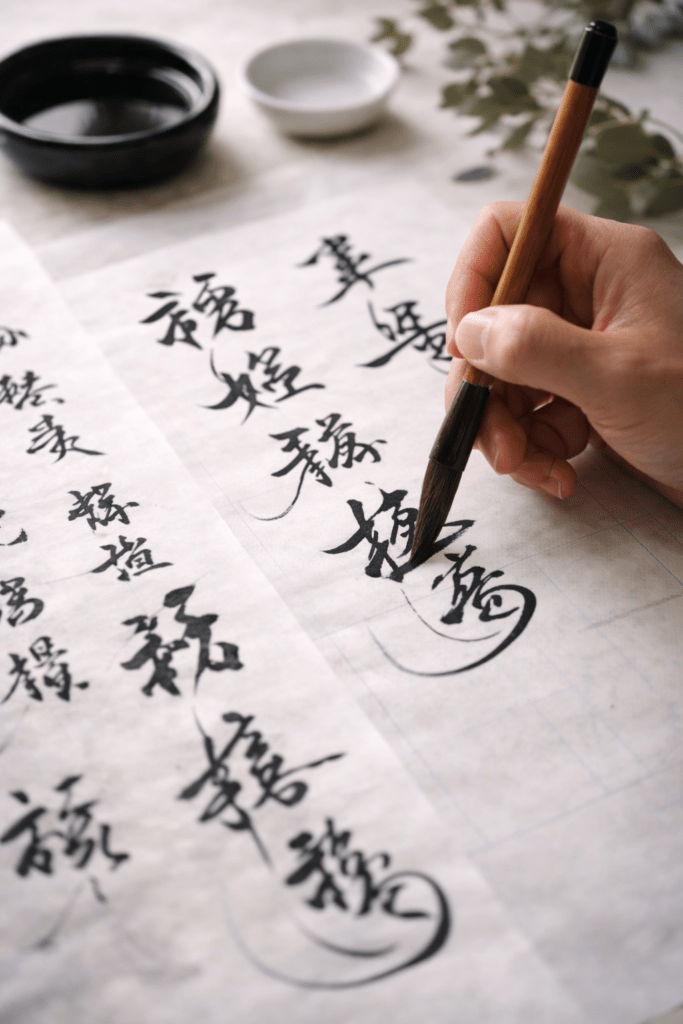
Style Summary: A Clear and Complete Overview of Chinese Calligraphy Styles for Learning, Practice, and Understanding
Why a Style Summary Matters
After learning about multiple calligraphy styles, it is easy to feel overwhelmed.
Each style has:
different strokes
different structure
different movement
You may understand them individually—
but struggle to see the whole picture.
👉 a summary brings everything together
It simplifies what you have learned.
It helps you:
review key ideas
see connections
reinforce understanding
👉 clarity comes from seeing the system as a whole
What This Summary Covers
This summary focuses on:
the five core styles
their key characteristics
their role in learning
👉 it is not detailed explanation
It is structured understanding.
The Five Core Calligraphy Styles
Zhuanshu (Seal Script)
Key traits
smooth lines
uniform thickness
symmetrical structure
Core quality
consistency
Role in learning
develops control and patience
👉 calm and balanced
Lishu (Clerical Script)
Key traits
wide structure
strong horizontal strokes
distinct endings
Core quality
rhythm
Role in learning
improves structural awareness
👉 grounded and stable
Kaishu (Regular Script)
Key traits
clear strokes
balanced proportions
defined structure
Core quality
precision
Role in learning
builds foundation
👉 structured and reliable
Xingshu (Running Script)
Key traits
partial connections
fluid movement
flexible structure
Core quality
flow
Role in learning
develops movement and rhythm
👉 natural and continuous
Caoshu (Cursive Script)
Key traits
continuous strokes
simplified forms
dynamic movement
Core quality
expression
Role in learning
develops creativity and energy
👉 free and expressive
The Core Differences in One View
Structure
Zhuanshu: symmetrical
Lishu: wide
Kaishu: balanced
Xingshu: flexible
Caoshu: abstract
Stroke Behavior
Zhuanshu: even
Lishu: varied
Kaishu: controlled
Xingshu: connected
Caoshu: continuous
Movement
Zhuanshu: minimal
Lishu: rhythmic
Kaishu: controlled
Xingshu: flowing
Caoshu: dynamic
👉 each style changes how writing behaves
The Learning Order (Most Important Insight)
The correct learning path is:
Kaishu → Xingshu → Caoshu
Optional:
Lishu
Zhuanshu
👉 this order builds skill step by step
From:
structure → flow → expression
Skipping this order creates problems.
The Five Core Skills Developed Through Styles
Each style trains a specific skill.
Control
Zhuanshu
Kaishu
Structure
Kaishu
Lishu
Flow
Xingshu
Energy
Xingshu
Caoshu
Expression
Caoshu
👉 styles are tools for skill development
Not just visual forms.
How Styles Connect to Each Other
Styles are not separate.
They are connected stages.
Zhuanshu leads to Lishu
Lishu leads to Kaishu
Kaishu leads to Xingshu
Xingshu leads to Caoshu
👉 this is a progression
Understanding this removes confusion.
You begin to see:
how one style transforms into another
The Most Important Principles to Remember
Structure Comes First
Without structure, everything becomes unstable.
Do Not Mix Styles
Each style has its own system.
Practice Consistently
Improvement comes from repetition.
Focus on Movement
Calligraphy is dynamic, not static.
👉 these principles guide your learning
Common Mistakes to Avoid
Skipping Kaishu
Weak foundation.
Practicing Too Many Styles
Confusion and inconsistency.
Writing Too Fast
Loss of control.
Ignoring Composition
Poor balance and structure.
👉 awareness improves progress
What Progress Looks Like
At first:
styles feel confusing
Then:
differences become clearer
Later:
you recognize styles easily
Eventually:
you write with intention
👉 progress is gradual
Stay consistent.
How to Use This Summary
Review Regularly
Use it to reinforce understanding.
Check Your Practice
Compare your writing with style characteristics.
Adjust Your Approach
Focus on the correct skills.
👉 summary becomes a reference
It supports your learning.
FAQ
What are the main calligraphy styles?
Zhuanshu, Lishu, Kaishu, Xingshu, and Caoshu.
Which style should beginners learn first?
Kaishu.
Why are styles important?
They develop different skills.
Can I skip styles?
No, each stage builds essential ability.
How do I remember all styles?
Focus on key characteristics and practice.
Final Thought
Calligraphy styles are not just categories.
They are a system.
A progression.
A path.
Each style teaches something different.
Each step builds on the last.
From control—
to structure—
to flow—
to expression.
You do not need to master everything at once.
You only need to move forward—
step by step.
Understanding first.
Practice second.
Consistency always.
And over time—
what once felt complex—
becomes clear.
Not because it changed—
but because you did.
One step at a time.