Why It’s So Hard to Stay Present Today
Most people don’t struggle with time.
They struggle with attention.
You may sit still—
but your mind doesn’t.
It moves between:
- Past memories
- Future worries
- Endless thoughts
Even when nothing is happening externally—
something is always happening internally.
This creates a constant sense of restlessness.
And that’s why mindfulness has become so popular.
Because people are looking for a way to:
- Slow down
- Focus
- Be present
But here’s the problem.
Most approaches to mindfulness feel difficult.
Sitting still.
Watching your breath.
Trying not to think.
For many people, this feels unnatural.
And that’s where craft offers a different path.
What Is Mindfulness (In Simple Terms)
Mindfulness is often misunderstood.
It is not about:
- Stopping thoughts
- Emptying the mind
- Being perfectly calm
It is simply:
👉 Paying attention to what is happening right now
Without judgment.
Without resistance.
That’s all.
But even that can feel difficult—
when your mind is constantly moving.
Why Craft Naturally Leads to Mindfulness
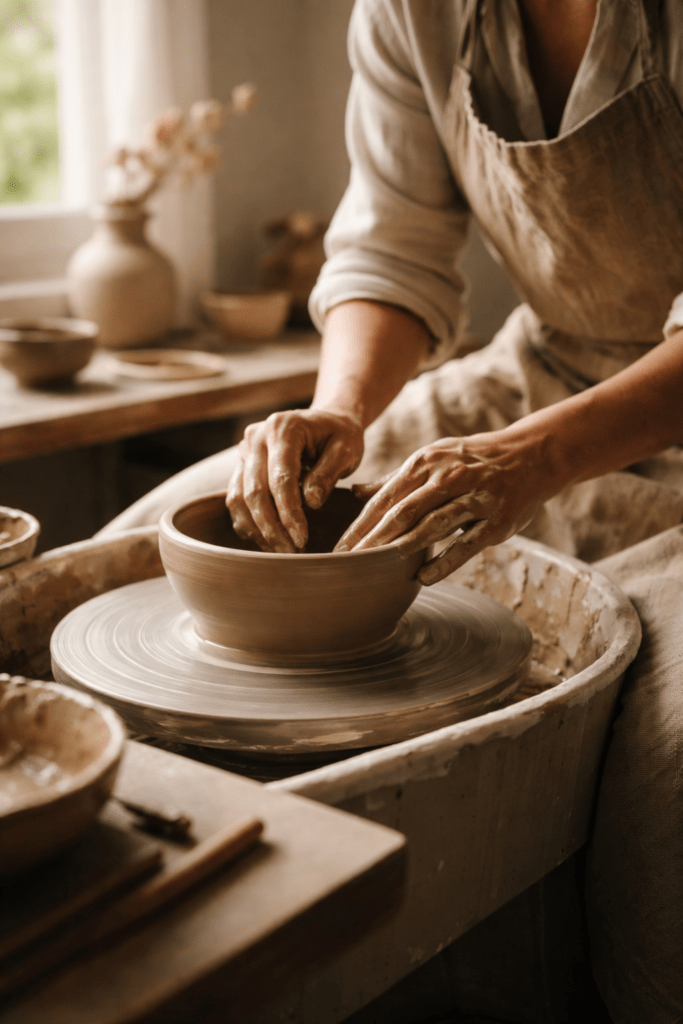
Craft does something unique.
It gives your attention a place to rest.
When you are working with your hands:
- Cutting
- Shaping
- Folding
- Repeating
Your attention follows the action.
You don’t need to force focus.
It happens naturally.
This is what makes craft so powerful.
It creates mindfulness through doing—
not through effort.
The Shift From Thinking to Doing
Most of the time, we live in thinking mode.
We analyze.
We imagine.
We worry.
Craft shifts you into doing mode.
When you are engaged in a physical task:
- Thinking becomes secondary
- Action becomes primary
This reduces mental noise.
Not by removing thoughts—
but by giving your attention something more stable.
How Craft Anchors Your Attention
In mindfulness practice, people often use the breath as an anchor.
In craft, the anchor is different.
It can be:
- The movement of your hands
- The texture of a material
- The rhythm of repetition
These anchors are tangible.
You can feel them.
You can see them.
This makes it easier to stay present.
Because your attention has something real to connect to.
The Role of Repetition in Mindfulness
Repetition is a key part of many crafts.
And it plays an important role in mindfulness.
When you repeat a simple action:
- Your mind begins to settle
- Your body finds a rhythm
- Your attention stabilizes
This repetition creates a quiet mental space.
Not empty—
but steady.
Why Craft Feels Calming Without Trying
Many people notice that crafting feels calming.
But they don’t know why.
The reason is simple.
Craft reduces the gap between:
- Attention
- Action
When these two align—
there is less internal conflict.
You are not divided.
You are engaged.
And this creates a sense of calm.
Craft as Active Meditation
Meditation is often seen as stillness.
But it doesn’t have to be.
Craft is a form of active meditation.
You are:
- Moving
- Creating
- Engaging
But your attention remains focused.
You are present in the activity.
This makes craft an accessible form of mindfulness.
Especially for people who struggle with traditional meditation.
The Sensory Experience of Mindful Crafting
Craft engages the senses in a direct way.
You feel:
- Texture
- Pressure
- Movement
You see:
- Detail
- Form
- Change
This sensory input keeps your attention grounded.
You are not lost in abstract thoughts.
You are connected to what is happening now.
Letting Go of Control Through Craft
Many people try to control their thoughts.
This often creates more tension.
Craft offers a different approach.
Instead of controlling—
you engage.
You follow the process.
You allow things to unfold.
Mistakes happen.
Adjustments are made.
There is no need for perfection.
This creates a more relaxed mental state.
Why Craft Helps With Overthinking
Overthinking happens when attention has no stable anchor.
It moves freely between thoughts.
Craft gives attention structure.
It provides:
- A clear task
- A defined process
- A physical focus
This reduces the space for excessive thinking.
Not by force—
but by redirection.
How to Practice Mindfulness Through Craft
You don’t need a complex method.
Keep it simple.
Choose a basic craft.
Sit in a quiet space.
Begin slowly.
Pay attention to:
- Your hands
- Your movements
- The material
If your mind wanders, that’s fine.
Just return your attention to what you are doing.
This is the practice.
What to Avoid When Using Craft for Mindfulness
Trying to be perfect
Rushing through the process
Multitasking while crafting
Judging your results
All of these pull you out of the present moment.
Mindful crafting is not about outcome.
It is about attention.
The Long-Term Effect of Craft and Mindfulness
Over time, something changes.
Your attention becomes more stable.
You become more aware of:
- Your thoughts
- Your reactions
- Your habits
You respond more slowly.
More clearly.
This is not something you force.
It develops naturally.
Through repeated practice.
Why Crafting Feels Meaningful
When you are fully present in an activity—
it feels meaningful.
Not because of the result.
But because of the experience.
Craft creates these moments.
Small, simple, focused.
And that is enough.
Common Misunderstandings About Mindfulness and Craft
Some people think mindfulness requires silence and stillness.
It does not.
Others think they need to clear their mind.
They don’t.
Some believe crafting is just a hobby.
But it can be a form of awareness practice.
Understanding this changes how you approach it.
FAQ
What is mindfulness in crafting?
It is the practice of paying full attention to the process of making something by hand.
Can crafting replace meditation?
For many people, crafting can serve as an alternative form of meditation.
Why does crafting help with focus?
Because it anchors attention in physical action and reduces distractions.
Do I need experience to practice mindful crafting?
No. Beginners can experience mindfulness through simple crafts.
How long should I practice mindful crafting?
Even 10–20 minutes can be effective when done with attention.
Final Reflection
Mindfulness does not require you to stop.
It does not require you to control your mind.
It only asks you to be present.
Craft gives you a way to do that—
naturally.
Through your hands.
Through your attention.
Through simple action.
You don’t need to think about it too much.
Just begin.
And let what you are doing—
bring you back
to where you already are.