Why Tools Feel Confusing for Beginners
When you first enter the world of craft, one of the most overwhelming parts is not the craft itself—
it’s the tools.
You start searching, and suddenly you see:
- Dozens of tool types
- Different sizes and materials
- Expensive kits and specialized equipment
It quickly becomes confusing.
You may begin to wonder:
Do I need all of this?
Am I missing something important?
What should I actually start with?
This confusion often leads to two extremes:
Buying too much
Or not starting at all
But the truth is simple.
You don’t need many tools.
You only need the right ones.
What Craft Tools Really Are
At its core, a tool is just this:
👉 Something that helps you shape a material
That’s it.
Tools are not the goal.
They are not what makes you good.
They are simply extensions of your hands.
A tool allows you to:
- Cut
- Shape
- Measure
- Join
- Refine
Understanding this removes a lot of pressure.
You are not collecting tools.
You are learning how to use them.
The Most Important Rule for Beginners
Before anything else, remember this:
Start with fewer tools.
More tools do not mean better results.
In fact, too many tools can:
- Slow you down
- Confuse your process
- Distract your attention
The goal is simplicity.
One tool, used well, is more valuable than many tools used poorly.
The Core Types of Craft Tools
Most craft tools fall into a few basic categories.
Understanding these categories makes everything clearer.
Cutting Tools
These are used to divide materials.
Examples:
- Scissors
- Craft knives
- Cutting blades
They are essential for almost every type of craft.
Learning control is more important than speed.
Shaping Tools
These tools help you form materials.
Examples:
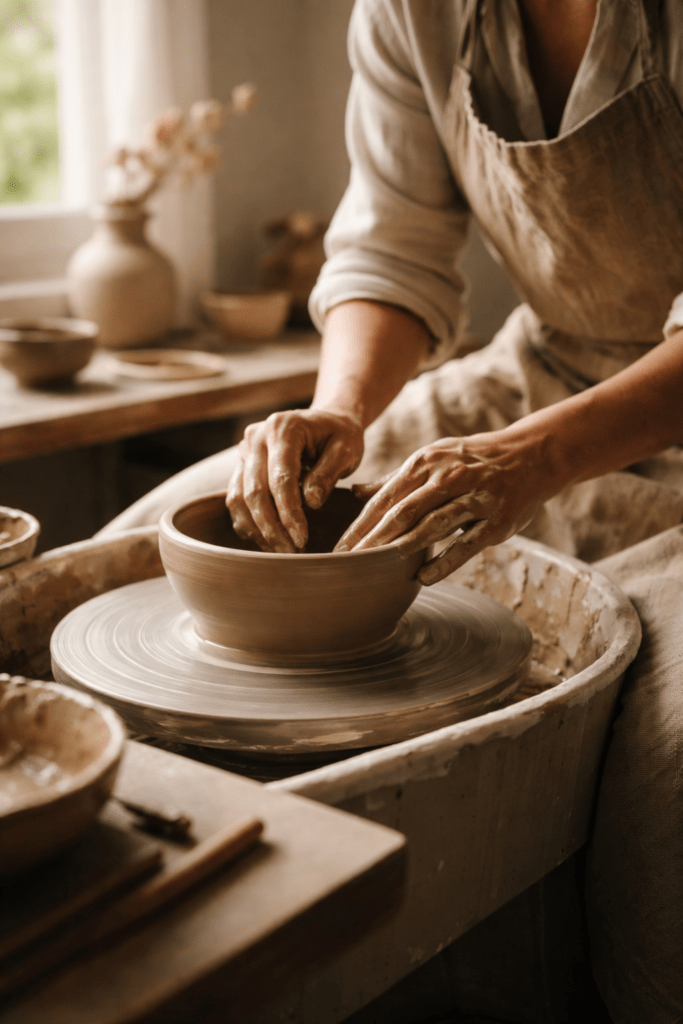
- Hands (the most important tool)
- Clay tools
- Carving tools
They allow you to move from rough form to refined shape.
Measuring Tools
These provide accuracy.
Examples:
- Rulers
- Measuring tapes
- Marking tools
They help maintain proportion and consistency.
Joining Tools
These help connect materials.
Examples:
- Glue
- Adhesives
- Fastening tools
They allow separate parts to become one.
Finishing Tools
These refine the final result.
Examples:
- Sandpaper
- Brushes
- Polishing tools
They improve texture, appearance, and detail.
The Only Tools You Really Need to Start
If you are a beginner, your setup can be extremely simple.
A basic starter setup might include:
- A pair of scissors or a cutting tool
- A simple measuring tool
- A basic joining method (like glue)
- Your material
That’s enough.
You do not need a full toolkit.
You need a starting point.
Choosing Tools Based on Your Craft
Different crafts use different tools.
But the principle remains the same.
Choose tools based on:
- The material you use
- The action you perform
For example:
Paper craft → scissors, glue, ruler
Clay craft → hands, shaping tools
Textile craft → needles, thread, scissors
You don’t choose tools first.
You choose the craft first.
Quality vs Quantity
Beginners often ask:
Should I buy cheap tools or expensive ones?
The answer is:
Start simple, but avoid very low quality.
Poor tools can:
- Break easily
- Reduce control
- Create frustration
But expensive tools are not necessary either.
Choose tools that are:
- Reliable
- Comfortable to use
- Appropriate for your level
Quality matters—but only to a point.
Skill matters more.
How to Use Tools Properly
Using tools well is more important than having many tools.
Focus on:
Control over speed
Accuracy over force
Consistency over perfection
Move slowly.
Pay attention to how the tool interacts with the material.
Let the tool guide your movement.
Over time, this becomes natural.
Safety Basics Every Beginner Should Know
Craft tools are simple—but they still require care.
Basic safety includes:
- Using tools for their intended purpose
- Keeping tools clean and in good condition
- Working in a stable, well-lit space
- Avoiding rushing
Pay attention to your hands.
Awareness is your best protection.
Common Beginner Mistakes with Tools
Buying too many tools
Choosing tools before choosing a craft
Using tools too quickly or forcefully
Ignoring safety
Expecting tools to replace skill
These mistakes create unnecessary difficulty.
The solution is always the same:
Simplify.
When to Upgrade Your Tools
You do not need better tools immediately.
Upgrade only when:
- You understand your craft
- You use a tool regularly
- You feel limited by your current tools
At that point, better tools can:
- Improve efficiency
- Increase precision
- Enhance comfort
But upgrading too early has little benefit.
The Relationship Between Tool and Skill
A tool does not create skill.
Skill develops through:
- Practice
- Attention
- Repetition
A skilled person can create with simple tools.
An unskilled person will struggle even with advanced tools.
This is important to remember.
Focus on your ability.
Not your equipment.
Tools as Extensions of Your Hands
The more you practice, the more tools begin to feel natural.
They become:
- Familiar
- Comfortable
- Responsive
At this stage, tools are no longer separate from you.
They become part of your process.
This is where crafting begins to feel smooth.
How to Build Your Tool Set Over Time
Start small.
Add tools gradually.
Each new tool should have a clear purpose.
Avoid collecting tools without using them.
A good tool set is not large.
It is:
- Practical
- Functional
- Well-used
FAQ
What tools do I need to start crafting?
Basic tools like scissors, a measuring tool, and simple materials are enough to begin.
Do I need expensive craft tools?
No. Simple, reliable tools are sufficient for beginners.
How do I choose the right tools?
Choose tools based on the material and type of craft you are doing.
Are tools important for crafting?
Yes, but skill and practice are more important than tools.
When should I upgrade my tools?
Upgrade when your current tools limit your ability or efficiency.
Final Reflection
Tools are simple.
They are not what defines your craft.
They are not what determines your progress.
They are only there to support you.
What matters is:
Your attention.
Your consistency.
Your willingness to learn.
Start with what you have.
Use it well.
And over time—
your hands will become more skilled
your movements more precise
and your tools—
will simply follow.