Calligraphy and Meditation: How Writing Becomes a Practice of Awareness
Why Calligraphy Feels Like Meditation
Many people come to calligraphy for different reasons.
Some are drawn by its beauty.
Some are interested in culture.
Some simply want to learn something new.
But after practicing for a while, many notice something unexpected.
The mind becomes quieter.
The body slows down.
Attention becomes steady.
And a natural question appears:
Is calligraphy a form of meditation?
The answer is not simple, but it is clear.
Calligraphy is not meditation in the traditional sense.
But it can become one.
Not because you try to meditate.
But because the act of writing creates the same conditions.
What Meditation Actually Means
Before connecting calligraphy and meditation, it helps to understand what meditation is.
Meditation is often misunderstood as:
emptying the mind
stopping thoughts
achieving calm instantly
In reality, meditation is much simpler.
It is the practice of:
👉 maintaining awareness
Awareness of breath.
Awareness of body.
Awareness of the present moment.
Thoughts still appear. Distractions still happen.
But you notice them.
And you return.
Again and again.
How Calligraphy Creates the Same Conditions
When you practice calligraphy, something similar happens.
You focus on the brush.
You observe the movement.
You pay attention to pressure and direction.
If your attention drifts, the stroke changes.
If your mind wanders, the structure weakens.
The feedback is immediate.
So you return.
Not because you force yourself to.
But because the process requires it.
This is the same pattern found in meditation.
Attention moves.
You notice.
You return.
Calligraphy becomes a physical form of this cycle.
The Role of the Body in Awareness
One key difference between calligraphy and seated meditation is the role of movement.
In meditation, you often sit still and observe.
In calligraphy, you move.
But the movement is controlled and intentional.
Your hand, wrist, and arm work together.
Your posture affects stability.
Your breathing influences rhythm.
This creates a connection between body and awareness.
You are not just observing your mind.
You are observing how your body moves in real time.
This makes calligraphy an active form of awareness.
Breath and Rhythm
Although calligraphy does not explicitly focus on breathing, the two are connected.
When you are tense, your breath becomes shallow.
Your strokes become rigid.
When you relax, your breath deepens.
Your movement becomes smoother.
Over time, you begin to notice this relationship.
You do not need to control your breathing deliberately.
It adjusts naturally as your movement becomes more stable.
This creates a rhythm.
Brush, breath, and movement begin to align.
And that alignment feels similar to meditative flow.
Why Calligraphy Reduces Mental Noise
Modern life constantly stimulates the mind.
Information, notifications, and tasks compete for attention.
This creates mental noise.
Calligraphy reduces this noise by limiting what you focus on.
There is only:
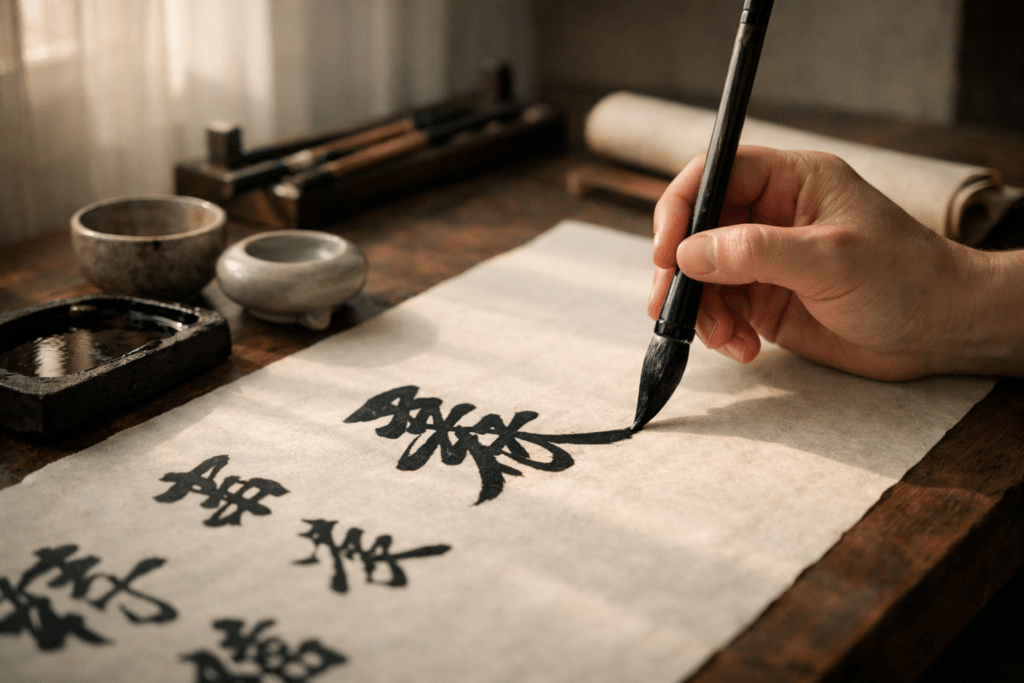
the brush
the ink
the paper
Nothing else demands your attention.
Because the process requires precision, your mind does not have space to wander too far.
It returns to the task.
Again and again.
This repetition quiets unnecessary thinking.
Not by force, but by simplicity.
The Difference Between Relaxation and Awareness
Calligraphy is often described as relaxing.
And it can be.
But relaxation is not the same as awareness.
You can be relaxed and distracted.
You can be calm but not attentive.
Calligraphy goes beyond relaxation.
It requires engagement.
You are involved in what you are doing.
You are not zoning out.
You are present.
This is why calligraphy can feel both calm and focused at the same time.
Common Misconception: You Need to Be Calm First
Some beginners believe they need to be calm before practicing calligraphy.
They think:
“I should relax first, then practice.”
In reality, it works the other way around.
You practice first.
And through practice, calmness appears.
Trying to force a calm state before starting often creates more tension.
Calligraphy does not require a specific mental state.
It creates one.
How to Practice Calligraphy as Meditation
You do not need to change your tools.
You do not need special techniques.
You only need to adjust how you approach practice.
Start by slowing down.
Do not rush to complete characters.
Focus on each stroke.
Notice how the brush touches the paper.
Pay attention to pressure and movement.
If your mind drifts, notice it.
Then return to the stroke.
Do not judge.
Do not force.
Just continue.
This simple approach turns practice into awareness.
It is not about doing something extra.
It is about doing the same thing with more attention.
The Role of Repetition
Repetition is central to both calligraphy and meditation.
In calligraphy, you repeat strokes.
In meditation, you return to the same point of focus.
This repetition is not boring.
It is stabilizing.
Each repetition gives you another chance to notice.
Another chance to adjust.
Another chance to refine.
Over time, repetition builds familiarity.
Familiarity reduces resistance.
And with less resistance, attention becomes easier to maintain.
Why This Practice Feels Different Over Time
At the beginning, calligraphy feels mechanical.
You focus on technique.
You try to control the brush.
You think about how to improve.
But with consistent practice, something changes.
You think less.
You feel more.
Movement becomes smoother.
Attention becomes more stable.
The process becomes less effortful.
This is similar to what happens in meditation.
At first, it feels like work.
Later, it becomes natural.
The Limits of Comparison
Calligraphy is not a replacement for meditation.
It does not follow the same structure.
It does not aim for the same outcomes.
But it shares important qualities:
attention
presence
repetition
For some people, calligraphy becomes their primary way of developing awareness.
For others, it complements other practices.
There is no single correct way to use it.
What matters is how you engage with it.
FAQ
Is calligraphy a form of meditation?
It is not traditional meditation, but it can create the same conditions for awareness.
Does calligraphy help with mindfulness?
Yes, because it requires attention to movement, pressure, and structure.
Do I need to meditate before practicing calligraphy?
No. Calligraphy itself can create a focused and calm state.
Why does calligraphy feel calming?
Because it slows movement and reduces mental distractions.
Can beginners experience this effect?
Yes, even simple practice can improve focus and awareness.
Final Thought
Calligraphy does not ask you to clear your mind.
It asks you to pay attention.
To the brush.
To the movement.
To the moment in front of you.
You begin by trying to write better.
But over time, something else happens.
You become more aware of how you move, how you focus, and how you respond.
And in that awareness, there is a kind of quiet.
Not forced.
Not artificial.
Just present.
Stroke by stroke.