Calligraphy and Mindfulness: How Writing Becomes a Practice of Being Present
Why Calligraphy Naturally Leads to Mindfulness
Many people begin calligraphy for practical or aesthetic reasons.
They want to learn a traditional art.
They want to improve their writing.
They are curious about the process.
But after some time, something unexpected happens.
They feel more present.
More focused.
Less scattered.
And they realize:
This is not just writing.
This is something closer to mindfulness.
Calligraphy does not advertise itself as a mindfulness practice.
But the way it is practiced naturally creates the same conditions.
What Mindfulness Actually Is
Mindfulness is often misunderstood as relaxation or calmness.
But at its core, mindfulness is simple:
👉 paying attention to the present moment, without distraction
It is not about removing thoughts.
It is not about forcing stillness.
It is about noticing what is happening as it happens.
You observe:
your movement
your breath
your attention
And when your mind drifts, you return.
This process repeats continuously.
Calligraphy follows this same pattern.
Attention and Movement
In calligraphy, your focus is tied directly to your movement.
You watch the brush.
You feel the pressure.
You guide the stroke.
If your attention weakens, the line changes.
If your focus breaks, the structure collapses.
This creates a clear connection between attention and result.
You do not need to remind yourself to stay present.
The process itself brings you back.
This is what makes calligraphy naturally mindful.
You are not trying to be present.
You are required to be present.
The Feedback Loop of Awareness
Calligraphy creates an immediate feedback loop.
Action leads to result.
Result reflects action.
If your movement is stable, the stroke is clean.
If your movement is uneven, the stroke shows it.
This feedback is direct and visible.
It allows you to notice small changes.
You begin to see how your internal state affects your external result.
Tension becomes visible.
Distraction becomes visible.
Control becomes visible.
This awareness builds naturally over time.
You do not analyze it.
You experience it.
Slowing Down Without Resistance
Mindfulness often requires slowing down.
But slowing down can feel unnatural.
The mind resists it.
Calligraphy makes slowing down necessary.
You cannot rush a stroke and maintain structure.
You cannot move quickly and control pressure.
So your movement slows.
And as your movement slows, your attention stabilizes.
This creates a different experience of time.
You are no longer rushing to finish.
You are engaged in the process itself.
This is where mindfulness begins to deepen.
From Thinking to Observing
Most daily activity is driven by thinking.
You plan, evaluate, and react.
In calligraphy, thinking has limits.
You can think about structure and technique.
But once the brush touches the paper, thinking must give way to observation.
You watch what happens.
You feel how the brush moves.
You adjust in real time.
This shift from thinking to observing is central to mindfulness.
You are no longer trying to control everything mentally.
You are responding to what is actually happening.
Letting Go of Perfection
Many beginners approach calligraphy with the goal of making perfect characters.
This creates tension.
You try too hard.
You grip too tightly.
You overcorrect.
The result becomes rigid.
Mindfulness requires a different approach.
Instead of aiming for perfection, you pay attention to the process.
You focus on:
how the stroke begins
how it moves
how it ends
If the result is imperfect, you notice it without judgment.
You adjust in the next attempt.
This reduces pressure.
You are no longer trying to achieve something immediately.
You are learning through repetition.
The Role of Repetition
Repetition is often seen as boring.
But in calligraphy, repetition is essential.
You repeat strokes.
You repeat characters.
You repeat movements.
Each repetition gives you another opportunity to notice.
At first, the differences are small.
But over time, your awareness sharpens.
You begin to feel subtle changes.
You notice when your pressure shifts slightly.
You notice when your movement becomes smoother.
This deepens your connection to the process.
Repetition becomes a way of refining attention.
Mindfulness Through the Body
Calligraphy is not only mental.
It is physical.
Your posture affects stability.
Your grip affects control.
Your arm movement affects flow.
Mindfulness in calligraphy includes awareness of the body.
You notice tension in your hand.
You notice stiffness in your arm.
You notice how your body supports the movement.
As you become more aware, unnecessary tension decreases.
Your movement becomes more efficient.
This physical awareness supports mental clarity.
Common Mistakes That Break Mindfulness
Some habits prevent calligraphy from becoming a mindful practice.
Rushing is the most common.
When you try to finish quickly, attention drops.
The process becomes mechanical.
Another mistake is focusing only on the result.
If you only care about how the character looks, you ignore how it was created.
This disconnect reduces awareness.
Overthinking is also a problem.
Too much analysis interrupts natural movement.
Balance is important.
You need enough awareness to guide the process, but not so much that it becomes forced.
How to Practice Calligraphy Mindfully
You do not need special techniques.
You only need a different approach.
Slow down your movement.
Focus on one stroke at a time.
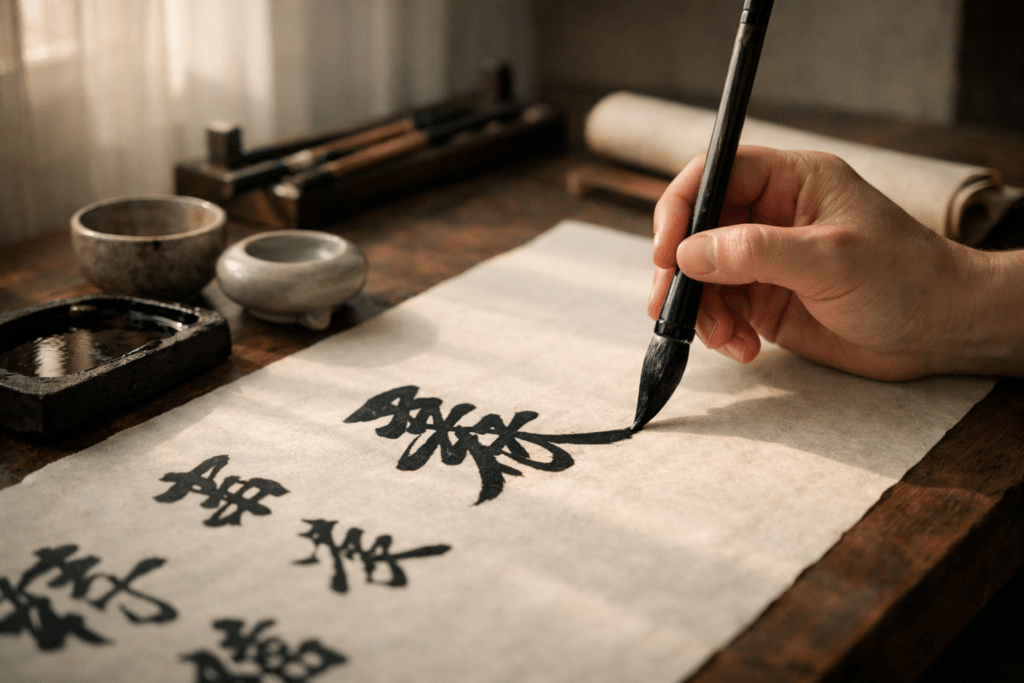
Notice how the brush touches the paper.
Feel the pressure as it changes.
Watch the ink as it spreads.
If your mind drifts, notice it.
Then return to the stroke.
Do not judge the result.
Do not rush to correct.
Just continue.
This is enough.
Over time, this simple approach changes how you experience practice.
The Long-Term Effect
With consistent practice, mindfulness becomes more natural.
You do not need to remind yourself to focus.
Attention stabilizes on its own.
You become more aware of small details.
You respond more calmly to mistakes.
You develop a steadier relationship with your own actions.
These changes extend beyond calligraphy.
They influence how you approach other tasks.
How you focus.
How you react.
How you stay present.
Calligraphy becomes more than an activity.
It becomes a way of training attention.
FAQ
Does calligraphy help with mindfulness?
Yes, because it requires continuous attention to movement and structure.
Is calligraphy a mindfulness practice?
It can be, depending on how you approach it.
Do I need experience to benefit from this?
No, even beginners can develop awareness through simple practice.
Why does calligraphy improve focus?
Because it creates immediate feedback between attention and result.
How long does it take to feel mindful while practicing?
Some effects appear quickly, but deeper awareness develops over time.
Final Thought
Calligraphy does not force you to be mindful.
It gives you a process where mindfulness naturally appears.
You begin by trying to control the brush.
You continue by observing your movement.
And eventually, you realize something has changed.
You are more present.
Not because you tried to be.
But because the practice required it.
And that presence stays with you.
Beyond the paper.