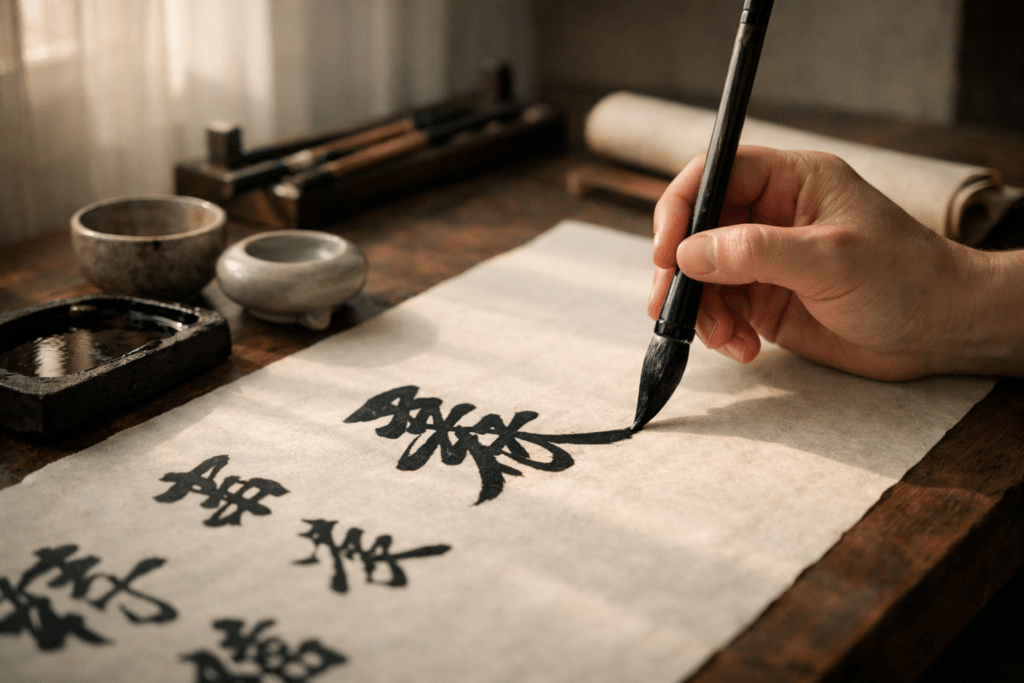
Calligraphy Terminology: Essential Terms Every Beginner Should Understand
Why Terminology Matters in Calligraphy
When you first start learning calligraphy, you quickly encounter unfamiliar terms.
Words like stroke, structure, pressure, and flow appear often.
At first, they can feel confusing.
You may recognize the words, but not fully understand what they mean in practice.
This creates a gap.
You follow instructions, but without clarity.
You practice, but without full awareness.
Understanding terminology helps close that gap.
It gives you a clearer way to think about what you are doing.
It allows you to understand guidance more precisely.
And it helps you observe your own work more effectively.
You do not need to memorize everything at once.
But knowing the core terms will make your learning smoother.
Core Concepts in Calligraphy
Stroke
A stroke is the most basic unit of calligraphy.
Every character is made of strokes.
Each stroke has a beginning, a movement, and an ending.
Learning to control strokes is the foundation of calligraphy.
If strokes are unstable, the entire character becomes unstable.
Structure
Structure refers to how strokes are arranged within a character.
It includes:
balance
spacing
proportion
Good structure makes a character feel stable and complete.
Poor structure makes it look uneven or awkward.
Structure is not about decoration.
It is about organization.
Pressure
Pressure is how much force you apply to the brush.
It changes the thickness and intensity of a stroke.
More pressure creates thicker lines.
Less pressure creates thinner lines.
Controlling pressure allows variation within a single stroke.
This is one of the key differences between calligraphy and handwriting.
Flow
Flow refers to the smoothness and continuity of movement.
A stroke with good flow feels natural and connected.
A stroke without flow feels stiff or interrupted.
Flow comes from relaxed movement and consistent control.
It cannot be forced.
It develops over time.
Balance
Balance is how different parts of a character relate to each other.
It includes:
visual weight
spacing
alignment
A balanced character feels stable.
An unbalanced one may feel tilted or uneven.
Balance is often subtle, but very important.
Alignment
Alignment refers to how strokes are positioned relative to each other.
It affects how straight or organized a character appears.
Even small misalignments can change the overall look.
Good alignment supports clarity and structure.
Spacing
Spacing is the distance between strokes.
It affects readability and balance.
Too much space can make a character feel loose.
Too little space can make it feel crowded.
Learning to control spacing is essential for clean writing.
Movement and Technique Terms
Brush Control
Brush control is your ability to guide the brush accurately.
It includes:
direction
pressure
speed
Good brush control leads to consistent strokes.
It develops through practice and repetition.
Stroke Order
Stroke order is the sequence in which strokes are written.
Following the correct order helps maintain structure.
It also supports smoother movement.
Ignoring stroke order can lead to awkward forms.
Speed
Speed refers to how fast you move the brush.
Too fast, and you lose control.
Too slow, and the stroke may feel stiff.
Finding the right speed is part of developing flow.
Consistency
Consistency means producing similar results repeatedly.
It shows that your control is stable.
Inconsistent strokes indicate areas that need more practice.
Consistency is a sign of progress.
Tool-Related Terms
Brush
The brush is the main tool used in Chinese calligraphy.
It allows variation in line thickness through pressure and movement.
Understanding how to control the brush is essential.
Ink
Ink is the medium that creates the visible stroke.
Its thickness and amount affect how the stroke appears.
Controlling ink is part of controlling the result.
Paper
Paper affects how ink behaves.
It influences:
absorption
spread
texture
Different papers create different results.
Understanding this helps you adjust your technique.
Learning and Practice Terms
Practice
Practice is repeated effort with attention.
It is not just repetition.
It involves observation and adjustment.
Effective practice leads to improvement.
Routine
A routine is a structured way of practicing.
It helps maintain consistency.
A good routine makes practice easier to sustain.
Discipline
Discipline is the ability to practice regularly.
It supports long-term improvement.
Without discipline, progress becomes inconsistent.
Foundation
Foundation refers to your basic skills.
It includes:
stroke control
structure
movement
A strong foundation supports all advanced learning.
Without it, progress becomes unstable.
Common Confusions Beginners Have
Some terms may seem similar but have different meanings.
Flow vs Speed
Flow is about smoothness.
Speed is about how fast you move.
You can move slowly and still have good flow.
Structure vs Shape
Structure is about internal organization.
Shape is the overall appearance.
Good structure leads to better shape.
Pressure vs Force
Pressure is controlled.
Force is uncontrolled.
Calligraphy requires controlled pressure, not force.
How to Use Terminology in Practice
You do not need to remember every term immediately.
Instead, use them as tools for observation.
When you practice, ask yourself:
Is my stroke stable?
Is my structure balanced?
Is my movement smooth?
These questions guide your attention.
They make your practice more intentional.
Over time, the terms become natural.
They become part of how you think.
FAQ
Do I need to learn all terminology at once?
No, focus on core terms and understand them through practice.
Why is terminology important?
It helps you understand instructions and observe your work more clearly.
What is the most important term for beginners?
Stroke, because it is the foundation of all writing.
Is terminology different for each style?
Some terms remain the same, while others may vary slightly.
How can I remember these terms?
Use them during practice instead of memorizing them separately.
Final Thought
Terminology is not just language.
It is a way of seeing.
It helps you understand what is happening in your practice.
It gives you clarity.
It turns vague ideas into specific observations.
You do not need to know everything.
You need to understand enough to guide your attention.
And when your attention becomes clear, your practice becomes more effective.
Not more complicated.
Just more focused.