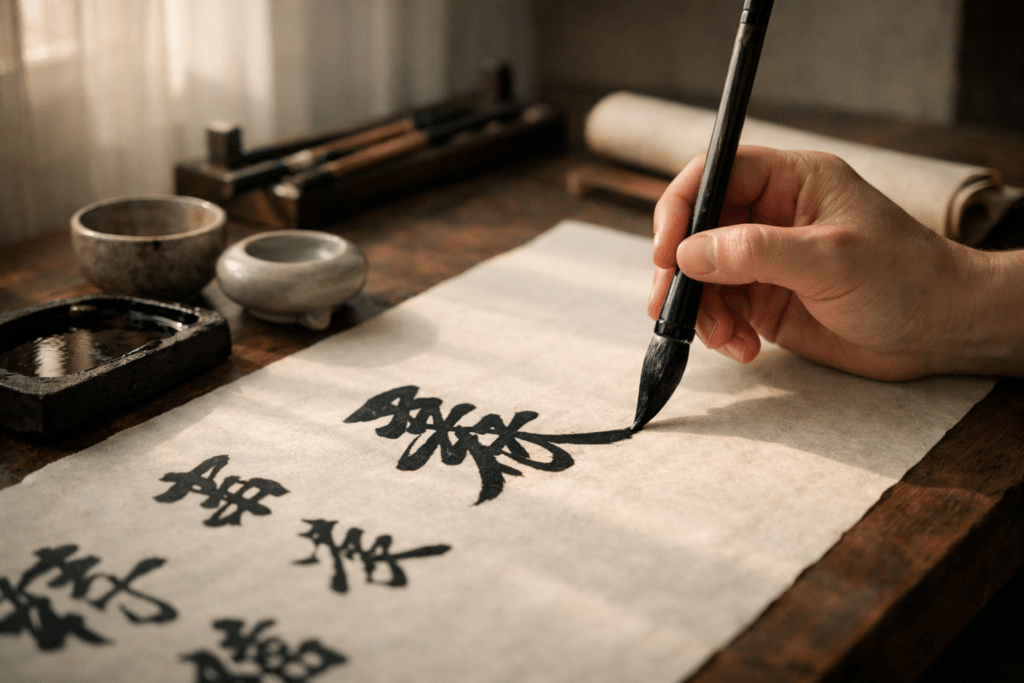
How Long Does It Take to Learn Calligraphy: A Realistic Timeline for Beginners
Why This Question Comes Up So Often
Almost every beginner asks the same question at some point:
How long will it take to learn calligraphy?
It is a natural question.
You want to know what to expect.
You want to understand the commitment.
You want to see if it is worth the effort.
But the answer is not simple.
Because calligraphy is not a skill you “finish.”
It is a skill you develop over time.
Still, there are clear stages of progress.
And understanding them can help you stay on track.
What “Learning Calligraphy” Actually Means
Before talking about time, it is important to define what learning means.
Does it mean:
writing basic strokes correctly?
creating balanced characters?
developing a personal style?
Each of these takes a different amount of time.
If your expectation is unclear, you may feel stuck even when you are improving.
So it helps to think of calligraphy as a process with stages.
Each stage builds on the previous one.
A Realistic Beginner Timeline
The following timeline assumes regular practice.
Not perfect practice.
Not long sessions.
Just consistent effort.
First Week: Awareness
In the first few days, you begin to understand the basics.
You learn:
how to hold the brush
how to control basic movement
how ink behaves
Your strokes may feel unstable.
Your writing may look uneven.
This is normal.
The goal at this stage is not quality.
It is awareness.
You are learning how the system works.
First Month: Basic Control
After a few weeks of consistent practice, something changes.
Your strokes become more stable.
You begin to control pressure more consistently.
You understand basic structure.
Your work may still look rough.
But it is no longer random.
There is intention behind your movement.
This is an important stage.
It shows that your practice is working.
Three Months: Visible Improvement
Around three months, progress becomes more noticeable.
Your characters start to look more balanced.
Your strokes become smoother.
You make fewer obvious mistakes.
You begin to recognize what needs improvement.
At this point, calligraphy starts to feel more natural.
Not easy, but manageable.
Six Months: Stability
With continued practice, your control becomes more stable.
You can repeat strokes more consistently.
Your posture and grip feel more natural.
You understand how different elements interact.
Your work still has room to improve, but it is clearly structured.
You are no longer a beginner in the basic sense.
One Year: Strong Foundation
After about a year of regular practice, you build a solid foundation.
Your strokes are controlled.
Your characters are balanced.
Your movement is more efficient.
You can begin exploring more advanced techniques.
You have enough control to experiment.
At this stage, progress continues, but at a slower pace.
Improvement becomes more subtle.
Beyond One Year: Refinement
After the first year, calligraphy becomes a process of refinement.
You focus on:
precision
consistency
expression
You notice smaller details.
You adjust more carefully.
You develop a deeper understanding of structure and movement.
There is no clear endpoint.
You continue improving over time.
Why Progress Feels Slow
Many beginners feel that calligraphy is slow to learn.
This is partly true.
Calligraphy requires:
repetition
attention
control
These take time to develop.
But there is another reason.
Progress in calligraphy is often subtle.
Changes happen gradually.
You may not notice improvement day by day.
But over weeks and months, the difference becomes clear.
What Affects How Fast You Improve
Not everyone progresses at the same speed.
Several factors influence learning time.
Consistency
Practicing regularly is the most important factor.
Short daily sessions are more effective than occasional long sessions.
Quality of Practice
Focused practice leads to faster improvement.
Random repetition slows progress.
Understanding Fundamentals
Learning proper posture, grip, and basic strokes early makes everything easier later.
Patience
Rushing leads to frustration.
Accepting gradual progress leads to stability.
Tools and Setup
Using simple, consistent tools reduces confusion.
It allows you to focus on technique.
Common Misconceptions About Learning Time
Some beginners believe they should improve quickly.
When this does not happen, they feel discouraged.
Others believe calligraphy takes too long and give up early.
Both views are misleading.
Calligraphy does not improve instantly.
But it does improve reliably.
If you practice consistently, progress will come.
It may not be fast, but it will be steady.
How to Stay Motivated Over Time
Understanding the timeline helps, but staying motivated is still important.
Focus on small improvements.
Notice when your strokes become more stable.
Compare your current work to earlier attempts.
This shows progress more clearly.
Set realistic goals.
Instead of aiming to be “good,” aim to improve one aspect at a time.
Keep your practice simple.
Avoid unnecessary complexity.
Consistency is easier when the process is clear.
FAQ
How long does it take to learn calligraphy?
Basic control can develop in a few weeks, while a strong foundation may take around a year.
Can I learn calligraphy quickly?
You can learn the basics quickly, but mastery takes time and consistent practice.
How often should I practice?
Daily practice, even for 20–30 minutes, is effective.
Why does my progress feel slow?
Because improvements are gradual and often subtle.
Is it too late to start learning calligraphy?
No. Calligraphy can be learned at any age.
Final Thought
Calligraphy is not something you finish.
It is something you continue.
You begin with simple strokes.
You build control over time.
You refine your movement gradually.
There is no fixed endpoint.
Only progress.
If you stay consistent, improvement is inevitable.
Not because it is easy.
But because the process works.
And over time, what once felt difficult becomes natural.