Caoshu Explained: The Complete Guide to Cursive Script (Freedom, Structure, and Mastery)
What Is Caoshu and Why It Matters
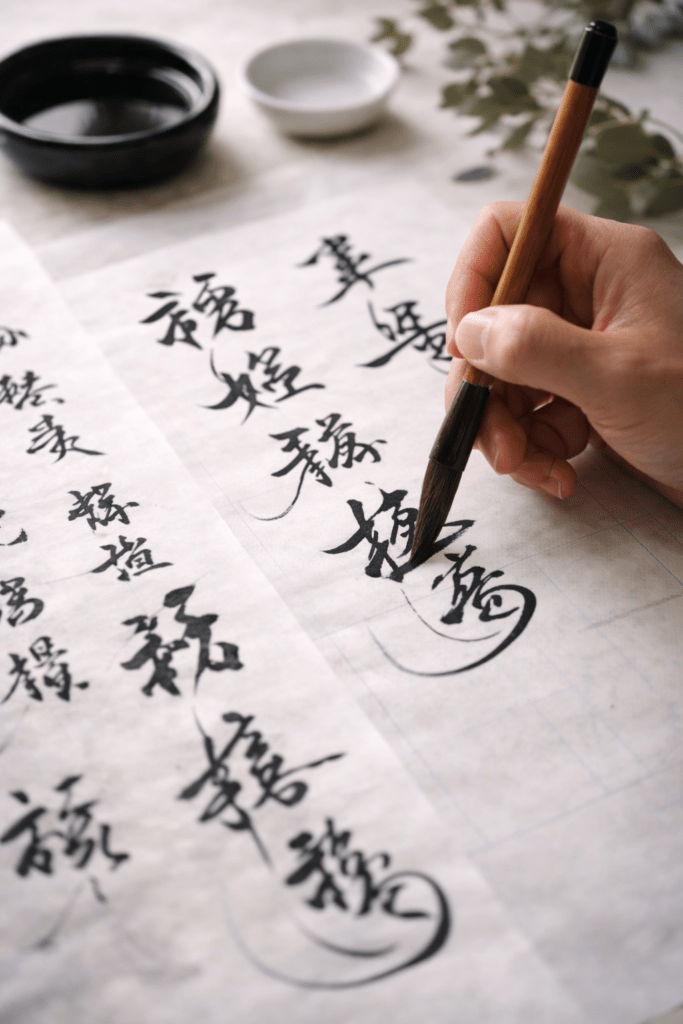
Caoshu, often translated as Cursive Script or Grass Script, is the most expressive and free form of Chinese calligraphy.
At first glance, it may look chaotic.
Strokes seem merged.
Characters appear simplified beyond recognition.
But this impression is misleading.
👉 Caoshu is not disorder
It is highly controlled freedom.
It represents the furthest evolution of calligraphy movement, where:
structure becomes internal
movement becomes continuous
expression becomes dominant
Caoshu is not designed for beginners.
It is a high-level style built on deep understanding of structure, strokes, and movement.
What Defines Caoshu
Caoshu is defined by:
extreme simplification
continuous movement
abstraction of form
Unlike Kaishu, where every stroke is clearly separated, and Xingshu, where some connections exist—
Caoshu transforms the writing process entirely.
Strokes may:
merge into one motion
disappear into gesture
be represented by a single sweeping movement
👉 the brush rarely stops
The writing becomes a flowing line of energy.
The Core Characteristics of Caoshu
To understand Caoshu, focus on its defining qualities.
Continuity
Movement is uninterrupted.
Multiple strokes are often executed in a single motion.
The brush flows across the page.
Simplification
Characters are reduced to essential forms.
Details are removed.
Only the core structure remains.
Abstraction
Forms are no longer literal.
They represent the idea of the character.
Not its exact structure.
Speed and Rhythm
Movement is faster.
Speed varies within strokes.
Rhythm becomes a key element.
Why Caoshu Is Important
Caoshu represents the highest level of calligraphic expression.
It develops:
movement freedom
dynamic control
personal style
It is not about readability.
👉 it is about expression and energy
Caoshu allows the calligrapher to:
translate thought into motion
express emotion through strokes
It is often considered the most artistic form of calligraphy.
The Hidden Structure in Caoshu
Although Caoshu appears free, it still has structure.
This structure is:
internal
compressed
implied
A skilled calligrapher understands:
the original Kaishu structure
the stroke order
the character composition
These elements are not visible in full form—
but they guide the movement.
👉 without internal structure, Caoshu collapses into chaos
Structure is not removed.
It is absorbed.
The Stroke Behavior in Caoshu
Strokes in Caoshu behave very differently.
They are:
merged
compressed
transformed
Merging
Multiple strokes combine into one continuous motion.
Compression
Complex structures are reduced.
Only essential movement remains.
Transformation
Strokes may change shape.
They adapt to flow and speed.
👉 the stroke becomes a gesture
It is no longer a fixed form.
How Caoshu Differs from Other Styles
Compared to Kaishu:
Kaishu:
clear, separate strokes
strict structure
Caoshu:
merged strokes
flexible structure
Compared to Xingshu:
Xingshu:
partially connected
readable
Caoshu:
fully connected
often abstract
👉 Caoshu is the most free, but also the most demanding
It requires mastery of all fundamentals.
Why Beginners Should Not Start with Caoshu
Caoshu may look appealing.
It feels expressive.
But starting with it creates problems.
Without foundation:
strokes become random
structure is lost
habits become incorrect
👉 Caoshu requires deep control
You must first learn:
Kaishu for structure
Xingshu for flow
Then Caoshu becomes possible.
How to Practice Caoshu Effectively
Strengthen Foundation First
Practice Kaishu and Xingshu.
Understand structure and flow.
Without this, Caoshu cannot be controlled.
Study Simplification Patterns
Learn how strokes are reduced.
Observe how characters change.
This builds understanding.
Practice Continuous Movement
Train long, uninterrupted strokes.
Focus on flow and rhythm.
This builds motion control.
Maintain Internal Structure
Even when simplifying, keep balance.
Do not lose character identity.
Study Master Works
Observe how masters:
merge strokes
control movement
maintain rhythm
This is essential for learning.
Common Mistakes in Caoshu
Writing Without Structure
Random strokes create chaos.
Understand the original form.
Over-simplifying
Too much simplification destroys readability.
Keep essential structure.
Moving Too Fast
Speed without control creates disorder.
Build control first.
Imitating Without Understanding
Copying shapes without understanding movement leads to poor results.
Focus on process.
What Good Caoshu Feels Like
When Caoshu is executed well:
movement feels continuous
strokes feel connected
writing feels alive
There is no hesitation.
No stiffness.
The brush moves freely, but with control.
This feeling is important.
Because Caoshu is movement in its purest form.
How Caoshu Connects to Technique
Caoshu integrates all techniques:
flow
speed control
pressure variation
brush angle
rhythm
It is not a separate skill.
👉 it is the result of mastery
All fundamentals must be internalized.
Only then can they be expressed freely.
The Role of Rhythm and Energy in Caoshu
Rhythm guides movement.
Energy drives the stroke.
Speed changes.
Pressure varies.
The writing becomes dynamic.
👉 Caoshu is written in time, not just space
It is a performance of movement.
How Long It Takes to Learn Caoshu
Caoshu takes time.
It is not a beginner style.
At first:
movement feels uncontrolled
structure is difficult to maintain
With practice:
control improves
flow becomes natural
Eventually:
expression becomes possible
This is a long-term process.
FAQ
What is Caoshu in calligraphy?
It is a cursive script with continuous movement and simplified forms.
Is Caoshu readable?
Often difficult to read, especially for beginners.
Should beginners learn Caoshu?
No, it requires strong foundational skills.
Why does Caoshu look messy?
It simplifies and merges strokes, creating abstract forms.
How can I learn Caoshu?
Start with Kaishu and Xingshu, then transition gradually.
Final Thought
Caoshu is not chaos.
It is freedom built on control.
It is structure transformed into movement.
It is technique expressed as energy.
You do not begin with Caoshu.
You arrive at it.
Through practice.
Through discipline.
Through understanding.
And when you reach it, writing becomes more than form.
It becomes motion.
It becomes expression.
It becomes alive.
One continuous movement at a time.