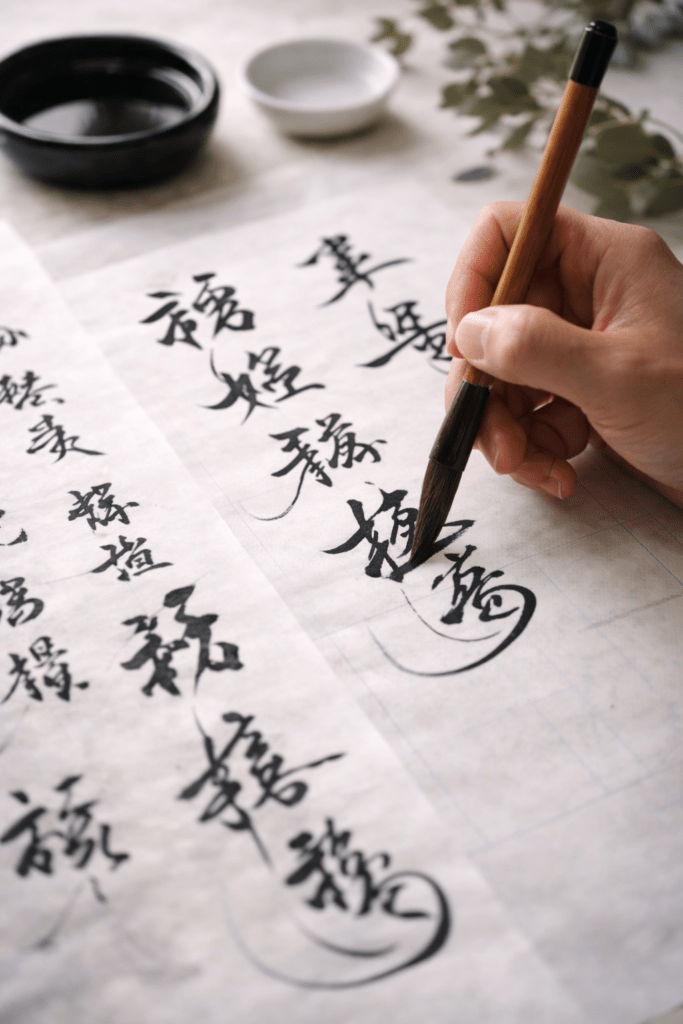
Cursive Script Guide: The Complete Introduction to Caoshu for Speed, Expression, and Advanced Calligraphic Mastery
What Is Cursive Script and Why It Matters
Cursive Script, known as Caoshu, is the most expressive and fastest form of Chinese calligraphy.
It represents the extreme end of calligraphic evolution where:
structure becomes flexible
strokes become simplified
movement becomes continuous
👉 it is writing reduced to pure motion and energy
Unlike Regular Script, which emphasizes clarity, or Running Script, which balances flow and readability, Cursive Script prioritizes:
speed
expression
rhythm
It is often difficult for beginners to read.
But for experienced practitioners, it is one of the most powerful forms of artistic expression.
What Defines Cursive Script
Cursive Script is defined by:
highly simplified forms
connected strokes
continuous movement
Strokes are often merged or omitted.
Brush lifting is minimal.
The writing flows almost without interruption.
👉 characters are suggested, not fully constructed
This creates a dynamic and spontaneous visual effect.
The Core Characteristics of Cursive Script
To understand Cursive Script deeply, focus on its key features.
Simplification
Many strokes are reduced or eliminated.
Characters become more abstract.
The goal is efficiency of movement.
Connection
Strokes connect freely.
Transitions are fluid.
The brush rarely stops.
Speed
Writing is faster than other styles.
Speed influences form.
Rhythm
There is a strong sense of timing and flow.
Writing feels musical.
👉 rhythm replaces rigid structure
Why Cursive Script Is Important
Cursive Script develops:
freedom of movement
expressive control
advanced brush technique
It teaches you to:
write without hesitation
maintain flow under speed
express energy through strokes
👉 it is where technique becomes art
However, it is not suitable as a starting point.
It requires strong fundamentals.
The Structure of Cursive Script Characters
Although highly flexible, structure still exists.
Characters must retain:
recognizable form
internal balance
spatial awareness
Recognizable Form
Even simplified characters should be identifiable.
Over-simplification leads to confusion.
Internal Balance
Weight distribution still matters.
Even in motion, balance must be maintained.
Spatial Awareness
Spacing between elements must be controlled.
Crowding reduces clarity.
👉 structure is hidden, not absent
This is what makes Caoshu difficult.
The Stroke System in Cursive Script
Strokes in Cursive Script are:
abbreviated
merged
fluid
Many strokes are written in one continuous motion.
Brush lifting is minimized.
Transitions replace separation.
👉 the entire character can become a single gesture
This requires advanced control.
How Cursive Script Differs from Other Styles
Compared to Regular Script:
Regular Script:
clear strokes
strict structure
Cursive Script:
merged strokes
flexible structure
Compared to Running Script:
Running Script:
partially connected
still readable
Cursive Script:
fully connected
often abstract
👉 Cursive Script prioritizes expression over clarity
It is less about reading, more about movement.
Types of Cursive Script
There are different levels of Cursive Script.
Zhangcao (Early Cursive)
More structured
less simplified
Jincao (Modern Cursive)
More fluid
more abstract
Kuangcao (Wild Cursive)
Highly expressive
extreme simplification
very difficult to read
👉 most learners start with structured forms
Wild Cursive requires mastery.
How to Practice Cursive Script Effectively
Master Foundations First
Without strong Regular Script skills, Cursive Script becomes chaotic.
Build structure first.
Practice Controlled Simplification
Do not remove strokes randomly.
Understand how characters simplify.
Develop Continuous Movement
Practice writing without lifting the brush.
Focus on smooth transitions.
Control Speed
Speed should come naturally.
Do not force it.
Study Classical Works
Observe master calligraphers.
Understand how they balance freedom and control.
Common Mistakes in Cursive Script
Writing Too Fast Too Early
Speed without control leads to messy writing.
Slow down.
Over-simplifying
Removing too much destroys readability.
Maintain recognizable forms.
Losing Structure
Ignoring balance creates unstable characters.
Keep internal structure.
Random Movement
Uncontrolled motion reduces quality.
Movement must be intentional.
What Good Cursive Script Feels Like
When Cursive Script improves:
movement feels continuous
writing feels effortless
strokes feel connected
There is energy.
There is rhythm.
The writing feels alive and expressive.
This feeling is essential.
Because Cursive Script is about expression through motion.
How Cursive Script Connects to Technique
Cursive Script integrates all techniques:
pressure control
speed control
flow
structure
It demands:
precision within freedom
👉 it is the highest level of coordination
Every movement matters.
The Role of Rhythm and Energy
Cursive Script is driven by rhythm.
Writing should feel:
dynamic
continuous
balanced
Energy flows through the brush.
👉 rhythm guides movement
Without rhythm, writing feels mechanical.
How Long It Takes to Learn Cursive Script
Cursive Script takes time.
At first:
characters may look unclear
movement may feel uncontrolled
With practice:
flow improves
control increases
Over time:
writing becomes expressive and stable
This is a long-term process.
FAQ
What is Cursive Script in calligraphy?
It is a highly simplified and expressive style with connected strokes.
Is Cursive Script difficult to learn?
Yes, it requires strong fundamentals.
Why is it hard to read?
Because strokes are simplified and merged.
Should beginners learn Cursive Script?
Not immediately. Start with Regular Script.
How do I practice it?
Focus on simplification, flow, and controlled movement.
Final Thought
Cursive Script is not about control alone.
It is about release.
It is where structure becomes movement.
Where strokes become rhythm.
Where writing becomes expression.
But it is not random.
It is guided by skill.
Built on foundation.
You do not rush into it.
You grow into it.
And over time, your writing becomes free.
Fluid.
Alive.
Not forced.
But flowing.
One movement at a time.