Hardest Calligraphy Style: Which Chinese Calligraphy Style Is the Most Difficult and Why It Matters for Your Learning
Why This Question Is Often Misunderstood
Many learners ask:
What is the hardest calligraphy style?
At first, it seems like a simple comparison.
But difficulty in calligraphy is not just about how something looks.
👉 it is about the level of control, understanding, and experience required
A style can look simple—but be extremely difficult to execute well.
Another style may look complex—but follow clear structure.
So to answer this question properly, we need to understand:
what makes a calligraphy style difficult
What Makes a Calligraphy Style “Hard”
There are four main factors that determine difficulty.
Level of Structure
Styles with clear structure are easier to learn.
Styles with hidden or flexible structure are harder.
Stroke Complexity
The more variation in stroke control, the harder the execution.
Movement Speed
Faster styles require higher control.
Speed increases difficulty.
Abstraction
The more a style simplifies or transforms characters, the harder it becomes to understand and execute.
👉 difficulty comes from control under complexity
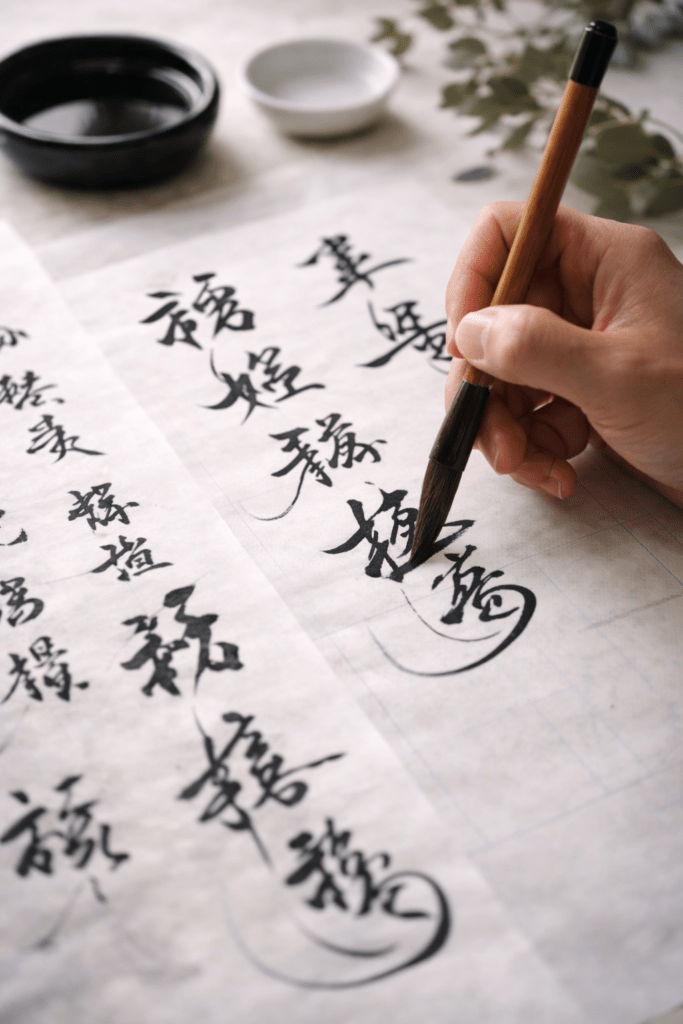
The Hardest Calligraphy Style: Caoshu (Cursive Script)
Among all major styles, Caoshu is generally considered the hardest.
It is defined by:
extreme simplification
continuous movement
high abstraction
👉 it removes visible structure while requiring perfect control
This combination makes it extremely demanding.
Why Caoshu Is the Hardest Style
Minimal Visible Structure
In Caoshu, structure is not clearly shown.
You must understand it internally.
👉 you cannot rely on visual guidance
This requires deep experience.
Extreme Simplification
Many strokes are:
merged
abbreviated
transformed
If you do not know the original structure, you cannot simplify correctly.
High Speed
Caoshu is written quickly.
But speed requires control.
👉 fast movement without control leads to chaos
Continuous Motion
Strokes are connected.
The brush rarely stops.
This requires:
coordination
timing
precision
👉 the entire character can become one movement
Strong Dependence on Foundation
Caoshu depends heavily on:
Kaishu (structure)
Xingshu (flow)
Without these, Caoshu cannot be executed properly.
👉 it is the result of mastery, not a starting point
Why Caoshu Looks Easy but Is Not
Many beginners think:
“it looks free, so it must be easy”
This is incorrect.
The freedom you see is controlled.
👉 it is structured freedom
Without skill, writing becomes:
messy
unreadable
unbalanced
True Caoshu requires:
discipline
experience
control
Other Difficult Styles (But Less Than Caoshu)
Xingshu (Running Script)
Moderately difficult.
Requires:
control of connection
understanding of structure
Less difficult because structure is still visible.
Lishu (Clerical Script)
Requires precision in:
stroke endings
horizontal balance
Challenging, but structured.
Zhuanshu (Seal Script)
Requires:
line consistency
symmetry
Difficult in precision, but slow and controlled.
👉 difficulty is technical, not dynamic
Kaishu (Regular Script)
Often underestimated.
It requires:
precision
discipline
consistency
👉 difficult to master, but not abstract
Its structure makes it learnable.
The Real Difficulty Progression
From easiest to hardest:
Kaishu → Xingshu → Caoshu
Other styles like Lishu and Zhuanshu develop different skills but do not reach the same level of dynamic difficulty as Caoshu.
👉 progression moves from structure to freedom
How to Approach the Hardest Style
If you want to learn Caoshu, follow this path.
Master Kaishu
Develop structure and control.
Without this, everything collapses.
Learn Xingshu
Understand flow and connection.
This prepares you for continuous movement.
Gradually Simplify
Do not jump into extreme simplification.
Reduce strokes step by step.
Practice Controlled Speed
Speed must be developed, not forced.
Maintain awareness.
👉 Caoshu is built, not jumped into
Common Mistakes When Attempting Difficult Styles
Starting Too Early
Without foundation, writing becomes chaotic.
Confusing Speed with Skill
Fast writing without control is not Caoshu.
Over-simplifying
Removing too much destroys structure.
Ignoring Rhythm
Without rhythm, writing feels mechanical.
👉 difficulty requires preparation
What “Mastery” in Caoshu Feels Like
When Caoshu is done well:
movement feels continuous
structure is invisible but present
writing feels alive
There is:
energy
rhythm
control
👉 freedom without losing balance
This is the goal.
Why Understanding Difficulty Matters
Knowing the hardest style helps you:
set realistic expectations
follow the correct learning path
avoid frustration
👉 it keeps your learning structured
Instead of rushing, you build skill step by step.
FAQ
What is the hardest Chinese calligraphy style?
Caoshu (Cursive Script) is generally the hardest.
Why is Caoshu so difficult?
Because it requires control, speed, and understanding of structure without visible guidance.
Is Kaishu difficult?
Yes, but it is structured and easier to learn.
Should beginners learn the hardest style first?
No, they should build foundation first.
How long does it take to learn Caoshu?
It depends on your foundation, but it requires long-term practice.
Final Thought
The hardest style is not the one that looks complex.
It is the one that demands the most from you.
Caoshu asks for:
control
experience
understanding
It removes support.
It removes structure from the surface.
And asks you to create it from within.
You do not start with it.
You grow into it.
Through discipline.
Through practice.
Through progression.
And one day, what once felt impossible—
becomes natural.
Not forced.
Not chaotic.
But free.
One movement at a time.