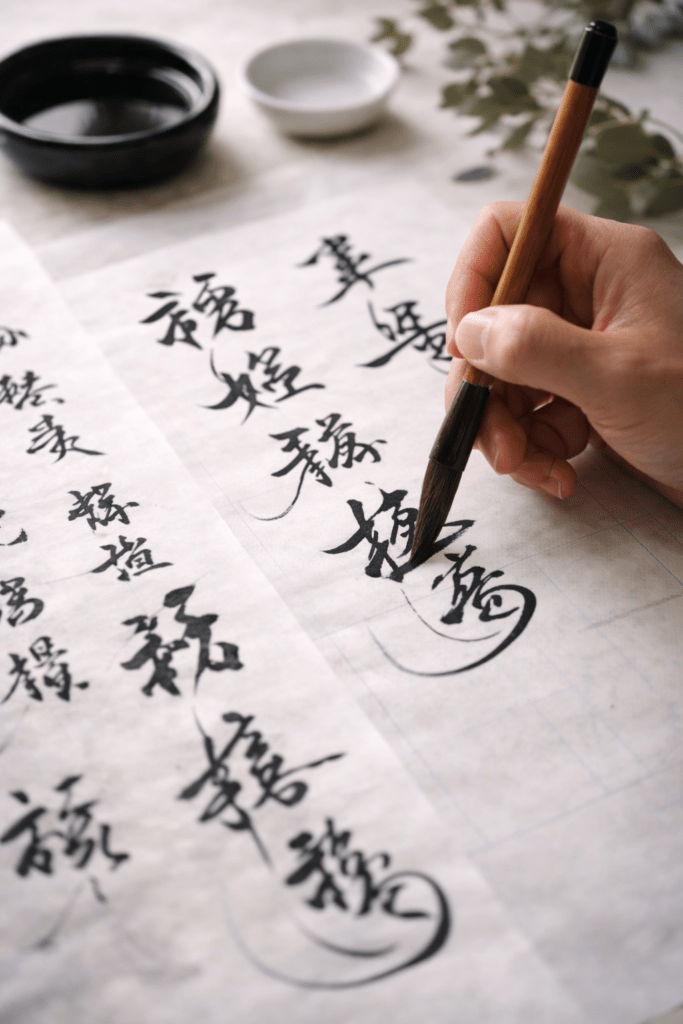
Kaishu vs Xingshu: The Complete Guide to Understanding Structure vs Flow in Chinese Calligraphy
What This Comparison Really Means
Many beginners ask a simple question:
What is the difference between Kaishu and Xingshu?
At first, the answer seems obvious.
Kaishu is neat.
Xingshu is flowing.
But this surface-level understanding is not enough.
👉 the real difference is deeper
It is about:
how strokes are formed
how movement is controlled
how structure is maintained
Understanding this comparison will change how you learn calligraphy.
Because it shows you:
when to control
when to release
What Is Kaishu (Regular Script)
Kaishu is the standard form of Chinese calligraphy.
It is defined by:
clear stroke separation
precise structure
controlled execution
Each stroke is written individually.
Nothing is connected.
Everything is explicit.
👉 Kaishu is about construction
It builds characters step by step.
This makes it:
highly readable
highly structured
technically demanding
It is the foundation of all calligraphy learning.
What Is Xingshu (Running Script)
Xingshu is a semi-cursive style.
It is defined by:
connected strokes
fluid movement
natural rhythm
Strokes are often linked.
Brush lifting is reduced.
Writing becomes continuous.
👉 Xingshu is about movement
It transforms construction into flow.
This makes it:
faster
more expressive
more natural
It is widely used in daily writing and artistic expression.
The Core Difference: Construction vs Flow
The most important difference is this:
Kaishu builds characters.
Xingshu moves through them.
In Kaishu:
each stroke is separate
each step is deliberate
In Xingshu:
strokes connect
movement continues
👉 Kaishu is structure
👉 Xingshu is flow
This difference affects everything.
Stroke Execution Differences
In Kaishu:
strokes have clear beginnings and endings
pressure changes are visible
brush lifts between strokes
In Xingshu:
strokes merge
transitions replace lifting
pressure changes are smoother
👉 the space between strokes disappears
Movement becomes continuous.
Speed Differences
Kaishu:
slow
deliberate
controlled
Xingshu:
faster
more natural
less rigid
But speed in Xingshu is not forced.
It emerges from flow.
👉 speed follows control
Without control, speed creates chaos.
Structure Differences
Kaishu:
strict proportion
fixed alignment
clear spacing
Xingshu:
flexible proportion
adaptive spacing
dynamic balance
However:
👉 Xingshu still depends on structure
Without structural understanding from Kaishu, Xingshu becomes unstable.
Readability Differences
Kaishu:
highly readable
standardized
Xingshu:
generally readable
sometimes simplified
Xingshu simplifies strokes, but keeps recognizable forms.
👉 it balances clarity and efficiency
Learning Order: Which Comes First
This is critical.
👉 Kaishu must come first
Kaishu teaches:
stroke control
structure
discipline
Xingshu builds on that foundation.
If you start with Xingshu:
structure weakens
strokes become inconsistent
writing becomes messy
👉 control before flow
This is the correct path.
How Practice Feels Different
Kaishu Practice
slow
focused
analytical
You think about:
stroke shape
structure
proportion
Xingshu Practice
continuous
rhythmic
intuitive
You focus on:
movement
connection
flow
👉 one trains precision
👉 the other trains continuity
Common Beginner Mistakes
Trying Xingshu Too Early
Without foundation, writing becomes unstable.
Over-connecting in Xingshu
Too many connections reduce clarity.
Keep balance.
Losing Structure
Flow without structure leads to distortion.
Maintain form.
Writing Kaishu Too Mechanically
Over-rigidity reduces natural movement.
Even Kaishu should have rhythm.
How to Transition from Kaishu to Xingshu
Start with strong Kaishu.
Then:
gradually connect simple strokes
reduce brush lifting
maintain structure
Practice slowly.
Do not rush the transition.
👉 Xingshu is Kaishu in motion
Understanding this makes learning easier.
What Each Style Teaches You
Kaishu teaches:
discipline
precision
structure
Xingshu teaches:
flow
connection
expression
Together, they form a complete system.
👉 one without the other is incomplete
How Long It Takes to Move Between Them
Transition time depends on your foundation.
With strong Kaishu:
Xingshu develops naturally
Without it:
progress is slow and unstable
This is why foundation matters.
FAQ
What is the main difference between Kaishu and Xingshu?
Kaishu focuses on structure, Xingshu focuses on flow.
Which is easier to learn?
Kaishu is easier to understand but harder to master.
Should beginners start with Xingshu?
No, they should start with Kaishu.
Why is Xingshu faster?
Because strokes are connected and movement is continuous.
Can Xingshu be as readable as Kaishu?
It is generally readable but less standardized.
Final Thought
Kaishu teaches you how to build.
Xingshu teaches you how to move.
One is control.
One is flow.
You do not choose between them.
You grow from one into the other.
First, you learn to place each stroke.
Then, you learn to connect them.
And over time, your writing changes.
From rigid to natural.
From separate to continuous.
From effort to flow.
One stroke at a time.