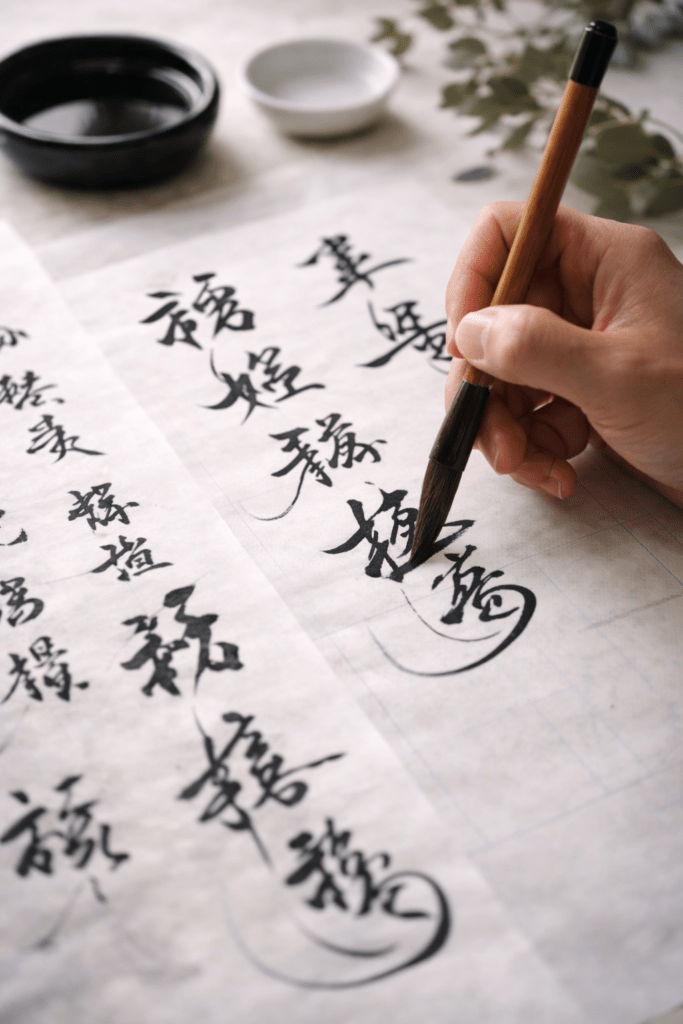
Style Composition: How Structure, Spacing, and Visual Balance Define Chinese Calligraphy Styles
Style Composition: How Structure, Spacing, and Visual Balance Define Chinese Calligraphy Styles
Why Composition Matters in Calligraphy
You can write each stroke correctly.
You can follow proper stroke order.
But if the character feels:
unbalanced
crowded
awkward
then the problem is not the stroke.
👉 it is composition
Composition determines how a character holds together.
It affects:
visual harmony
readability
aesthetic quality
👉 without composition, even correct strokes look wrong
👉 with composition, simple writing looks refined
What “Style Composition” Really Means
Composition is how elements are arranged within a character.
It includes:
proportion
spacing
alignment
distribution of weight
Each style uses composition differently.
👉 composition is the structure behind appearance
It is not random.
It follows principles.
The Core Elements of Composition
Proportion
The size relationship between parts of a character.
Some parts are:
larger
smaller
wider
narrower
👉 proportion creates hierarchy
Spacing
The distance between strokes.
Good spacing feels:
even
intentional
Not too tight.
Not too loose.
👉 spacing creates clarity
Alignment
How strokes are positioned relative to each other.
Vertical alignment is especially important.
👉 alignment creates stability
Balance
How visual weight is distributed.
Heavy strokes must be balanced with lighter ones.
👉 balance creates harmony
These four elements define composition.
How Composition Differs Across Styles
Zhuanshu: Symmetrical Composition
Zhuanshu emphasizes:
symmetry
uniform spacing
consistent proportion
Characters feel:
centered
balanced
calm
👉 composition is highly controlled
There is little variation.
Everything is even.
Lishu: Wide and Horizontal Composition
Lishu expands horizontally.
It emphasizes:
wide structure
strong horizontal lines
Spacing is:
stretched
balanced across width
👉 composition feels grounded
There is a sense of weight.
Horizontal movement dominates.
Kaishu: Structured and Balanced Composition
Kaishu has:
clear proportion
defined alignment
balanced spacing
Each part of the character is:
carefully placed
👉 composition is stable and precise
It follows strict rules.
This makes it ideal for learning.
Xingshu: Flexible Composition
Xingshu introduces:
variation
adaptation
Characters may:
lean
shift
compress
👉 composition becomes dynamic
Balance is maintained, but not rigidly.
Movement influences placement.
Caoshu: Expressive Composition
Caoshu breaks traditional structure.
It allows:
compression
expansion
overlap
👉 composition becomes fluid
Characters may:
merge
simplify
abstract
Balance still exists—
but it is intuitive.
Comparing Composition Across Styles
Symmetry
Zhuanshu: high
Kaishu: moderate
Xingshu: flexible
Caoshu: low
Spacing
Zhuanshu: even
Kaishu: controlled
Xingshu: varied
Caoshu: dynamic
Structure
Kaishu: strongest
Lishu: wide
Xingshu: adaptable
Caoshu: abstract
👉 composition evolves with freedom
Understanding this helps you adjust your writing.
Why Composition Is Difficult for Beginners
Most beginners focus on strokes.
They ignore:
spacing
balance
proportion
This leads to:
crowded writing
uneven structure
visual imbalance
👉 composition requires awareness
It is not learned automatically.
How to Improve Composition
Use Grid Paper
Grids help you:
control proportion
maintain alignment
Observe Character Structure
Break characters into parts.
Understand how they fit together.
Compare Your Writing
Check:
spacing
balance
proportion
👉 comparison reveals errors
Practice Slowly
Do not rush.
Composition needs attention.
Common Composition Mistakes
Crowding Strokes
Too little space between lines.
Uneven Proportion
Parts of the character too large or too small.
Ignoring Alignment
Characters lean unintentionally.
Over-focusing on Detail
Losing overall balance.
👉 awareness improves structure
What Good Composition Feels Like
When composition is correct:
the character feels stable
spacing feels natural
balance feels effortless
Nothing looks forced.
Nothing feels off.
👉 the character “sits” well on the page
This is a key sign of progress.
How Composition Develops Over Time
At first:
characters feel uneven
With practice:
spacing improves
balance becomes clearer
Eventually:
composition becomes intuitive
👉 you begin to adjust automatically
This takes time.
How Composition Connects to Style Identity
Each style has its own compositional logic.
If you ignore it:
styles become mixed
If you follow it:
style becomes clear
👉 composition defines visual identity
It is as important as stroke technique.
FAQ
What is composition in calligraphy?
It is how strokes and parts are arranged within a character.
Why is composition important?
It creates balance, clarity, and visual harmony.
Which style has the strictest composition?
Kaishu has the most structured composition.
How do I improve composition?
Use grids, observe structure, and practice consistently.
Can beginners learn composition?
Yes, with careful observation and repetition.
Final Thought
Calligraphy is not just about strokes.
It is about how those strokes come together.
Each character is a structure.
Each structure requires balance.
Spacing.
Proportion.
Alignment.
When these elements work together—
the writing feels complete.
Not crowded.
Not unstable.
But whole.
And in that wholeness—
you begin to see the deeper beauty of calligraphy.
Not in individual strokes—
but in how everything fits together.
One character at a time.