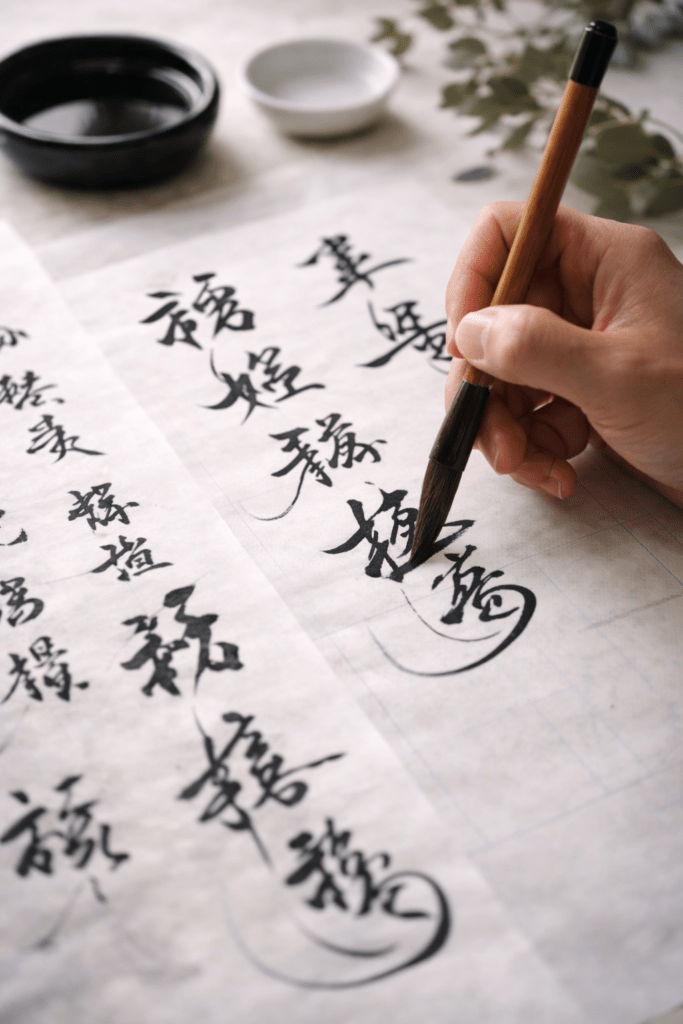
Style Evolution: The Complete Guide to How Chinese Calligraphy Styles Developed from Ancient Forms to Modern Expression
Why Understanding Style Evolution Matters
Many learners approach calligraphy as a collection of separate styles.
Kaishu.
Xingshu.
Caoshu.
Lishu.
Zhuanshu.
But these styles are not isolated.
👉 they are part of a continuous evolution
Each style developed in response to:
practical needs
cultural changes
technological shifts
Understanding this evolution changes how you learn.
Because instead of memorizing styles, you begin to see:
how one style leads into another
👉 calligraphy becomes a system, not a list
The Core Evolution Path
Chinese calligraphy evolved through a clear progression:
Zhuanshu → Lishu → Kaishu → Xingshu → Caoshu
Each stage represents a shift in:
structure
efficiency
expression
👉 from form to function to freedom
This progression explains why styles look and behave differently.
Stage 1: Zhuanshu (Seal Script) — The Age of Form
Zhuanshu is one of the earliest standardized scripts.
It emphasizes:
symmetry
uniform line thickness
balanced structure
Characters are:
rounded
even
carefully constructed
👉 writing is about form and visual harmony
At this stage:
speed is not important
expression is minimal
precision is everything
Zhuanshu reflects a time when writing was:
formal
ceremonial
symbolic
It was used for:
inscriptions
official records
seals
👉 this is the foundation of structure
Stage 2: Lishu (Clerical Script) — The Shift to Function
Lishu marks a major transformation.
It introduces:
simplification
straight lines
horizontal emphasis
Characters become:
wider
clearer
more practical
👉 writing becomes more efficient
This shift was driven by:
administrative needs
increased writing volume
Lishu allows faster writing than Zhuanshu.
But still maintains structure.
👉 it is the bridge between ancient and modern writing
Stage 3: Kaishu (Regular Script) — The Standardization of Structure
Kaishu refines and stabilizes writing.
It becomes:
the standard script
the foundation of modern Chinese characters
It emphasizes:
clear stroke separation
precise structure
readability
👉 writing becomes systematic
Kaishu balances:
clarity
consistency
control
It is still used today in:
printing
education
formal writing
👉 this is the foundation of all learning
Stage 4: Xingshu (Running Script) — The Introduction of Flow
Xingshu evolves from Kaishu.
It introduces:
stroke connection
reduced lifting
natural rhythm
Characters become:
more fluid
faster to write
👉 writing becomes movement
Xingshu balances:
structure
flow
It allows:
personal style
greater efficiency
👉 it is the bridge between structure and expression
Stage 5: Caoshu (Cursive Script) — The Freedom of Expression
Caoshu represents the most expressive stage.
It emphasizes:
speed
simplification
continuous motion
Characters become:
abstract
highly dynamic
👉 writing becomes expression
Structure is still present—
but no longer visible.
It is internal.
Caoshu allows:
personal interpretation
emotional expression
👉 this is the highest level of freedom
The Key Pattern in Style Evolution
If you look at the entire progression, a clear pattern emerges:
structure → efficiency → standardization → flow → expression
Each stage builds on the previous one.
👉 nothing is random
Every change solves a problem.
Zhuanshu solves form.
Lishu solves efficiency.
Kaishu solves clarity.
Xingshu solves movement.
Caoshu explores freedom.
This is why the order matters.
Why This Evolution Matters for Learning
Understanding evolution gives you a learning path.
Instead of guessing where to start, you follow:
Kaishu → Xingshu → Caoshu
You may also study:
Lishu for structure
Zhuanshu for form
👉 you learn in the same order styles evolved
This makes learning:
logical
efficient
stable
What Happens If You Ignore This Order
If you start with advanced styles:
you lack structure
your strokes become unstable
your writing becomes inconsistent
👉 skipping stages breaks the system
Calligraphy is cumulative.
Each stage prepares you for the next.
How Evolution Reflects Different Skills
Each style develops different abilities.
Zhuanshu develops:
precision
symmetry
form awareness
Lishu develops:
horizontal balance
stroke endings
structure
Kaishu develops:
control
clarity
discipline
Xingshu develops:
flow
connection
rhythm
Caoshu develops:
expression
energy
freedom
👉 together, they form a complete system
What Evolution Teaches About Calligraphy
Calligraphy is not static.
It is adaptive.
It changes based on:
function
culture
individual expression
👉 styles are solutions, not decorations
Understanding this changes how you practice.
You no longer imitate blindly.
You understand purpose.
FAQ
What is the order of Chinese calligraphy styles?
Zhuanshu, Lishu, Kaishu, Xingshu, Caoshu.
Why did calligraphy styles evolve?
To improve efficiency, readability, and expression.
Which style should I learn first?
Kaishu is the best starting point.
Is Caoshu the final stage?
Yes, it represents the most expressive form.
Are all styles still used today?
Yes, but for different purposes.
Final Thought
Calligraphy is a journey.
Not just for the learner—
but for the art itself.
It began with form.
It moved toward function.
It became structure.
Then it began to flow.
And finally—
it became expression.
You are not just learning styles.
You are following a path.
One that has been refined over centuries.
Step by step.
Stroke by stroke.
From control to freedom.
From form to expression.
And over time, your writing reflects that journey.
Not forced.
Not rushed.
But naturally evolving.
Just like the art itself.