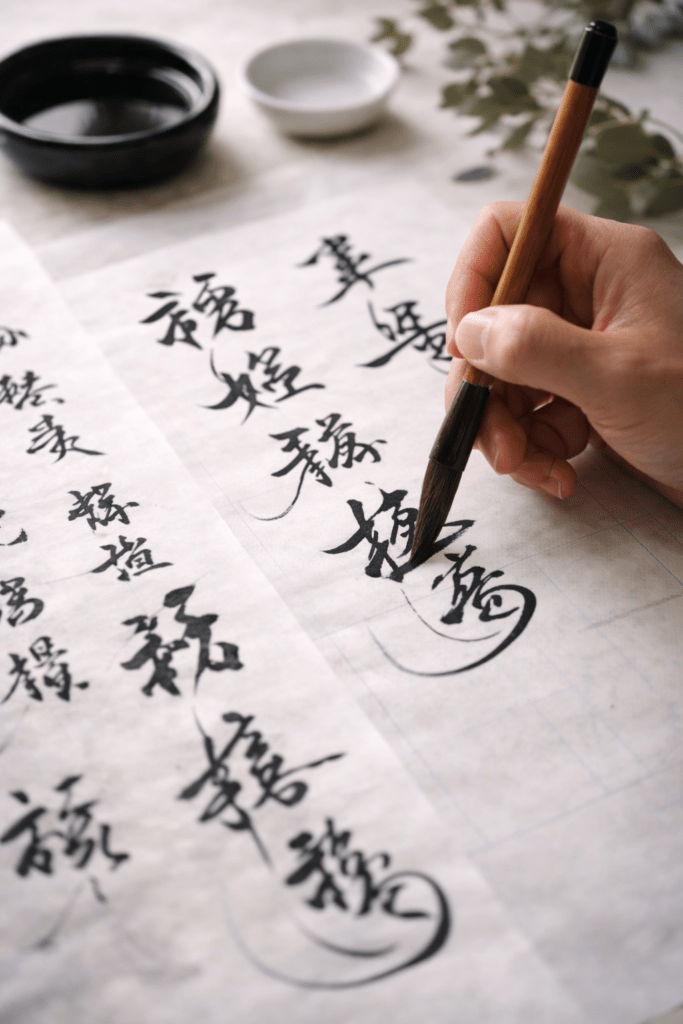
Style Examples: Real Chinese Calligraphy Style Examples Explained Through Structure, Stroke, and Visual Understanding
Style Examples: Real Chinese Calligraphy Style Examples Explained Through Structure, Stroke, and Visual Understanding
Why Studying Examples Is Essential
You can read about calligraphy styles.
You can understand theory.
But until you see real examples—
👉 the knowledge remains abstract
Calligraphy is visual.
It must be observed.
Studying examples helps you:
recognize styles instantly
understand how strokes actually look
connect theory with real writing
👉 examples turn knowledge into understanding
Without them, practice becomes blind.
What “Style Examples” Really Mean
A style example is not just a character.
It is a complete demonstration of:
stroke behavior
structure
movement
balance
Each example shows:
how the brush moves
how strokes connect or separate
how the character is built
👉 examples reveal how theory becomes reality
You are not just looking.
You are learning how writing happens.
How to Study Calligraphy Examples Correctly
Most beginners look at examples the wrong way.
They focus only on shape.
Instead, you should observe:
stroke thickness
stroke direction
entry and exit points
spacing
rhythm
👉 observe movement, not just appearance
Ask yourself:
How was this stroke made?
Where does pressure increase?
Where does it release?
This changes how you learn.
Kaishu Example: Structured and Balanced
A typical Kaishu example shows:
clear stroke separation
strong beginnings and endings
balanced proportions
Each stroke is:
independent
precise
intentional
The character appears:
upright
stable
easy to read
👉 what to observe
how each stroke starts
how corners are formed
how space is distributed
Key insight:
nothing is rushed
everything is controlled
Kaishu examples teach discipline.
Xingshu Example: Flowing and Connected
A typical Xingshu example shows:
partial stroke connections
smooth transitions
natural movement
Strokes are:
linked but still readable
less rigid than Kaishu
The character appears:
fluid
lively
balanced
👉 what to observe
where strokes connect
how movement continues
how speed changes
Key insight:
flow replaces strict separation
Xingshu examples teach continuity.
Caoshu Example: Expressive and Abstract
A typical Caoshu example shows:
continuous strokes
simplified forms
dynamic movement
Strokes are:
fast
connected
highly expressive
The character appears:
abstract
energetic
difficult to read
👉 what to observe
how strokes merge
how structure is simplified
how energy flows
Key insight:
movement dominates structure
Caoshu examples teach expression.
Lishu Example: Wide and Rhythmic
A typical Lishu example shows:
horizontal emphasis
distinct stroke endings
flattened structure
Strokes are:
broad
controlled
decorative
The character appears:
wide
grounded
stable
👉 what to observe
horizontal expansion
ending shapes
contrast between strokes
Key insight:
structure defines rhythm
Lishu examples teach variation within control.
Zhuanshu Example: Uniform and Symmetrical
A typical Zhuanshu example shows:
even stroke thickness
smooth curves
symmetrical structure
Strokes are:
continuous
consistent
calm
The character appears:
balanced
refined
formal
👉 what to observe
line consistency
symmetry
curve smoothness
Key insight:
uniformity creates harmony
Zhuanshu examples teach consistency.
Comparing Examples Across Styles
When you compare examples side by side, differences become clear.
Stroke Behavior
Kaishu: separated
Xingshu: partially connected
Caoshu: fully connected
Structure
Zhuanshu: symmetrical
Lishu: wide
Kaishu: balanced
Xingshu: flexible
Caoshu: abstract
Movement
Zhuanshu: minimal
Kaishu: controlled
Xingshu: flowing
Caoshu: dynamic
👉 comparison sharpens understanding
This is one of the fastest ways to learn.
How to Use Examples in Practice
Copy Carefully
Do not rush.
Observe before writing.
Focus on One Style
Do not mix examples.
Study patterns.
Repeat Key Characters
Practice the same example multiple times.
Analyze Mistakes
Compare your writing to the example.
👉 correction improves accuracy
What Makes a Good Example
Not all examples are equal.
A good example has:
clear stroke definition
balanced structure
consistent style
Choose examples from:
recognized works
skilled calligraphers
👉 quality examples accelerate learning
Avoid unclear or distorted samples.
Common Mistakes When Studying Examples
Copying Shape Only
Ignoring stroke behavior.
Switching Examples Too Often
Reduces consistency.
Choosing Complex Examples Too Early
Start simple.
Ignoring Proportion
Structure matters as much as strokes.
👉 awareness prevents ineffective practice
How Your Perception Changes Over Time
At first:
all styles look similar
With practice:
differences become clear
Eventually:
you recognize styles instantly
👉 perception improves with exposure
This is a natural process.
How Examples Build Real Skill
Studying examples helps you:
develop visual accuracy
understand structure
improve stroke control
👉 it connects observation and execution
Without examples, practice lacks direction.
FAQ
Why are examples important in calligraphy?
They show how strokes and structure are actually executed.
How should beginners study examples?
By observing movement, copying carefully, and focusing on one style.
Which style is easiest to learn from examples?
Kaishu, because it is clear and structured.
How many examples should I study?
Start with a few high-quality examples and repeat them.
Can I learn without examples?
It is very difficult. Examples are essential.
Final Thought
Calligraphy cannot be learned through words alone.
It must be seen.
It must be observed.
It must be experienced.
Each example is more than a character.
It is a record of movement.
A trace of intention.
A moment captured in ink.
When you study examples carefully—
you begin to see beyond the surface.
You see how strokes live.
How structure holds.
How movement flows.
And over time—
your writing begins to reflect what you see.
Not by imitation—
but by understanding.
One example at a time.