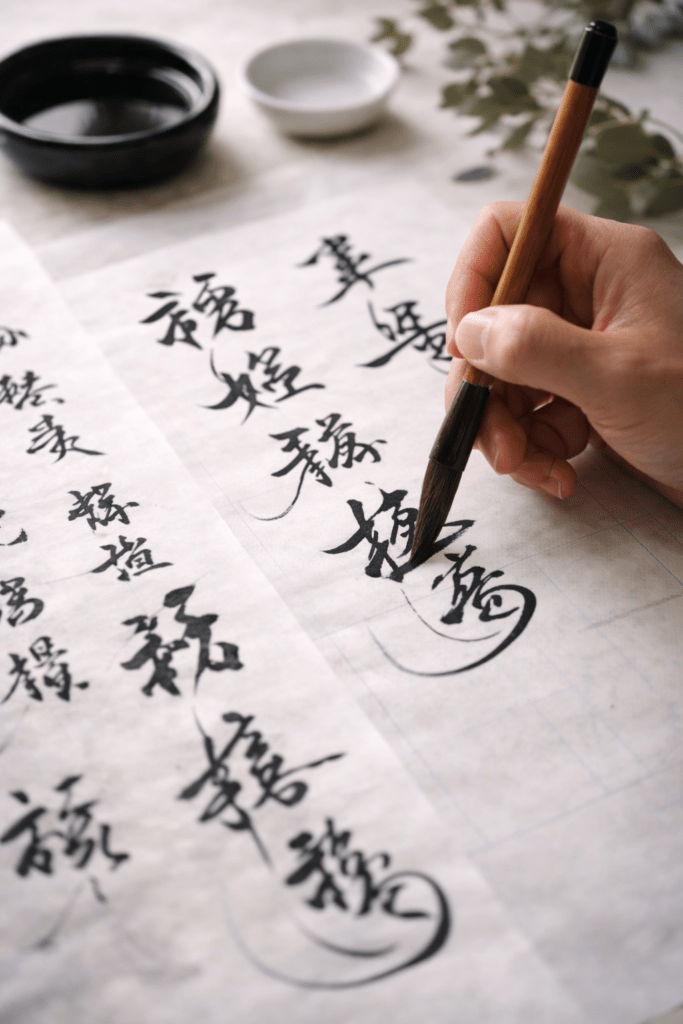
Style Flow: How Movement, Connection, and Continuity Shape Chinese Calligraphy Styles
Why Flow Is Essential in Calligraphy
You can write each stroke correctly.
You can build proper structure.
But if your writing feels:
stiff
disconnected
mechanical
then something is missing.
That missing element is:
👉 flow
Flow is what connects strokes.
It turns separate movements into a continuous experience.
👉 without flow, calligraphy feels fragmented
👉 with flow, it feels alive
What “Flow” Really Means
Flow is the continuity of movement.
It is how one stroke leads into the next.
It is influenced by:
speed
pressure
direction
timing
Flow is not just visible.
It is felt in:
how smoothly the brush moves
how naturally strokes connect
👉 flow is movement without interruption
Even when strokes are separate—
the motion between them still matters.
The Flow Spectrum Across Styles
Each calligraphy style expresses flow differently.
Zhuanshu → Lishu → Kaishu → Xingshu → Caoshu
This progression shows:
minimal flow → structured flow → controlled flow → continuous flow → uninterrupted flow
👉 styles differ in how much flow they allow
Understanding this helps you adjust your writing.
Zhuanshu: Hidden Flow
In Zhuanshu, flow is:
subtle
internal
even
Strokes are:
uniform
smooth
consistent
There are no visible connections.
👉 but movement is continuous
The brush does not stop abruptly.
Flow exists within each stroke.
Zhuanshu teaches:
how to maintain internal continuity
Lishu: Rhythmic Flow
In Lishu, flow becomes:
more visible
more structured
Strokes remain separate.
But there is:
rhythm
timing
balance
👉 flow exists between strokes
The brush moves with intention.
Pauses are controlled.
Lishu teaches:
how to manage rhythm
Kaishu: Controlled Flow
In Kaishu, flow is:
clear
intentional
balanced
Each stroke is:
separate
complete
But transitions are smooth.
👉 flow connects structure
There is no unnecessary movement.
Everything is precise.
Kaishu teaches:
how to control flow
This is critical for beginners.
Xingshu: Continuous Flow
In Xingshu, flow becomes:
visible
natural
dynamic
Strokes begin to:
connect
merge
transition smoothly
👉 flow becomes the main feature
Movement continues across strokes.
The brush rarely fully stops.
Xingshu teaches:
how to maintain flow across characters
This creates:
fluidity
natural rhythm
Caoshu: Uninterrupted Flow
In Caoshu, flow is:
fast
continuous
expressive
Strokes:
connect completely
simplify
accelerate
👉 flow dominates structure
The brush moves without interruption.
Characters may become:
abstract
merged
Caoshu teaches:
how to sustain flow at high speed
This requires advanced control.
The Key Principle: Flow Connects Everything
Flow is not only about connection.
It is about continuity.
Even in structured styles:
movement must not break
👉 every stroke has direction
👉 every transition has intention
If flow breaks:
writing feels rigid
If flow continues:
writing feels natural
How to Develop Flow
Relax Your Hand
Tension blocks movement.
Relaxation allows continuity.
Use Larger Movement
Do not rely only on fingers.
Use wrist and arm.
👉 this improves fluid motion
Control Speed
Flow depends on timing.
Too slow:
movement becomes stiff
Too fast:
control is lost
👉 find a balanced pace
Practice Transitions
Focus on how strokes connect.
Even when they are separate.
👉 transitions create flow
Common Mistakes
Writing Stroke by Stroke
Ignoring transitions.
Over-controlling Movement
Reduces natural flow.
Stopping Too Often
Breaks continuity.
Forcing Connections
Leads to unnatural writing.
👉 awareness improves flow
What Good Flow Feels Like
When flow is correct:
movement feels smooth
strokes connect naturally
writing feels continuous
You are not thinking about each stroke.
You are moving through them.
👉 writing becomes effortless
This is a key milestone.
How Flow Evolves Over Time
At first:
movement is slow
flow is limited
With practice:
transitions improve
movement becomes smoother
Eventually:
flow becomes natural
👉 this takes repetition
Flow cannot be forced.
It must be developed.
How Flow Connects to Style
Each style defines how flow behaves.
Some styles:
limit flow
Some styles:
expand flow
👉 understanding flow helps you switch styles
Without it, styles become mixed.
Flow also affects:
readability
expression
visual balance
FAQ
What is flow in calligraphy?
It is the continuity of movement between strokes.
Why is flow important?
It makes writing smooth and connected.
Which style has the most flow?
Caoshu has the most continuous flow.
How do I improve flow?
Practice transitions, control speed, and relax your hand.
Can beginners develop flow?
Yes, starting with controlled movement in Kaishu.
Final Thought
Calligraphy is not just strokes.
It is movement.
Each stroke leads to another.
Each motion continues forward.
Flow is what connects them.
Without flow—
writing feels separate.
With flow—
writing becomes whole.
Not forced.
Not broken.
But continuous.
One movement into the next.
One stroke into another.
Until the entire character becomes:
a single, flowing expression.