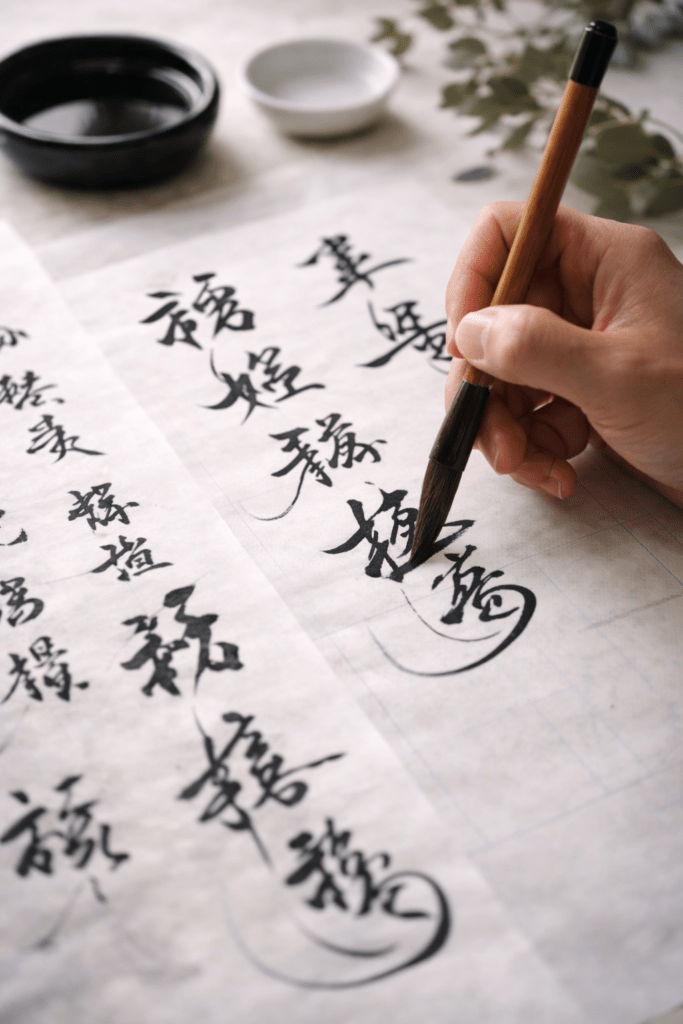
Style Mistakes: The Most Common Errors in Chinese Calligraphy Styles and How to Correct Them
Why Style Mistakes Slow Your Progress
Many learners spend hours practicing.
They repeat characters.
They follow examples.
They try different styles.
But progress remains limited.
Not because of lack of effort—
👉 but because of repeated mistakes
Mistakes in calligraphy are not always obvious.
Some look correct at first glance.
But they weaken:
structure
flow
consistency
👉 identifying mistakes is the fastest way to improve
What “Style Mistakes” Really Mean
A style mistake is not just a wrong stroke.
It is a mismatch between:
technique
structure
style identity
👉 you may write correctly—but in the wrong way for that style
Each style has:
its own rules
its own movement
its own balance
Mistakes happen when these are ignored.
The Three Types of Style Mistakes
Technical Mistakes
Problems with:
stroke shape
pressure control
brush handling
Structural Mistakes
Problems with:
proportion
spacing
alignment
Stylistic Mistakes
Problems with:
mixing styles
incorrect flow
wrong movement
👉 understanding these categories helps you diagnose errors
Common Mistakes in All Styles
Inconsistent Stroke Quality
Lines are uneven.
Pressure is unstable.
Cause:
lack of control
writing too fast
Solution:
slow down
practice basic strokes
Poor Structure
Characters feel:
crooked
unbalanced
Cause:
ignoring proportion
not using guides
Solution:
use grid practice
focus on layout
Overwriting
Strokes become:
too heavy
too thick
Cause:
too much pressure
Solution:
practice lifting and releasing
Weak Endings
Strokes end abruptly.
They feel incomplete.
Cause:
lack of attention to stroke endings
Solution:
focus on entry and exit points
Style-Specific Mistakes
Kaishu Mistakes
Writing too quickly
Kaishu requires control.
Rushing leads to:
unclear strokes
poor structure
Inconsistent proportions
Characters become uneven.
Solution:
practice slowly
use grid structure
Ignoring stroke definition
Beginnings and endings are unclear.
Solution:
focus on stroke precision
Xingshu Mistakes
Over-connecting strokes
Too many connections reduce clarity.
Solution:
maintain balance between connection and separation
Losing structure
Flow replaces structure completely.
Solution:
keep Kaishu foundation
Uneven rhythm
Movement becomes irregular.
Solution:
practice controlled speed
Caoshu Mistakes
Writing without control
Speed without structure creates chaos.
Solution:
build strong foundation first
Over-simplification
Characters become unreadable.
Solution:
learn standard forms before simplifying
Forcing expression
Trying to be expressive without skill.
Solution:
focus on movement control
Lishu Mistakes
Ignoring horizontal emphasis
Characters lose their characteristic shape.
Solution:
focus on horizontal expansion
Weak stroke endings
Ending shapes are unclear.
Solution:
practice stroke finishing techniques
Zhuanshu Mistakes
Uneven line thickness
Breaks visual harmony.
Solution:
practice consistent pressure
Poor symmetry
Characters feel unbalanced.
Solution:
focus on proportion and alignment
The Most Critical Mistake: Mixing Styles
One of the biggest problems is:
mixing style elements
For example:
Kaishu structure with Xingshu flow
Caoshu movement with weak control
👉 this creates confusion
Each style must remain:
clear
consistent
Solution:
practice one style at a time
Why Mistakes Keep Repeating
Mistakes persist because:
they are not recognized
they are not corrected
👉 repetition reinforces habits
If you repeat errors—
they become permanent.
How to Identify Your Mistakes
Compare With Reference
Look at high-quality examples.
Check differences.
Slow Down
Mistakes become visible when you write slowly.
Focus on One Element
Analyze:
stroke
structure
flow
👉 isolation improves clarity
How to Correct Mistakes Effectively
Correct Immediately
Do not continue repeating errors.
Practice Targeted Exercises
Focus on the specific problem.
Repeat Correct Movement
Replace wrong habits with correct ones.
👉 correction must be intentional
What Improvement Feels Like
At first:
mistakes are frequent
With awareness:
you begin to notice them
With correction:
they decrease
Eventually:
writing becomes consistent
👉 progress is gradual
Mistakes are part of learning.
How to Avoid Developing Bad Habits
Practice Slowly
Speed hides errors.
Use Clear References
Study good examples.
Stay Consistent
Do not switch styles too often.
Review Your Work
Regularly check for errors.
👉 awareness prevents habit formation
FAQ
What are the most common calligraphy mistakes?
Inconsistent strokes, poor structure, and mixing styles.
Why do mistakes keep happening?
Because they are repeated without correction.
How do I fix calligraphy mistakes?
Identify the problem, slow down, and practice targeted exercises.
Should beginners focus on one style?
Yes, to avoid confusion.
Is it normal to make mistakes?
Yes, mistakes are part of the learning process.
Final Thought
Mistakes are not failure.
They are information.
They show you:
what is missing
what needs attention
Every error is a signal.
A direction.
An opportunity to improve.
The key is not to avoid mistakes—
but to see them clearly.
To correct them intentionally.
To replace them with better movement.
And over time—
your writing becomes more stable.
More consistent.
More refined.
Not because you practiced more—
but because you practiced better.
One correction at a time.