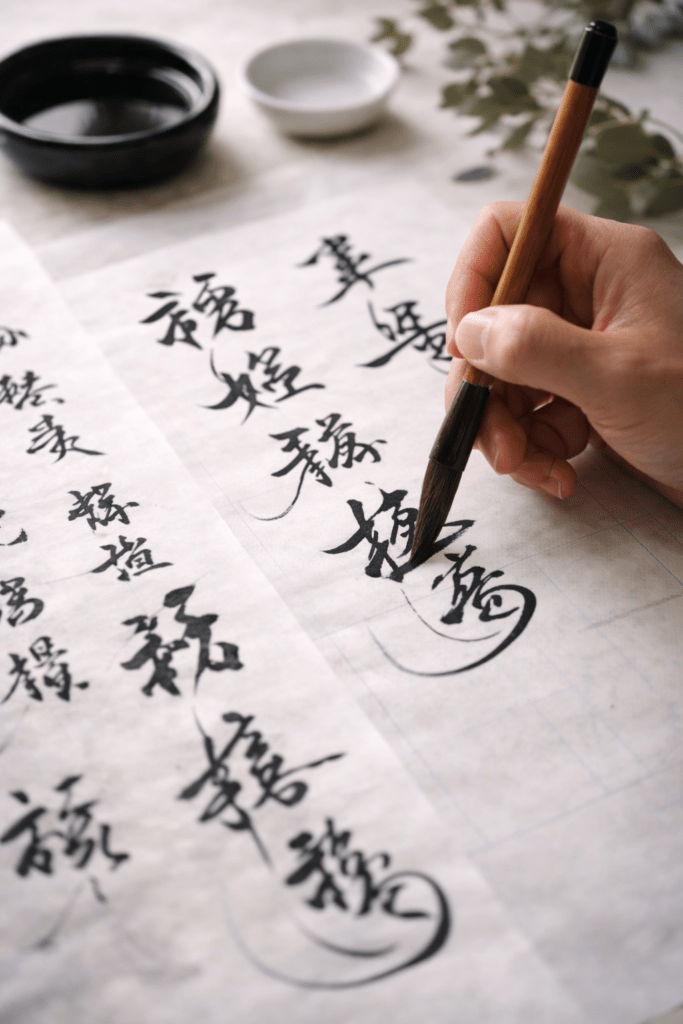
Style Structure: How Structure Defines Every Chinese Calligraphy Style and Determines Writing Quality
Why Structure Is the Core of Every Style
When people look at calligraphy, they often notice:
beauty
flow
expression
But behind all of these, there is one element that determines everything:
👉 structure
Without structure:
strokes lose direction
characters lose balance
writing loses clarity
Structure is what holds a character together.
It defines:
where each stroke belongs
how elements relate
how the whole character feels
👉 style differences begin with structure
If you understand structure, you understand calligraphy.
What “Structure” Means in Calligraphy
Structure is not just the outline of a character.
It is the internal organization.
It includes:
proportion
alignment
spacing
balance
Every stroke must:
fit into the structure
support the overall form
👉 structure is invisible but essential
You may not notice it at first—
but you feel it immediately when it is wrong.
The Structural Logic of Chinese Characters
Chinese characters are not random shapes.
They follow consistent structural logic.
Each character has:
a center of gravity
a spatial arrangement
a relationship between parts
Common structural types include:
left-right
top-bottom
enclosure
single-body
Each type requires different balance.
👉 structure is systematic
Understanding this system improves accuracy.
How Structure Changes Across Styles
Each calligraphy style has its own structural behavior.
Zhuanshu (Seal Script)
Structure is:
symmetrical
evenly spaced
geometric
Characters often appear:
tall and balanced
👉 structure is highly controlled
Lishu (Clerical Script)
Structure becomes:
wide
flat
horizontally expanded
Characters feel:
grounded
stable
👉 horizontal balance dominates
Kaishu (Regular Script)
Structure is:
precise
balanced
proportional
Characters are:
upright
clear
👉 this is the standard structural model
Xingshu (Running Script)
Structure becomes:
flexible
adaptive
Spacing adjusts based on movement.
👉 structure is maintained but relaxed
Caoshu (Cursive Script)
Structure becomes:
implicit
dynamic
It is no longer clearly visible.
👉 structure is internalized
You must feel it, not see it.
The Three Core Elements of Structure
To understand structure deeply, focus on three elements.
Proportion
Each part of the character must have the correct size.
If one part is too large or too small:
balance breaks
👉 proportion defines harmony
Alignment
Strokes must align properly.
Vertical and horizontal relationships must be controlled.
Misalignment creates instability.
👉 alignment creates order
Spacing
The space between strokes matters as much as the strokes themselves.
Too tight:
crowded
Too loose:
disconnected
👉 spacing creates clarity
These three elements work together.
How to Practice Structure Effectively
Practice with Grids
Use grid paper.
It helps control:
proportion
alignment
Start with Basic Structures
Practice simple characters.
Understand their layout.
Focus on Balance
Check:
center of gravity
distribution of weight
Do not let characters lean.
Analyze Before Writing
Look at the character.
Understand its structure.
Then write.
👉 awareness improves accuracy
Common Structural Mistakes
Uneven Proportion
Parts of the character are not balanced.
Fix by observing reference.
Misalignment
Strokes drift away from their intended positions.
Use guidelines.
Ignoring Spacing
Crowded or empty areas reduce clarity.
Adjust spacing.
Focusing Only on Strokes
Good strokes cannot fix poor structure.
Structure comes first.
👉 structure errors are more serious than stroke errors
Because they affect the entire character.
What Good Structure Feels Like
When structure is correct:
the character feels stable
the strokes feel connected
the writing looks balanced
There is no tension.
No imbalance.
Everything fits naturally.
This feeling is important.
Because structure is not just visual—
it is felt.
How Structure Supports All Styles
Structure is the foundation of:
Kaishu clarity
Xingshu flow
Caoshu expression
Without structure:
flow becomes chaos
expression becomes random
👉 structure enables freedom
It allows you to move without losing control.
How Structure Develops Over Time
At first:
structure feels difficult
characters look uneven
With practice:
alignment improves
proportion stabilizes
Over time:
structure becomes intuitive
You no longer calculate it.
You feel it.
FAQ
What is structure in calligraphy?
It is the internal organization of a character.
Why is structure important?
It ensures balance, clarity, and stability.
Which style has the strongest structure?
Kaishu has the most visible and defined structure.
Can structure be ignored in expressive styles?
No, it is still essential but less visible.
How do I improve structure?
Practice with grids and focus on proportion and alignment.
Final Thought
Structure is not decoration.
It is the foundation.
It holds everything together.
You may focus on strokes.
You may focus on flow.
But without structure—
nothing works.
Learn to see it.
Learn to feel it.
Learn to build it.
And over time, your writing becomes stable.
Balanced.
Clear.
Not by chance—
but by structure.
One character at a time.