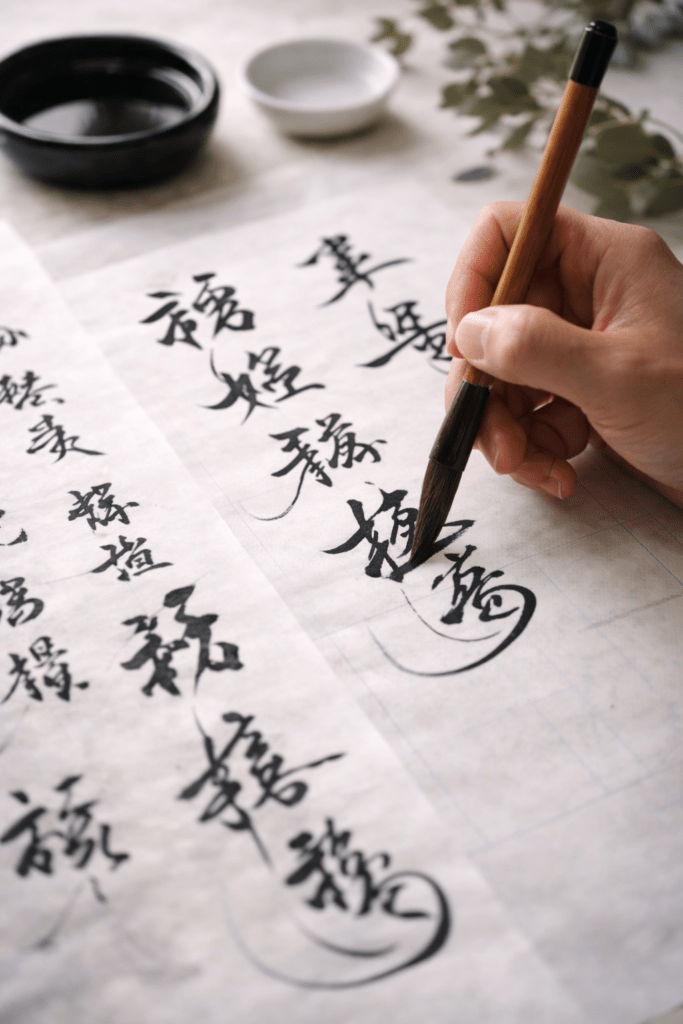
Style Visual Guide: How to Recognize Chinese Calligraphy Styles Instantly Through Form, Stroke, and Movement
Why You Need a Visual Guide
When you look at Chinese calligraphy for the first time, it can feel confusing.
Different styles may seem similar.
Characters look unfamiliar.
You are not sure what you are seeing.
👉 this is normal
Calligraphy is a visual language.
It must be learned through seeing, not just reading.
👉 a visual guide trains your eye
It helps you:
recognize styles quickly
understand differences clearly
connect theory with real observation
What “Visual Recognition” Really Means
Recognizing a style is not about memorizing names.
It is about noticing patterns.
Each style has:
distinct stroke behavior
unique structure
specific movement
👉 visual recognition is pattern recognition
You learn to see:
how strokes are formed
how characters are shaped
how movement flows
Once you see these patterns—
styles become obvious.
The Five Key Visual Signals
Every calligraphy style can be identified through five signals:
stroke shape
line thickness
structure
connection
movement
👉 these are your visual tools
Focus on them.
They reveal everything.
Zhuanshu (Seal Script): Smooth and Symmetrical
How it looks
Lines are:
even
rounded
consistent
Characters appear:
symmetrical
balanced
calm
Visual clues
no sharp corners
uniform thickness
curved strokes
👉 recognition tip
If everything looks smooth and even—
it is likely Zhuanshu.
Lishu (Clerical Script): Wide and Structured
How it looks
Characters are:
wide
flattened
Strokes show:
strong horizontal emphasis
distinct endings
Visual clues
horizontal lines stretch outward
stroke endings flare
👉 recognition tip
If the character feels wide and grounded—
it is likely Lishu.
Kaishu (Regular Script): Clear and Balanced
How it looks
Characters are:
upright
structured
easy to read
Strokes are:
separate
well-defined
Visual clues
clear stroke beginnings and endings
balanced proportions
👉 recognition tip
If everything looks precise and readable—
it is Kaishu.
Xingshu (Running Script): Flowing and Connected
How it looks
Characters are:
fluid
slightly connected
Strokes:
link together
flow naturally
Visual clues
partial connections
smooth transitions
👉 recognition tip
If strokes begin to connect but remain readable—
it is Xingshu.
Caoshu (Cursive Script): Fast and Abstract
How it looks
Characters are:
simplified
dynamic
often hard to read
Strokes:
merge
move quickly
Visual clues
continuous lines
irregular shapes
high movement
👉 recognition tip
If it looks expressive and abstract—
it is Caoshu.
Comparing Visual Differences Quickly
Stroke Clarity
Kaishu: very clear
Xingshu: moderately clear
Caoshu: unclear
Structure
Zhuanshu: symmetrical
Lishu: wide
Kaishu: balanced
Xingshu: flexible
Caoshu: abstract
Connection
Kaishu: none
Xingshu: partial
Caoshu: full
👉 these comparisons speed up recognition
You begin to identify styles instantly.
How to Train Your Eye
Look at Many Examples
Exposure improves recognition.
Compare Styles Side by Side
Differences become obvious.
Focus on One Feature at a Time
Stroke shape
connection
structure
👉 isolation improves observation
Practice Without Writing
Just observe.
Recognition is a skill.
Common Beginner Mistakes
Focusing Only on Characters
Ignoring stroke behavior.
Trying to Memorize Everything
Recognition comes from observation.
Confusing Xingshu and Caoshu
Because both have flow.
👉 pay attention to readability
Xingshu is readable.
Caoshu is abstract.
What Good Visual Recognition Feels Like
At first:
everything looks similar
With practice:
differences become clearer
Eventually:
you recognize styles instantly
👉 this is visual awareness
It develops naturally.
How Visual Understanding Improves Practice
When you can see clearly:
you copy more accurately
you avoid mixing styles
you improve faster
👉 seeing correctly leads to writing correctly
This is a key connection.
How Long It Takes to Develop Recognition
With regular exposure:
basic recognition in weeks
strong recognition in months
👉 consistency matters
You do not need to rush.
FAQ
How do I recognize calligraphy styles?
By observing stroke shape, structure, connection, and movement.
Which style is easiest to recognize?
Kaishu, because it is clear and structured.
Why do Xingshu and Caoshu look similar?
Both have flow, but Caoshu is more abstract.
Can I learn recognition without writing?
Yes, observation alone improves recognition.
How do I improve faster?
Compare styles and study examples regularly.
Final Thought
Calligraphy is not just something you write.
It is something you see.
Each style has its own visual language.
Its own patterns.
Its own movement.
When you learn to see these patterns—
the confusion disappears.
Styles become clear.
Differences become obvious.
And your understanding deepens.
Not through memorization—
but through observation.
One detail at a time.