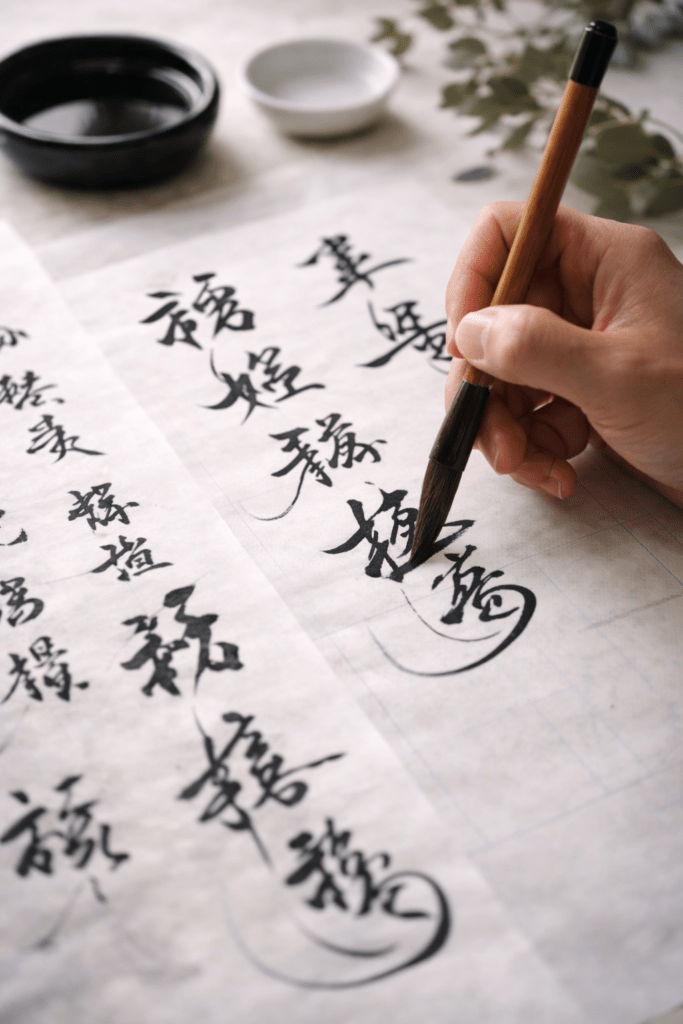
Xingshu vs Caoshu: The Complete Guide to Understanding Flow vs Freedom in Chinese Calligraphy
What This Comparison Really Reveals
At first glance, Xingshu (Running Script) and Caoshu (Cursive Script) can look similar.
Both are:
fluid
connected
dynamic
But this similarity is misleading.
👉 they operate on completely different levels of control
Understanding the difference between Xingshu and Caoshu is essential because it shows you:
where structure begins to loosen
where expression begins to dominate
It also tells you:
when you are ready to move forward in your calligraphy journey.
What Is Xingshu (Running Script)
Xingshu is a semi-cursive style.
It is defined by:
moderate simplification
connected strokes
controlled flow
It evolves directly from Regular Script (Kaishu).
Characters are still:
recognizable
structured
balanced
👉 Xingshu is structured flow
It allows movement, but does not abandon clarity.
This makes it:
practical
readable
widely used
What Is Caoshu (Cursive Script)
Caoshu is a fully cursive style.
It is defined by:
extreme simplification
continuous motion
high abstraction
Strokes are often:
merged
abbreviated
transformed
👉 Caoshu is expressive movement
It prioritizes:
speed
energy
rhythm
Over strict readability.
This makes it:
highly artistic
difficult to read
technically demanding
The Core Difference: Control vs Freedom
The most important difference is this:
Xingshu controls flow.
Caoshu releases it.
In Xingshu:
movement is guided
structure is preserved
In Caoshu:
movement is dominant
structure is hidden
👉 Xingshu is controlled freedom
👉 Caoshu is expressive freedom
This distinction defines everything else.
Stroke Connection Differences
Xingshu:
strokes connect partially
transitions are smooth
brush lifts occasionally
Caoshu:
strokes connect continuously
transitions are rapid
brush rarely lifts
👉 in Caoshu, the character can become one continuous gesture
This increases speed, but reduces clarity.
Simplification Differences
Xingshu:
simplifies selectively
maintains recognizable forms
Caoshu:
simplifies aggressively
removes or merges strokes
👉 Caoshu often sacrifices detail for movement
This is why it can be difficult to read.
Structure Differences
Xingshu:
flexible but stable
balanced proportions
clear internal organization
Caoshu:
highly flexible
structure becomes implicit
balance is maintained through experience
👉 structure in Caoshu is felt, not seen
This requires advanced understanding.
Speed Differences
Xingshu:
moderate speed
controlled rhythm
Caoshu:
high speed
continuous motion
But speed in Caoshu is not careless.
👉 it is controlled speed
Without control, it becomes chaotic.
Readability Differences
Xingshu:
generally readable
widely understood
Caoshu:
often difficult to read
requires experience
👉 readability decreases as expression increases
This is a key trade-off.
Learning Order: Why Xingshu Comes Before Caoshu
This is critical.
👉 you must learn Xingshu before Caoshu
Xingshu teaches:
connection
flow control
structural flexibility
Caoshu builds on these skills.
If you skip Xingshu:
writing becomes uncontrolled
structure collapses
movement becomes random
👉 Caoshu without foundation is chaos
This is why progression matters.
How Practice Feels Different
Xingshu Practice
smooth
controlled
intentional
You focus on:
connection
balance
transition
Caoshu Practice
fast
dynamic
intuitive
You focus on:
movement
energy
rhythm
👉 one refines control
👉 the other releases it
Common Beginner Mistakes
Jumping into Caoshu Too Early
Without foundation, writing lacks structure.
Over-simplifying in Caoshu
Removing too much destroys recognizability.
Losing Rhythm
Fast writing without rhythm becomes messy.
Confusing Flow with Speed
Flow is controlled movement, not rushing.
How to Transition from Xingshu to Caoshu
Start with strong Xingshu.
Then:
increase connection between strokes
reduce pauses
simplify gradually
Maintain awareness of structure.
Do not abandon it completely.
👉 Caoshu is Xingshu pushed further
Understanding this makes progression clearer.
What Each Style Teaches You
Xingshu teaches:
flow
connection
balance
Caoshu teaches:
expression
energy
freedom
Together, they develop advanced skill.
👉 one prepares
👉 the other expresses
How Long It Takes to Transition
With solid Xingshu:
Caoshu becomes accessible
Without it:
progress is slow and unstable
This is why foundation matters.
FAQ
What is the main difference between Xingshu and Caoshu?
Xingshu maintains structure with flow, Caoshu emphasizes expression with minimal structure.
Which is easier to learn?
Xingshu is easier because it is more structured.
Is Caoshu readable?
It can be difficult to read, especially for beginners.
Should beginners learn Caoshu?
No, they should first learn Kaishu and Xingshu.
Why is Caoshu so fast?
Because strokes are simplified and connected continuously.
Final Thought
Xingshu teaches you how to move.
Caoshu teaches you how to release.
One is controlled flow.
One is expressive freedom.
You do not jump from structure to chaos.
You transition.
You refine.
You expand.
First, you learn to connect strokes.
Then, you learn to let them flow.
And over time, your writing changes.
From controlled movement.
To expressive motion.
From guided rhythm.
To natural energy.
Not forced.
Not random.
But alive.
One movement at a time.