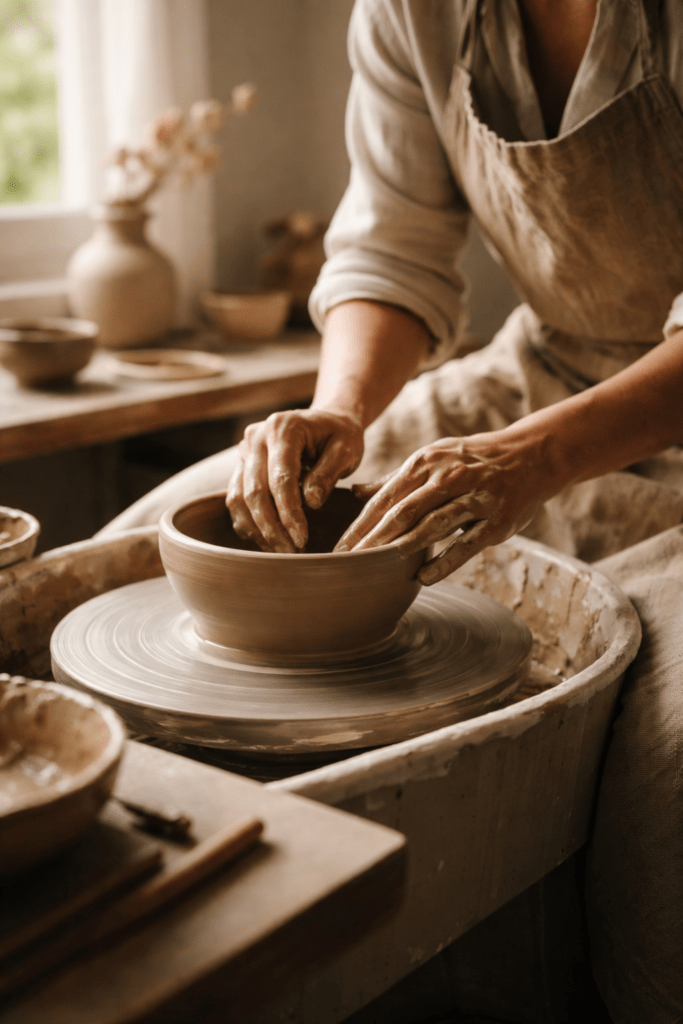
Craft vs Art: Understanding the Real Difference Between Making and Expression
Why People Confuse Craft and Art
At some point, almost everyone asks this question:
Is craft the same as art?
You see a handmade object—
a ceramic bowl, a woven textile, a carved piece of wood—
and you wonder:
Is this craft?
Or is this art?
The confusion is natural.
Because the line between craft and art is not always clear.
Sometimes they look similar.
Sometimes they overlap.
And sometimes, they become the same thing.
But understanding the difference matters.
Not for labeling—
but for clarity.
Because craft and art are not just categories.
They are different ways of creating.
Different ways of thinking.
Different ways of engaging with the world.
What Is Craft (In Simple Terms)
Craft is the process of making something by hand using skill and technique.
It focuses on:
- Material
- Process
- Precision
Craft involves:
- Repetition
- Practice
- Improvement
The goal of craft is often:
- To create something functional
- To develop skill
- To refine technique
In craft, the process is central.
The act of making is as important as the result.
What Is Art (In Simple Terms)
Art is the expression of ideas, emotions, or perspectives.
It focuses on:
- Meaning
- Interpretation
- Expression
Art does not require function.
It does not need to be useful.
Its purpose is often:
- To communicate
- To evoke feeling
- To explore ideas
In art, meaning is central.
The message matters more than the method.
The Core Difference Between Craft and Art
At the deepest level, the difference can be understood like this:
Craft is about how something is made.
Art is about what something expresses.
Craft asks:
How well is this made?
Art asks:
What does this mean?
This difference shapes everything else.
Function vs Expression
One of the clearest distinctions is function.
Craft often creates objects that are usable.
- A cup
- A chair
- A piece of clothing
These objects have a purpose.
They exist to be used.
Art, on the other hand, does not require function.
- A painting
- A sculpture
- An installation
These objects exist to be experienced.
Not used.
But this distinction is not absolute.
A crafted object can be expressive.
An artwork can be functional.
The line is flexible.
Skill vs Concept
Craft emphasizes skill.
It requires:
- Practice
- Precision
- Technique
The quality of craft is often judged by:
- Accuracy
- Finish
- Consistency
Art emphasizes concept.
It focuses on:
- Idea
- Message
- Interpretation
The value of art is often judged by:
- Meaning
- Impact
- Originality
Both require ability.
But they prioritize different things.
Process vs Outcome
In craft, the process is highly structured.
There are:
- Methods
- Techniques
- Standards
The outcome is often predictable.
In art, the process is more open.
There are fewer rules.
The outcome may be uncertain.
This difference affects how each is approached.
Craft builds through repetition.
Art explores through variation.
Repetition vs Exploration
Craft relies on repetition.
Doing the same action many times:
- Improves skill
- Refines control
- Builds consistency
Art relies on exploration.
Trying new approaches:
- Creates variation
- Generates ideas
- Breaks patterns
Both are valuable.
But they serve different purposes.
Why the Line Between Craft and Art Is Blurry
In reality, craft and art often overlap.
A handmade object can be deeply expressive.
A work of art can require high technical skill.
For example:
A ceramic bowl can be functional (craft) and expressive (art).
A painting can require technique (craft) and convey meaning (art).
This is why the distinction is not always clear.
Because in practice:
Craft and art often exist together.
The Modern Shift: Craft Becoming Art
In the modern world, the boundary has become even less defined.
Craft is no longer seen as only functional.
Many craftspeople create work that is:
- Conceptual
- Expressive
- Artistic
At the same time, artists often use craft techniques.
The two fields influence each other.
This creates a new space:
Where making and meaning coexist.
Why This Difference Matters for Beginners
For someone starting out, understanding this difference removes confusion.
You don’t need to decide:
“Am I doing craft or art?”
You can simply focus on:
- Learning the process (craft)
- Exploring expression (art)
Over time, your work may include both.
What matters is:
- Your attention
- Your intention
- Your experience
Craft as Foundation, Art as Expansion
A helpful way to think about it is this:
Craft provides the foundation.
Art provides the expansion.
Craft builds skill.
Art uses that skill to express something.
You can begin with craft.
And naturally move toward art.
Or move between the two.
Common Misunderstandings
Some people think craft is less valuable than art.
It is not.
Craft requires deep skill and discipline.
Some think art requires no skill.
This is also not true.
Many forms of art require high levels of technical ability.
Some believe they must choose one.
But you don’t.
You can engage with both.
How to Approach Craft and Art in Practice
If you are a beginner:
Start with craft.
Learn:
- Materials
- Techniques
- Basic skills
Once you are comfortable, allow yourself to explore.
Experiment.
Change things.
Express ideas.
This is where art begins to appear.
FAQ
What is the difference between craft and art?
Craft focuses on skill and making, while art focuses on expression and meaning.
Can craft be considered art?
Yes. Many crafted objects also express ideas and emotions, making them art.
Is art more important than craft?
No. Both are valuable and serve different purposes.
Do you need skill for art?
Some forms of art require skill, but expression can exist at any level.
Should beginners start with craft or art?
Starting with craft helps build skills that support creative expression later.
Final Reflection
The difference between craft and art is real.
But it is not a boundary.
It is a spectrum.
On one side:
Skill.
Process.
Making.
On the other:
Expression.
Meaning.
Exploration.
And in between—
is where most real work happens.
You don’t need to choose.
You only need to begin.
Make something.
Pay attention.
And over time—
what you create
will naturally find its place.
