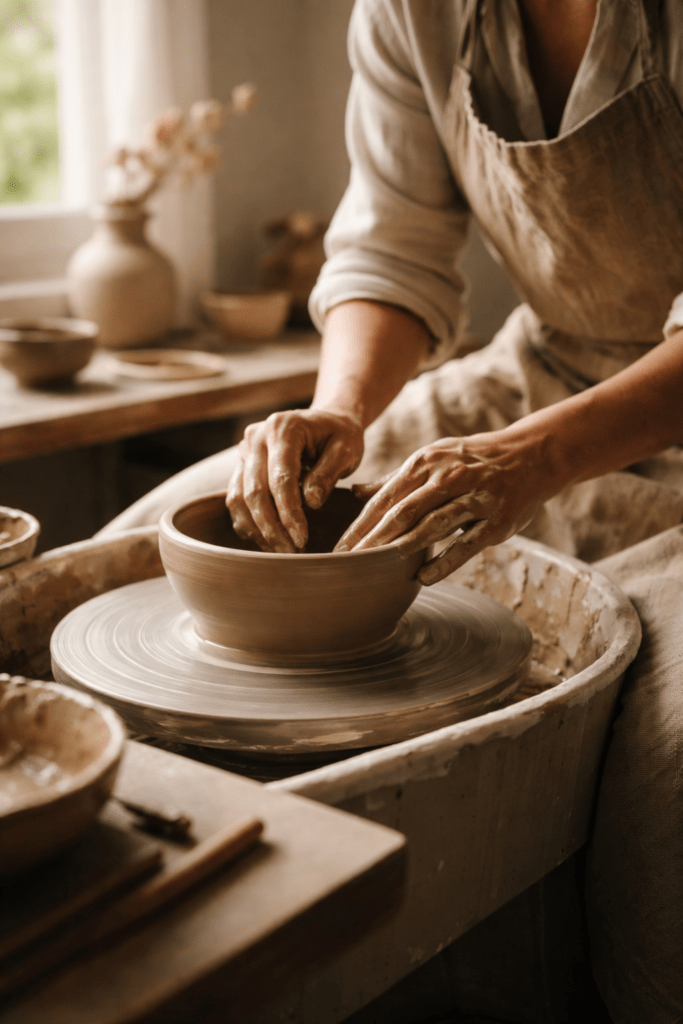
Handmade vs Machine Made: Understanding the Real Difference and What It Means Today
Why This Comparison Matters More Than Ever
Today, almost everything around us is made by machines.
Clothes.
Furniture.
Daily objects.
They are:
- Fast to produce
- Consistent
- Widely available
At the same time, handmade items are becoming more visible again.
People are choosing:
- Handmade goods
- Custom pieces
- Slow-made objects
This raises an important question:
👉 What is the real difference between handmade and machine made?
And more importantly—
👉 Why does it matter?
What “Handmade” Really Means
Handmade does not simply mean:
“Made by hand.”
It means:
👉 The maker is directly involved in shaping the object
This includes:
- Physical interaction
- Real-time decisions
- Adjustment during the process
Each piece is created through:
- Attention
- Time
- Skill
No two handmade items are exactly the same.
That variation is part of their nature.
What “Machine Made” Means
Machine made refers to:
👉 Objects produced by automated or mechanical processes
These processes are designed for:
- Efficiency
- Speed
- Consistency
The goal is to produce:
- Identical items
- At large scale
- With minimal variation
Machines follow instructions.
They do not adapt in the same way humans do.
The Core Differences
Understanding the difference requires looking at several key aspects.
1. Process
Handmade:
- Slow
- Flexible
- Adaptive
Machine made:
- Fast
- Fixed
- Standardized
2. Consistency
Handmade:
- Slight variations
- Unique details
Machine made:
- Uniform
- Predictable
3. Time
Handmade:
- Requires more time
- Focused on process
Machine made:
- Optimized for speed
- Focused on output
4. Skill
Handmade:
- Depends on human ability
- Improves over time
Machine made:
- Depends on system design
- Less dependent on individual skill
5. Scale
Handmade:
- Limited production
Machine made:
- Mass production
Why Handmade Feels Different
Even without knowing why, people often feel a difference.
Handmade objects tend to feel:
- Warmer
- More personal
- More “alive”
This comes from:
- Subtle variation
- Human touch
- Visible effort
These qualities are difficult to replicate mechanically.
Why Machine Made Is Dominant
Machine production became dominant for clear reasons:
- Lower cost
- Faster production
- Greater availability
It made products accessible to more people.
This is not a negative thing.
It solved real problems.
But it also changed how we relate to objects.
The Value of Imperfection
One of the biggest differences is imperfection.
Handmade work includes:
- Small irregularities
- Slight differences
- Natural variation
Machine-made work removes these.
But imperfection is not always a flaw.
It can be:
- Character
- Identity
- Evidence of process
In handmade work, imperfection is often part of the value.
Emotional Connection
Handmade items often create stronger emotional connections.
Because:
- Someone made it
- Time was invested
- Attention was present
This creates meaning.
Machine-made items are functional.
Handmade items are often personal.
Durability and Quality
Quality is not always determined by method.
Both handmade and machine-made can be:
- High quality
- Low quality
However:
Handmade quality depends on skill
Machine-made quality depends on system design
Good results are possible in both.
Cost Differences
Handmade items are often more expensive.
Because they require:
- Time
- Labor
- Skill
Machine-made items are cheaper due to:
- Scale
- Efficiency
Price reflects process.
Not just the final object.
Which One Is Better?
There is no single answer.
It depends on purpose.
Choose handmade when you value:
- Uniqueness
- Personal connection
- Process
Choose machine made when you need:
- Consistency
- Affordability
- Availability
Both have their place.
The Rise of Handmade in Modern Life
Even with machine dominance, handmade is growing again.
Why?
Because people are seeking:
- Meaning
- Slowness
- Connection
In a fast, digital world—
handmade offers something different.
Handmade as Experience, Not Just Product
For many people, handmade is not only about what you buy.
It is about what you do.
Making something yourself changes:
- Your attention
- Your understanding
- Your relationship with objects
You begin to see:
How things are made
How much effort is involved
How materials behave
This creates appreciation.
The Balance Between Both Worlds
Modern life includes both:
Handmade
Machine made
You do not need to choose one exclusively.
You can:
- Use machine-made for daily function
- Value handmade for meaning and experience
Balance creates flexibility.
Common Misunderstandings
Thinking handmade is always better
Believing machine-made has no value
Assuming handmade means high quality
Ignoring the purpose of each method
Each approach serves different needs.
FAQ
What is the main difference between handmade and machine made?
Handmade involves human skill and variation, while machine made focuses on consistency and efficiency.
Is handmade always better than machine made?
No. Each has its advantages depending on the situation.
Why are handmade products more expensive?
Because they require more time, effort, and skill.
Are machine-made products lower quality?
Not necessarily. Many machine-made products are high quality.
Why do people prefer handmade items?
For their uniqueness, emotional value, and connection to the maker.
Final Reflection
The difference between handmade and machine made is not just technical.
It is experiential.
One is fast.
One is slow.
One is uniform.
One is unique.
One is efficient.
One is attentive.
Neither is wrong.
But they offer different things.
And understanding that difference—
changes how you see what you use
what you make
and what you value.
