Why This Question Is Deeper Than It Looks
At first glance, it seems simple.
Calligraphy is just… writing.
Beautiful writing, maybe.
But then you see it.
Not typed. Not printed.
Written.
Each line slightly different. Each stroke alive.
Not perfect—but intentional.
And something in it feels different.
Not just visual.
But… alive.
That’s usually the moment the real question appears:
👉 What is Chinese calligraphy, really?
Is it:
- handwriting?
- art?
- tradition?
- meditation?
Or something that doesn’t fit neatly into any of those?
If you’ve ever felt drawn to calligraphy but couldn’t quite explain why—
this guide will take you all the way in.
If you’re completely new, start here →
calligraphy for beginners
What Is Chinese Calligraphy? (Simple Definition)
At the most basic level:
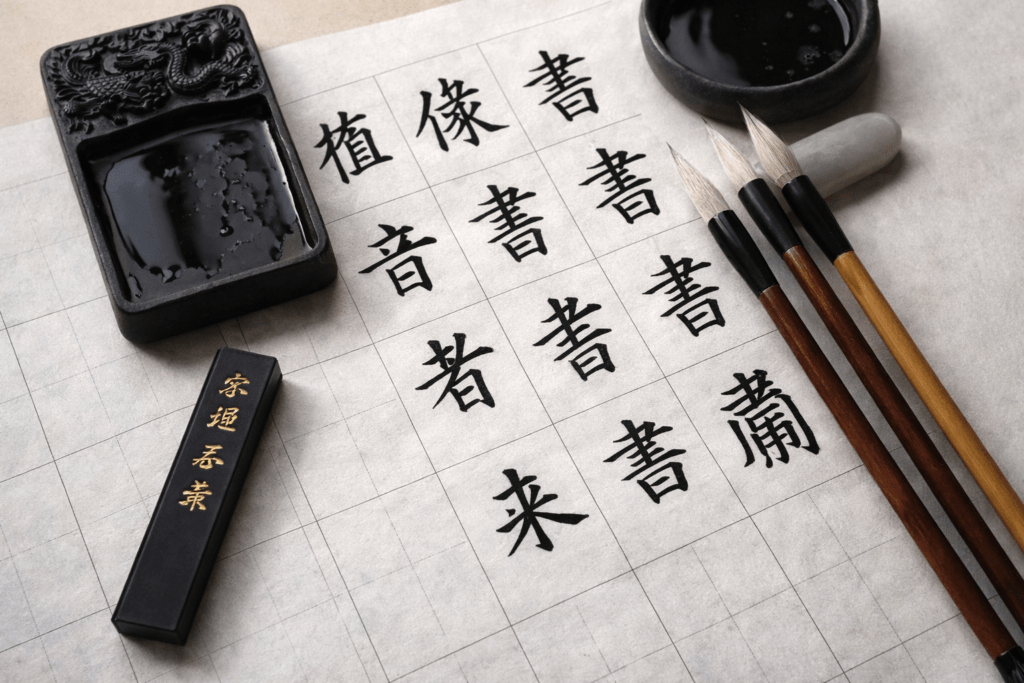
👉 Chinese calligraphy is the art of writing Chinese characters with a brush.
But that definition is only the surface.
Because calligraphy is not just about:
- forming characters
- making things look nice
It is about:
👉 movement, rhythm, and awareness expressed through writing
Each stroke carries:
- pressure
- speed
- direction
- intention
Which means:
👉 You are not just writing a character
👉 You are revealing how you move, think, and feel
That’s why calligraphy has always been considered both:
- an art form
- and a reflection of the mind
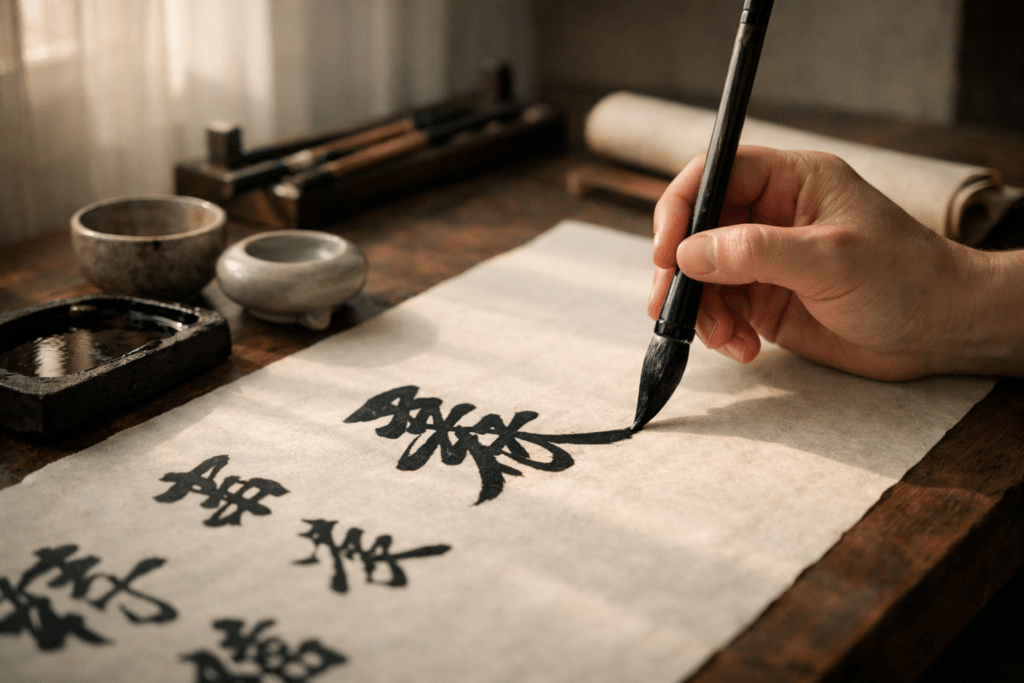
Calligraphy Is Not Handwriting
This is one of the most important distinctions.
Handwriting is:
- functional
- fast
- unconscious
Calligraphy is:
- intentional
- controlled
- fully aware
When you write normally, you don’t notice your movement.
When you practice calligraphy:
👉 every millimeter matters
You begin to notice:
- how hard you press
- how fast you move
- how stable your hand is
And slowly—
you start to notice your mind as well.
Calligraphy as “Moving Meditation”
Many people describe calligraphy as:
👉 a form of meditation
Not because it is spiritual in a religious sense—
but because of what it does to your attention.
When you write with a brush:
- you cannot rush
- you cannot multitask
- you cannot be distracted
Your attention naturally returns to:
- the brush
- the ink
- the paper
This is why calligraphy connects deeply with
mindfulness in calligraphy
It trains:
- presence
- patience
- awareness
Not by thinking—
but by doing.
The Core Elements of Calligraphy
To understand calligraphy, you need to understand its building blocks.
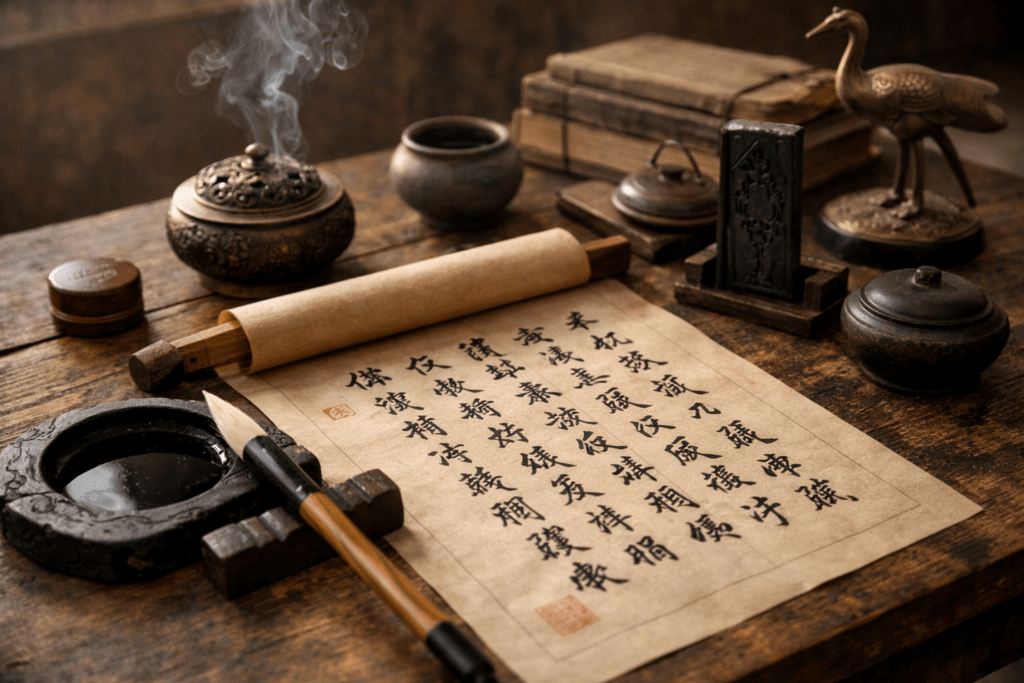
1. Brush (笔)
Unlike a pen:
- flexible
- responsive
- sensitive to pressure
It captures subtle changes in movement.
2. Ink (墨)
Not just black liquid.
It carries:
- density
- texture
- tone variation
3. Paper (纸)
Rice paper absorbs ink instantly.
Which means:
👉 there is no undo
Every stroke is final.
4. Stroke (笔画)
The smallest unit.
Everything in calligraphy is built from strokes.
👉 Learn them here →
basic brush strokes
A Brief History of Chinese Calligraphy
Calligraphy is not new.
It has evolved over more than 3,000 years.
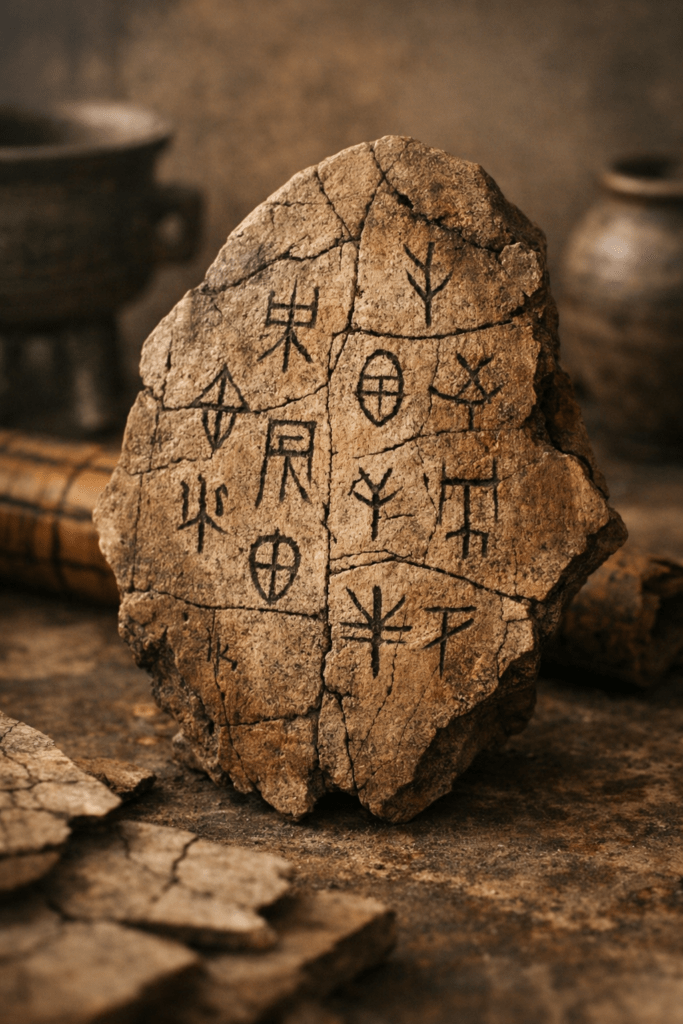
Origins (Oracle Bones)
- earliest forms of Chinese writing
- carved into bones and shells
Seal Script (篆书)
- formal
- structured
- used in ancient inscriptions
Clerical Script (隶书)
- flatter strokes
- more practical
- used in administration
Regular Script (楷书)
- clear
- balanced
- foundation for learning
Running Script (行书)
- semi-cursive
- more fluid
Cursive Script (草书)
- expressive
- fast
- abstract
👉 Full breakdown here →
types of calligraphy styles
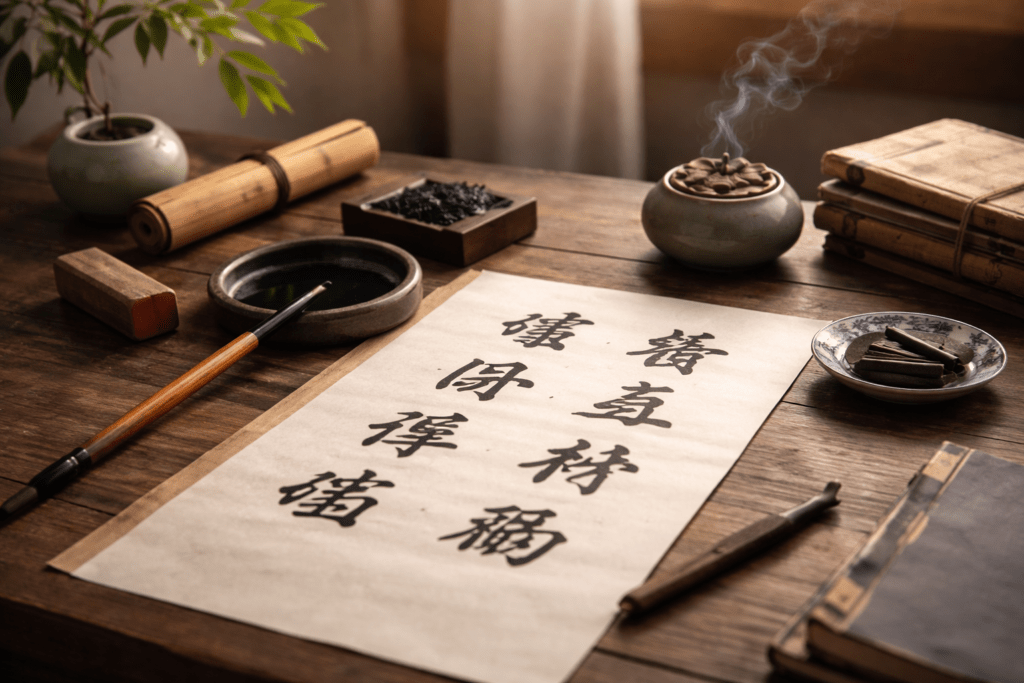
The Five Main Calligraphy Styles (Beginner Overview)
Understanding styles is essential.
Each one reflects a different level of control and expression.
Kaishu (Regular Script)
- structured
- clear
- best for beginners
Xingshu (Running Script)
- smoother
- more connected
- semi-cursive
Caoshu (Cursive Script)
- fast
- expressive
- hardest to read
Lishu (Clerical Script)
- wide strokes
- historical feel
Zhuanshu (Seal Script)
- ancient
- decorative
👉 If you’re starting, read:
best calligraphy style for beginners
What Makes Calligraphy “Beautiful”?
This is not random.
Calligraphy follows principles.
1. Balance (结构)
Characters must feel stable.
2. Rhythm (节奏)
Strokes flow in sequence.
3. Energy (气)
Each stroke has life.
4. Space (留白)
Empty space matters as much as ink.
👉 Explore deeper here →
calligraphy aesthetics guide
The Role of the Body in Calligraphy
Calligraphy is not just hand movement.
It involves:
- posture
- breathing
- arm movement
Your whole body affects the stroke.
If your body is tense:
👉 your lines will show it
If your mind is scattered:
👉 your structure will break
Common Misconceptions About Calligraphy
Let’s clear this up.
❌ “It’s just decorative writing”
No. It’s structured and disciplined.
❌ “You need talent”
No. It’s learned through repetition.
❌ “It’s only for artists”
No. Many practitioners are not artists.
❌ “It takes too long to start”
You can begin in one day.
How Beginners Should Start
Keep it simple.
Step 1: Get basic tools
👉 calligraphy tools basics
Step 2: Learn strokes
👉 basic brush strokes
Step 3: Practice regularly
👉 calligraphy practice routine
Step 4: Stay consistent
Even 15 minutes daily works.
What You Gain from Practicing Calligraphy
People start for different reasons.
But they often stay for unexpected ones.
1. Focus
You learn to concentrate deeply.
2. Patience
Progress is slow—but real.
3. Calmness
The act itself reduces mental noise.
4. Awareness
You begin to notice subtle details.
👉 Related:
benefits of calligraphy
Calligraphy in Modern Life
Today, calligraphy is used in:
- art
- design
- branding
- personal practice
But its deeper value remains:
👉 it slows you down in a fast world
In a time of:
- typing
- scrolling
- instant results
Calligraphy offers:
👉 a return to deliberate movement
FAQ
What is Chinese calligraphy used for?
It is used for artistic expression, cultural preservation, meditation, and personal development.
Is Chinese calligraphy hard to learn?
It can be challenging at first, but with consistent practice, beginners can improve steadily.
What is the best style for beginners?
Kaishu (Regular Script) is the most recommended starting point.
Do I need special tools?
Yes, basic tools like brush, ink, and paper are essential.
Can calligraphy improve focus?
Yes. It naturally trains attention and mindfulness through slow, controlled practice.
Final Reflection: More Than Writing
At the end of it all—
calligraphy is simple.
A brush.
Ink.
Paper.
But within that simplicity—
something shifts.
You slow down.
You pay attention.
You begin to see what you normally miss.
And over time—
you realize:
👉 You’re not just writing characters
👉 You’re learning how to move with awareness
So the next time you pick up a brush—
don’t rush.
Just begin.