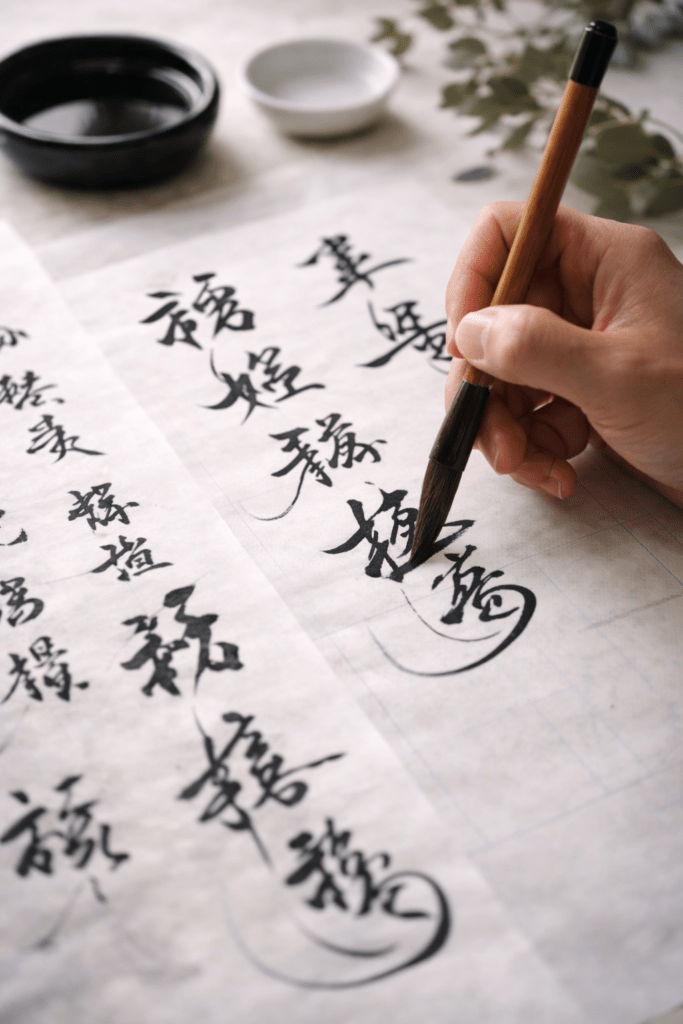
What Is Regular Script and Why It Matters
Regular Script, known in Chinese as Kaishu, is the most standard and widely used form of Chinese calligraphy.
It is the script used in:
modern printed Chinese
educational materials
formal writing
👉 it is the foundation of readable Chinese writing
If you want to learn calligraphy seriously, Regular Script is not just one style among many.
It is the starting point.
Without it, your understanding of structure, stroke formation, and proportion will remain incomplete.
What Defines Regular Script
Regular Script is defined by:
clear, separated strokes
balanced structure
precise execution
Each stroke is written distinctly.
There is no merging of strokes.
No simplification for speed.
👉 everything is explicit and controlled
This makes Regular Script:
easy to read
difficult to master
Because every detail is visible.
Nothing can be hidden.
The Core Characteristics of Regular Script
To understand Regular Script deeply, focus on its defining features.
Clarity
Each stroke has a clear beginning, middle, and ending.
Lines are clean and well-defined.
Structure
Characters follow strict proportions.
Spacing is balanced.
Everything is intentional.
Precision
Small errors are noticeable.
This forces accuracy.
Stability
Characters feel grounded.
They do not lean or distort.
Why Regular Script Is Essential
Regular Script builds the core skills required for all other styles.
It develops:
stroke control
structural awareness
discipline
👉 it is the training ground for calligraphy
Without mastering Regular Script:
Xingshu becomes unstable
Caoshu becomes chaotic
Regular Script teaches control before expression.
The Structure of Regular Script Characters
Structure is central to Regular Script.
Each character must maintain:
balance
proportion
alignment
Balance
The character must feel visually stable.
Weight should be evenly distributed.
Proportion
Each component must have correct size and placement.
Distortion breaks readability.
Alignment
Horizontal and vertical relationships must be controlled.
Strokes should not drift.
👉 structure is not guessed
It is constructed.
The Stroke System in Regular Script
Regular Script uses all fundamental strokes.
Each stroke has:
a defined shape
a specific direction
a controlled pressure pattern
Common strokes include:
horizontal
vertical
dot
hook
turn
sweep
Each stroke must be practiced individually.
Then combined into characters.
👉 strokes are the building blocks
Without strong strokes, characters cannot be stable.
The Role of Stroke Order
Stroke order is critical in Regular Script.
It ensures:
logical construction
efficient movement
consistent results
Correct stroke order improves:
flow
accuracy
memory
Ignoring stroke order leads to confusion and instability.
How to Practice Regular Script Effectively
Start With Basic Strokes
Do not begin with complex characters.
Practice simple strokes first.
Build control.
Practice Slowly
Speed is not important.
Accuracy is.
Slow practice improves awareness.
Focus on Structure
Do not just copy shapes.
Understand how characters are built.
Repeat With Consistency
Write the same character multiple times.
Compare and adjust.
Consistency builds skill.
Use Grid Practice
Guidelines help maintain proportion.
They improve alignment.
Common Mistakes in Regular Script
Rushing Practice
Speed reduces accuracy.
Fix by slowing down.
Ignoring Structure
Focusing only on strokes leads to imbalance.
Study full characters.
Inconsistent Pressure
Uneven pressure creates unstable lines.
Maintain control.
Over-simplifying
Removing details weakens the form.
Respect the structure.
What Good Regular Script Feels Like
When Regular Script improves:
movement feels controlled
strokes feel stable
characters look balanced
There is clarity.
There is precision.
The writing feels grounded and reliable.
This feeling is important.
Because Regular Script is about stability and control.
How Regular Script Connects to Other Styles
Regular Script is the foundation of:
Xingshu (Running Script)
Caoshu (Cursive Script)
These styles evolve by:
connecting strokes
simplifying forms
But the structure remains rooted in Regular Script.
👉 without this foundation, advanced styles lose clarity
The Role of Discipline in Regular Script
Regular Script requires discipline.
It demands:
patience
attention
consistency
There is no shortcut.
Every stroke must be intentional.
This discipline builds long-term skill.
How Long It Takes to Learn Regular Script
Regular Script takes time.
At first:
strokes feel difficult
structure feels complex
With practice:
control improves
understanding deepens
Over time:
writing becomes stable
This is a gradual process.
FAQ
What is Regular Script in calligraphy?
It is a structured and precise style used as the foundation of Chinese calligraphy.
Is Regular Script the same as Kaishu?
Yes, they refer to the same style.
Is it good for beginners?
Yes, it is the best starting point.
Why is Regular Script difficult?
Because it requires precision and discipline.
How should I practice it?
Start with strokes, then move to characters with consistent repetition.
Final Thought
Regular Script is not just a style.
It is training.
It teaches you:
how to control
how to structure
how to see
It is slow.
It is demanding.
But it builds everything.
You do not rush it.
You grow through it.
And over time, your writing becomes clear.
Stable.
Intentional.
One stroke at a time.