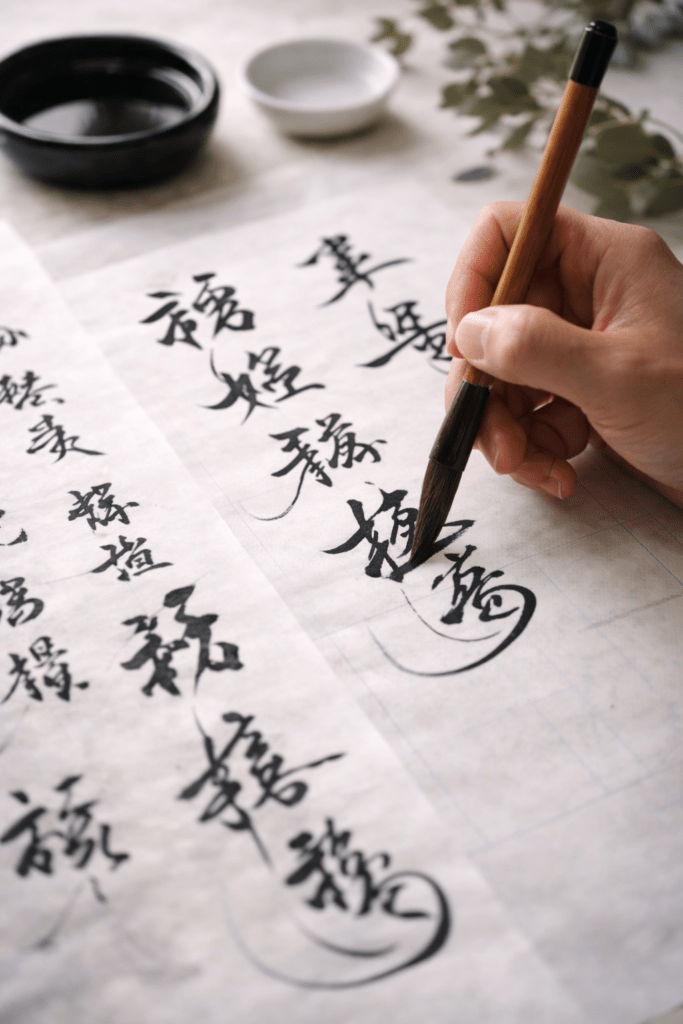
What Is Zhuanshu and Why It Matters
Zhuanshu, known as Seal Script, is one of the oldest forms of Chinese calligraphy.
It predates most other major styles and represents the early stage of written Chinese.
Historically, Zhuanshu was used for:
official inscriptions
bronze vessels
stone carvings
imperial seals
👉 it is the origin of structured Chinese writing
Unlike later styles that prioritize efficiency and readability, Zhuanshu emphasizes:
form
symmetry
visual harmony
Understanding Zhuanshu is not just about learning a style.
It is about understanding the roots of Chinese characters.
What Defines Zhuanshu
Zhuanshu is defined by:
continuous, even lines
symmetrical structure
uniform stroke thickness
There is no variation in line weight like in later styles.
The brush (or carving tool) produces lines that are:
smooth
rounded
consistent
👉 strokes do not show pressure variation
This creates a calm, balanced, and highly controlled visual effect.
The Core Characteristics of Zhuanshu
To understand Zhuanshu deeply, focus on its defining qualities.
Uniform Line Quality
Lines maintain consistent thickness.
There are no strong contrasts.
This creates visual harmony.
Rounded Forms
Corners are often curved.
Transitions are smooth.
The writing feels continuous.
Symmetry
Characters are balanced and often symmetrical.
Structure is carefully controlled.
Even Spacing
Spacing between strokes is consistent.
This enhances clarity and order.
Why Zhuanshu Is Important
Zhuanshu is foundational.
It represents:
the early structure of Chinese characters
the origin of many modern forms
👉 it is the root of calligraphy evolution
Studying Zhuanshu develops:
structural awareness
balance perception
attention to form
It also introduces a different mindset.
Less about movement.
More about form and proportion.
The Structure of Zhuanshu Characters
Zhuanshu characters are highly structured.
They emphasize:
symmetry
vertical alignment
balanced spacing
Symmetry
Many characters are visually balanced on both sides.
This creates harmony.
Vertical Alignment
Characters are often upright and centered.
They feel stable.
Balanced Spacing
Spacing is even and controlled.
No part feels crowded or empty.
👉 structure is geometric and deliberate
This distinguishes Zhuanshu from more dynamic styles.
The Stroke System in Zhuanshu
Strokes in Zhuanshu are:
uniform
continuous
rounded
Unlike Kaishu or Xingshu, strokes do not show:
sharp beginnings
strong endings
pressure variation
Instead, strokes flow smoothly.
They feel carved rather than written.
👉 the stroke behaves like a line, not a gesture
This gives Zhuanshu its unique visual identity.
How Zhuanshu Differs from Other Styles
Compared to Kaishu:
Kaishu:
varied stroke thickness
clear beginnings and endings
Zhuanshu:
uniform lines
no visible pressure change
Compared to Lishu:
Lishu:
flat, angular strokes
strong horizontal emphasis
Zhuanshu:
rounded, continuous strokes
balanced structure
👉 Zhuanshu is more abstract and formal
It focuses on visual harmony rather than efficiency.
Types of Zhuanshu
There are two main forms:
Dazhuan (Large Seal Script)
Earlier, less standardized
more complex forms
Xiaozhuan (Small Seal Script)
Standardized during the Qin Dynasty
more refined and consistent
👉 Xiaozhuan is more commonly studied today
It represents the formalized version of the script.
How to Practice Zhuanshu Effectively
Focus on Line Consistency
Maintain even thickness.
Avoid pressure variation.
This builds control.
Practice Slow, Controlled Movement
Speed is not important.
Accuracy is.
Move deliberately.
Study Character Structure
Understand symmetry and spacing.
Do not rely only on copying.
Practice Continuous Strokes
Avoid abrupt stops.
Maintain smooth transitions.
This improves flow.
Use Grid Practice
Guidelines help maintain proportion.
They improve structural accuracy.
Common Mistakes in Zhuanshu
Inconsistent Line Thickness
Uneven pressure breaks harmony.
Maintain consistency.
Sharp Corners
Zhuanshu requires smooth curves.
Avoid abrupt angles.
Poor Symmetry
Uneven balance disrupts structure.
Focus on alignment.
Rushing Practice
Speed reduces control.
Practice slowly.
What Good Zhuanshu Feels Like
When Zhuanshu is executed well:
movement feels steady
lines feel continuous
structure feels balanced
There is calmness.
There is control.
The writing feels stable and harmonious.
This feeling is important.
Because Zhuanshu emphasizes stillness over motion.
How Zhuanshu Connects to Technique
Zhuanshu develops:
line control
structural awareness
precision
It reduces reliance on:
pressure variation
dynamic movement
This builds foundational discipline.
The Role of Zhuanshu in Modern Calligraphy
Although not commonly used for daily writing, Zhuanshu remains important in:
seal carving
artistic calligraphy
design
It is often used for:
signatures
stamps
formal inscriptions
👉 Zhuanshu carries historical and aesthetic value
It connects modern practice to ancient tradition.
How Long It Takes to Learn Zhuanshu
Zhuanshu requires patience.
At first:
lines may be uneven
structure may feel unfamiliar
With practice:
control improves
symmetry becomes natural
Over time:
the style becomes stable
FAQ
What is Zhuanshu in calligraphy?
It is an ancient seal script characterized by uniform lines and symmetrical structure.
Is Zhuanshu difficult to learn?
It requires patience and precision, but is accessible with practice.
Why are Zhuanshu lines even?
The style emphasizes uniformity and balance.
What is the difference between Dazhuan and Xiaozhuan?
Dazhuan is earlier and less standardized, Xiaozhuan is refined and formalized.
Is Zhuanshu used today?
Yes, mainly in seals and artistic calligraphy.
Final Thought
Zhuanshu is not about speed.
It is not about expression.
It is about form.
Balance.
Harmony.
It teaches you to slow down.
To observe structure.
To control every line.
You do not rush Zhuanshu.
You align with it.
And over time, your writing becomes calm.
Balanced.
Intentional.
Not dynamic.
But timeless.
One line at a time.