Why Starting Is the Hardest Part
Most people don’t fail at crafting.
They just never start.
Not because they don’t want to—
but because they don’t know how.
They think they need:
- The right tools
- The perfect idea
- Enough time
- Some kind of talent
So they wait.
And the longer they wait, the harder it feels to begin.
But crafting does not require any of that.
It only requires one thing:
👉 A starting point
This guide will give you that.
Clear, simple, and practical.
What You Actually Need to Begin
Before anything else, let’s remove unnecessary complexity.
You do not need:
- A full workspace
- Expensive tools
- Advanced skills
You only need:
- One material
- One simple tool
- A small amount of time
That’s enough.
Everything else can come later.
Step 1: Choose One Simple Craft
Do not try to explore everything.
Choose one.
Keep it simple.
Good beginner options include:
- Paper craft
- Clay (air-dry)
- Basic DIY projects
Avoid complex crafts at the beginning.
Simplicity builds momentum.
Step 2: Gather Only What You Need
Once you choose your craft, gather only the essentials.
For example:
Paper craft → paper, scissors, glue
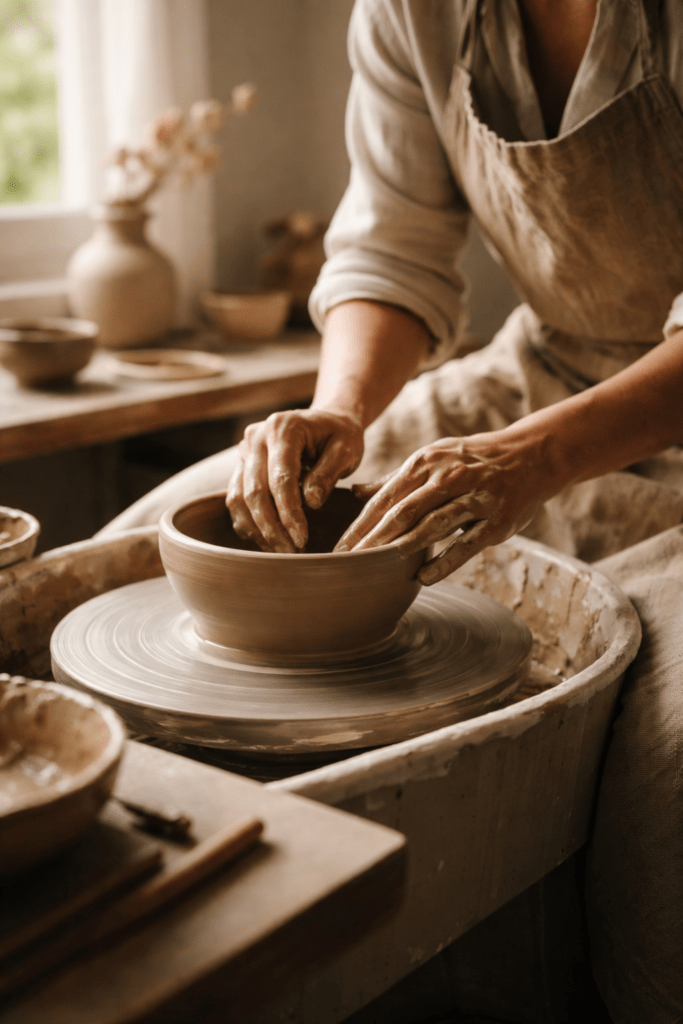
Clay craft → clay, hands, simple tools
Do not overbuy.
Do not prepare too much.
You are not setting up a system.
You are starting a practice.
Step 3: Create a Small Working Space
You don’t need a studio.
A small table is enough.
Your space should be:
- Clean
- Quiet
- Well-lit
- Comfortable
The goal is not perfection.
It is focus.
A simple space helps your attention settle.
Step 4: Start With a Very Small Project
Do not begin with something ambitious.
Start with something you can finish quickly.
For example:
- Fold a piece of paper
- Shape a small object
- Make a simple item
Finishing something builds confidence.
And confidence keeps you going.
Step 5: Focus on the Process, Not the Result
This is one of the most important steps.
Beginners often focus on outcome.
They want something that looks good.
But this creates pressure.
Instead:
Pay attention to what you are doing.
- How your hands move
- How the material responds
- How the process feels
The result will come naturally.
Step 6: Move Slowly
There is no need to rush.
Crafting is not about speed.
It is about control.
Moving slowly helps you:
- Improve accuracy
- Understand materials
- Reduce mistakes
Speed comes later.
Step 7: Accept Imperfection
Your first attempts will not be perfect.
That is normal.
Mistakes are part of learning.
Do not judge your work too quickly.
Instead:
Observe.
Adjust.
Continue.
Improvement happens through repetition.
Step 8: Repeat Regularly
Consistency matters more than intensity.
You do not need long sessions.
Start with:
10–20 minutes per day
At the same time
In the same space
This builds rhythm.
And rhythm makes it easier to continue.
Step 9: Reflect on Your Experience
After each session, take a moment to notice:
- What felt easy
- What felt difficult
- What you learned
This reflection improves awareness.
And awareness improves progress.
Step 10: Gradually Expand
Once you feel comfortable:
- Try slightly more complex projects
- Add one new tool
- Explore small variations
Do not jump too far ahead.
Growth should feel natural.
Not forced.
What You Should Expect as a Beginner
At the beginning, you may feel:
- Slow
- Uncertain
- Inconsistent
This is part of the process.
Over time, you will notice:
- Improved control
- Better results
- Increased confidence
Progress is gradual.
But it is reliable.
Common Mistakes When Starting Crafting
Starting too complex
Buying too many tools
Expecting fast results
Comparing yourself to others
Giving up too early
All of these come from unrealistic expectations.
Keep things simple.
And stay consistent.
How Crafting Changes Over Time
At first, crafting feels unfamiliar.
You think about every step.
You hesitate.
But with practice:
- Movements become natural
- Decisions become easier
- Results become more consistent
What once felt difficult becomes intuitive.
The Real Goal of Starting Crafting
The goal is not to create something perfect.
It is to:
- Begin
- Continue
- Improve
Craft is not about a single result.
It is about an ongoing process.
FAQ
How do I start crafting with no experience?
Start with a simple craft, basic materials, and small projects. Focus on learning through doing.
What is the easiest craft to begin with?
Paper craft is one of the easiest because it requires minimal tools and materials.
Do I need a lot of tools to start crafting?
No. A few basic tools are enough.
How often should I practice crafting?
Short, consistent sessions (10–20 minutes daily) are more effective than long, irregular sessions.
What if my work doesn’t look good at first?
That is normal. Improvement comes through repetition and experience.
Final Reflection
Starting is simple.
But it requires a decision.
Not a perfect plan.
Not perfect timing.
Just a beginning.
One material.
One action.
One moment.
You don’t need to be ready.
You only need to begin.
And once you do—
everything else
will follow.