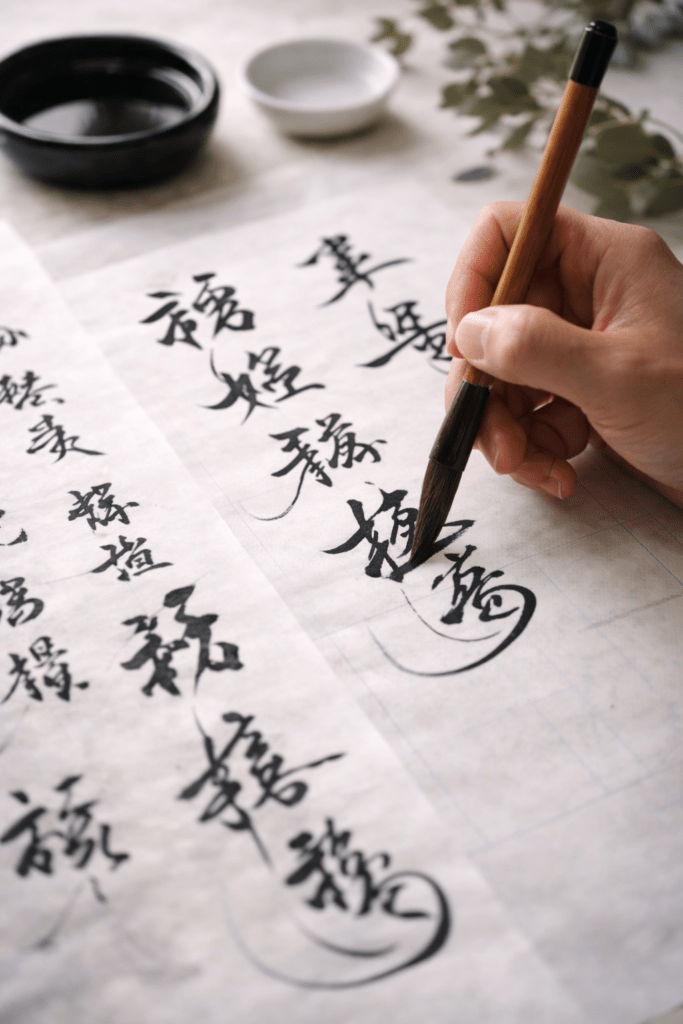
Lishu Explained: The Complete Guide to Clerical Script (Structure, Stroke Style, and Historical Significance)
What Is Lishu and Why It Matters
Lishu, known as Clerical Script, is one of the most important styles in the history of Chinese calligraphy.
It represents a major transformation in how Chinese characters evolved.
Before Lishu, writing was dominated by more complex and curved forms such as Seal Script.
Lishu introduced:
simplification
clarity
structured stroke patterns
👉 it is the bridge between ancient and modern writing
Many of the structural principles used in modern Chinese characters originate from Lishu.
Understanding Lishu is not only about learning a style—
it is about understanding how calligraphy developed.
What Defines Lishu
Lishu is defined by:
flat, wide structure
distinct stroke endings
strong horizontal emphasis
Its most recognizable feature is the unique stroke shape often described as:
👉 “silkworm head and wild goose tail”
This refers to:
rounded, heavy beginnings
flared, extended endings
These features give Lishu its distinctive appearance.
The Core Characteristics of Lishu
To understand Lishu deeply, focus on its key characteristics.
Horizontal Emphasis
Horizontal strokes are dominant.
They are longer and more pronounced.
Vertical strokes are shorter and more restrained.
This creates a wide, stable appearance.
Stroke Endings
Many strokes end with a slight outward flare.
This gives the writing a decorative yet controlled quality.
Structured Simplicity
Compared to earlier scripts, Lishu simplifies forms.
But it does not lose structure.
Clarity remains strong.
Flat Proportion
Characters are wider than they are tall.
This horizontal expansion is a defining feature.
Why Lishu Is Important
Lishu is historically significant because it transformed writing from complex forms into more practical structures.
It:
simplified characters
standardized writing
improved readability
👉 it laid the foundation for Kaishu
Without Lishu, modern Chinese writing would not exist in its current form.
For learners, Lishu develops:
stroke awareness
structural understanding
control of stroke endings
It also introduces a different aesthetic from other styles.
The Structure of Lishu Characters
Lishu characters are built with strong horizontal balance.
This includes:
wide layout
even spacing
stable center
Wide Layout
Characters extend horizontally.
They should not appear narrow.
Spacing
Strokes must be evenly distributed.
Crowding disrupts balance.
Center Stability
Despite horizontal expansion, the character must remain centered.
👉 balance is horizontal, not vertical
Understanding this difference is essential.
The Stroke System in Lishu
Lishu uses familiar strokes, but they behave differently.
Strokes are:
flatter
more deliberate
visually emphasized at the ends
Horizontal strokes:
long and slightly curved
Vertical strokes:
short and controlled
Turning strokes:
less sharp than in Kaishu
Stroke endings are especially important.
They define the style.
How Lishu Differs from Other Styles
Compared to Kaishu:
Kaishu:
upright structure
clear, separate strokes
Lishu:
wide structure
stylized stroke endings
Compared to Zhuanshu (Seal Script):
Zhuanshu:
curved, continuous lines
Lishu:
angular, structured strokes
👉 Lishu marks the transition to modern writing
It combines structure with stylization.
How to Practice Lishu Effectively
Focus on Stroke Endings
Practice the characteristic flared endings.
Control the movement carefully.
This defines the style.
Practice Horizontal Balance
Ensure strokes extend properly.
Do not compress the character.
Maintain the wide form.
Control Pressure Transitions
Stroke beginnings and endings require pressure changes.
Practice smooth transitions.
Study Classical Examples
Observe traditional Lishu works.
Understand how strokes are formed.
This builds accuracy.
Practice Slowly
Lishu requires deliberate movement.
Speed reduces control.
Common Mistakes in Lishu
Writing Too Narrow
Ignoring horizontal expansion.
Fix by extending strokes.
Weak Stroke Endings
Lack of flare reduces character.
Practice controlled endings.
Over-simplifying Strokes
Removing too much detail weakens structure.
Maintain form.
Inconsistent Proportion
Uneven spacing disrupts balance.
Focus on layout.
What Good Lishu Feels Like
When Lishu is executed well:
strokes feel grounded
structure feels stable
writing appears balanced
There is weight in the horizontal movement.
There is control in the endings.
This feeling is important.
Because Lishu is about balance and presence.
How Lishu Connects to Technique
Lishu develops:
pressure control
stroke shaping
structural awareness
It emphasizes:
deliberate movement
clear form
These skills support all other styles.
The Role of History in Lishu
Lishu originated during the Han Dynasty.
It was used for:
official documents
administrative writing
It replaced more complex scripts for practical use.
Over time, it evolved into a formal calligraphic style.
👉 Lishu reflects both function and art
Understanding its history deepens appreciation.
How Long It Takes to Learn Lishu
Lishu is accessible but requires attention to detail.
At first:
stroke endings may feel difficult
proportion may feel unfamiliar
With practice:
control improves
structure becomes natural
Over time:
the style becomes recognizable and stable
FAQ
What is Lishu in calligraphy?
It is a clerical script known for wide structure and distinctive stroke endings.
Is Lishu good for beginners?
Yes, it helps develop structure and stroke awareness.
Why are Lishu strokes flat?
The style emphasizes horizontal balance.
What makes Lishu unique?
Its flared stroke endings and wide proportions.
How do I practice Lishu?
Focus on stroke endings, horizontal balance, and structure.
Final Thought
Lishu is not just a historical style.
It is a turning point.
It shows how writing evolved from complexity to clarity.
From curves to structure.
From ancient to modern.
You do not just learn Lishu.
You understand it.
Through its strokes.
Through its balance.
Through its history.
And over time, your writing gains stability.
Not narrow.
Not rigid.
But wide.
Grounded.
Intentional.
One stroke at a time.