Most people don’t realize this.
Zen didn’t just influence meditation.
It changed:
👉 how people think
👉 how people perceive reality
👉 how people experience life
Not loudly.
Not aggressively.
But deeply.
Quietly.
And permanently.

Before Zen: The World of Thinking
For most of human history, understanding meant:
👉 thinking more
Philosophy:
- analyze
- categorize
- define
Religion:
- believe
- follow
- interpret
Science:
- measure
- explain
- predict
Everything was based on:
👉 building mental models
The assumption was simple:
👉 the more you think, the closer you get to truth
Zen questioned this.
Zen’s Radical Insight
Zen introduced something shocking:
👉 thinking is not the highest form of understanding
That was revolutionary.
Because it broke a fundamental belief:
👉 “The mind leads to truth”
Zen showed:
👉 the mind can also block truth
Zen Shifted the Center of Awareness
Before Zen:
👉 mind was central
After Zen:
👉 awareness became central
This is subtle, but powerful.
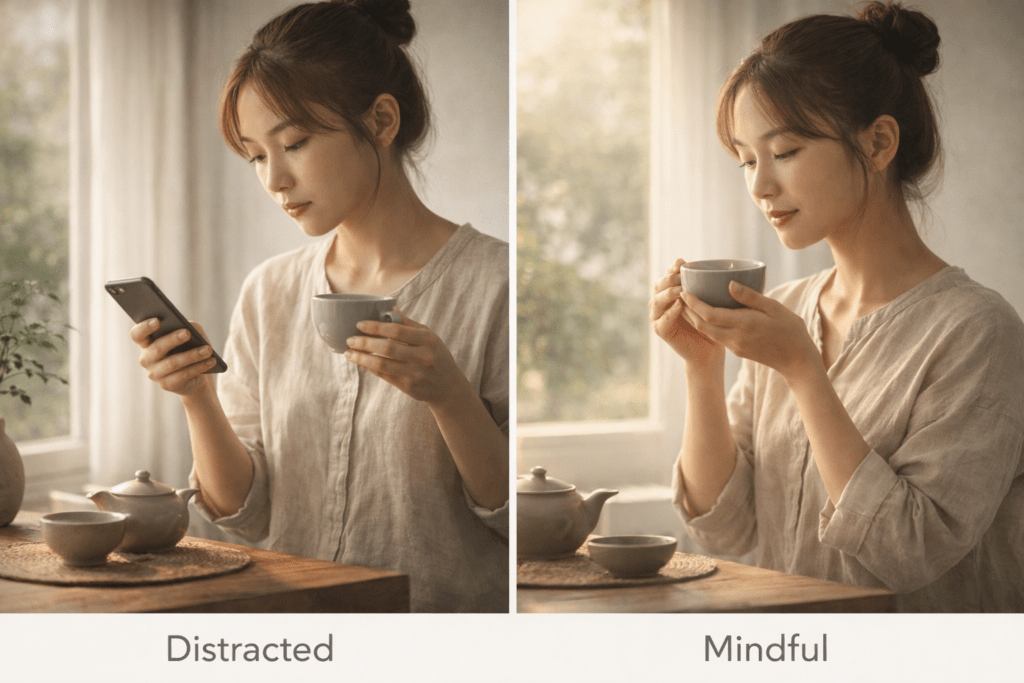
Mind:
- thinks
- judges
- compares
- analyzes
Awareness:
- observes
- receives
- experiences
Zen moved humanity from:
👉 thinking → seeing
That single shift changed everything.
Zen Changed How People Experience Reality
Before:
👉 reality was interpreted
After Zen:
👉 reality could be experienced directly
Instead of:
- naming things
- labeling things
- categorizing things
Zen encourages:
👉 just seeing
A flower is no longer:
- “a rose”
- “a species”
- “a symbol”
It is simply:
👉 what it is
Zen Reduced Psychological Suffering
This is one of its biggest impacts.
Most suffering is not from reality.
It is from:
👉 thinking about reality
Example:
You feel stress.
Then your mind adds:
- “Why am I like this?”
- “This is bad”
- “I need to fix it”
Now suffering multiplies.
Zen interrupts this process.
It shows:
👉 experience without resistance
And suddenly:
👉 suffering decreases
Zen Changed Creativity
Artists, writers, designers…
Many were influenced by Zen.
Because Zen encourages:
👉 less interference
When you stop overthinking:
👉 creativity flows naturally
This influenced:
- Japanese aesthetics
- minimalism
- modern design
- art movements worldwide
Zen created a new idea:
👉 less is more
Zen Influenced Modern Psychology
Even if indirectly.
Concepts like:
- mindfulness
- presence
- non-judgment
All echo Zen principles.
Modern therapy now includes:
👉 awareness-based practices
Which are deeply aligned with Zen.
Zen Changed How People Approach Problems
Before:
👉 solve the problem
After Zen:
👉 observe the problem
This changes everything.
Because:
👉 observation creates space
And in that space:
👉 clarity appears
Instead of forcing solutions…
👉 solutions emerge
Zen Changed Time Perception
Modern life feels rushed.
Because the mind is always:
👉 ahead of now
Zen slows perception.
Not time itself.
But:
👉 your relationship to time
When you are present:
👉 time feels fuller
Not faster.
Not slower.
Just:
👉 complete
Zen Changed the Meaning of “Success”
Before:
👉 success = achievement
After Zen influence:
👉 success = inner state
This doesn’t reject success.
It reframes it.
From:
👉 external gain
To:
👉 internal clarity
Why This Shift Matters Today
Because modern life is:
- fast
- noisy
- overloaded
And thinking has reached a limit.
People are overwhelmed by:
👉 too much information
Zen offers:
👉 less, but clearer
The Deep Transformation
Zen didn’t add something new.
It revealed something ancient:
👉 awareness without interference
This changed thinking itself.
From:
👉 control → observation
👉 effort → ease
👉 complexity → simplicity
Final Insight
Zen changed the way people think by showing:
👉 thinking is not the final layer
There is something deeper.
Quieter.
More direct.
And once you see it…
You cannot go back to thinking the same way again.